AC in a Warsaw tenement — no-mistake install
Why a tenement demands a different approach
Installing air conditioning in a Warsaw tenement house is a completely different project from an installation in a new apartment block in Białołęka, Wilanów, or Ursus. In modern construction, the installer usually works within a predictable setup: a cellular concrete or silicate wall has a defined thickness, the facade is subject to standard housing community rules, technical risers are easy to identify, and space for the outdoor unit can often be found on a balcony or loggia without much procedural struggle. In a tenement house, especially a pre-war one, every apartment is a separate case. Even at the stage of the first site visit, it turns out that the exterior wall is 50 cm of brick, the ceiling height is 3,5 m, the window joinery has a historic character, and the street-facing facade is under strict heritage control. On top of that comes the issue of shared courtyards, where the sound of a running outdoor unit reflects off four walls and can be more bothersome than in open space. In practice, this means the project has to be planned not only technically, but also legally, aesthetically, and with neighbors in mind. In Warsaw this is particularly important in districts such as Śródmieście, Stara Ochota, Praga Północ, or old Mokotów, where a significant share of buildings has individual restrictions stemming from age, architectural form, and the way the property is managed. In one tenement house, the housing community will allow installation from the courtyard side after reviewing a project and the unit’s technical sheet, while in another it will additionally require a structural engineer’s opinion, the nighttime noise level, and a precise condensate drainage method. Old electrical systems are often a problem as well: they may technically work, but for an air conditioner with a cooling capacity of 3,5 kW and power consumption in the range of 0,9–1,2 kW, the protective devices, cable cross-sections, and load on the specific circuit need to be checked. That is why a well-designed installation in a tenement house starts with technical inspection and document analysis, not with the question “which model do you recommend?” In the next part we will discuss the key differences: heritage protection, the specifics of thick walls, the impact of high ceilings on unit selection, facade restrictions, the realities of courtyard installation, and the issue of old systems and routes running through the historic fabric of the building.
The typology of Warsaw tenement houses has a huge impact on what kind of air conditioning can be installed in a sensible, legal way without conflicting with the character of the building. Under the common label “tenement house” there are actually buildings with very different construction, aesthetics, and technical possibilities. In pre-war tenement houses in Śródmieście, Stara Ochota, Praga Północ, or old Mokotów, we most often encounter apartments with a height of 3,2–3,8 m, with an outer brick wall 45–60 cm thick, large windows, and either enfilade or corridor layouts. Such a flat usually has excellent cooling potential in terms of spatial comfort, but it requires careful planning of airflow and installation routes. The thick brick adds a certain thermal inertia, so the interior heats up more slowly, but if it does overheat after several hot days, the air conditioner has to work steadily and for long periods rather than in short cycles. For a 28–35 m² living room in such a tenement house, we very often end up with a 3,5–5,0 kW unit, depending on window exposure, the number of occupants, and the quality of blinds or curtains. The second group is post-war reconstruction from the 1950s, including the MDM area, the vicinity of Plac Konstytucji, or parts of the Old Town development. Visually, such buildings may have a tenement-house character, with detailing, facade axes, and representative staircases, but technically they are already more predictable than classic pre-war buildings. Exterior walls are often thinner, apartment layouts are more orderly, and routing installation runs is usually easier. That does not mean the installation is easy, because aesthetic considerations and facade protection still apply, but the range of HVAC solutions is broader. The third category is Stalin-era apartment blocks and monumental buildings with detailing, present in part of MDM and in Praga. These buildings have a representative character, massive volumes, and often large courtyards, but their managers can be restrictive when it comes to visible outdoor units. In practice, the building typology affects everything: whether a classic split, a discreet multi-split, a ducted unit above the hallway, or sometimes even a system with one outdoor unit on the roof and distribution to several apartments will be the better choice, if the housing community allows collective solutions. That is precisely why in a tenement house you do not choose air conditioning solely by brand and price, but by compatibility with the specific architecture.
| Type | Wall thickness | Ceiling | Heritage status | Install difficulty |
|---|---|---|---|---|
| Prewar tenement (Śródmieście) | 45–60 cm brick | 3.4–3.8 m | Often MKZ/WUOZ | Hard |
| Prewar tenement (Praga, Mokotów) | 40–50 cm brick | 3.2–3.5 m | Partial | Medium |
| MDM rebuild (1950s) | 30–45 cm | 3.0–3.3 m | MDM zone | Medium |
| Stalinist block | 30–40 cm | 2.8–3.2 m | Rarely | Easy |
| Prefab panel (1970s) | 14–24 cm | 2.5–2.7 m | None | Easy |
| New construction | 25–30 cm | 2.7–3.0 m | None | Easy |
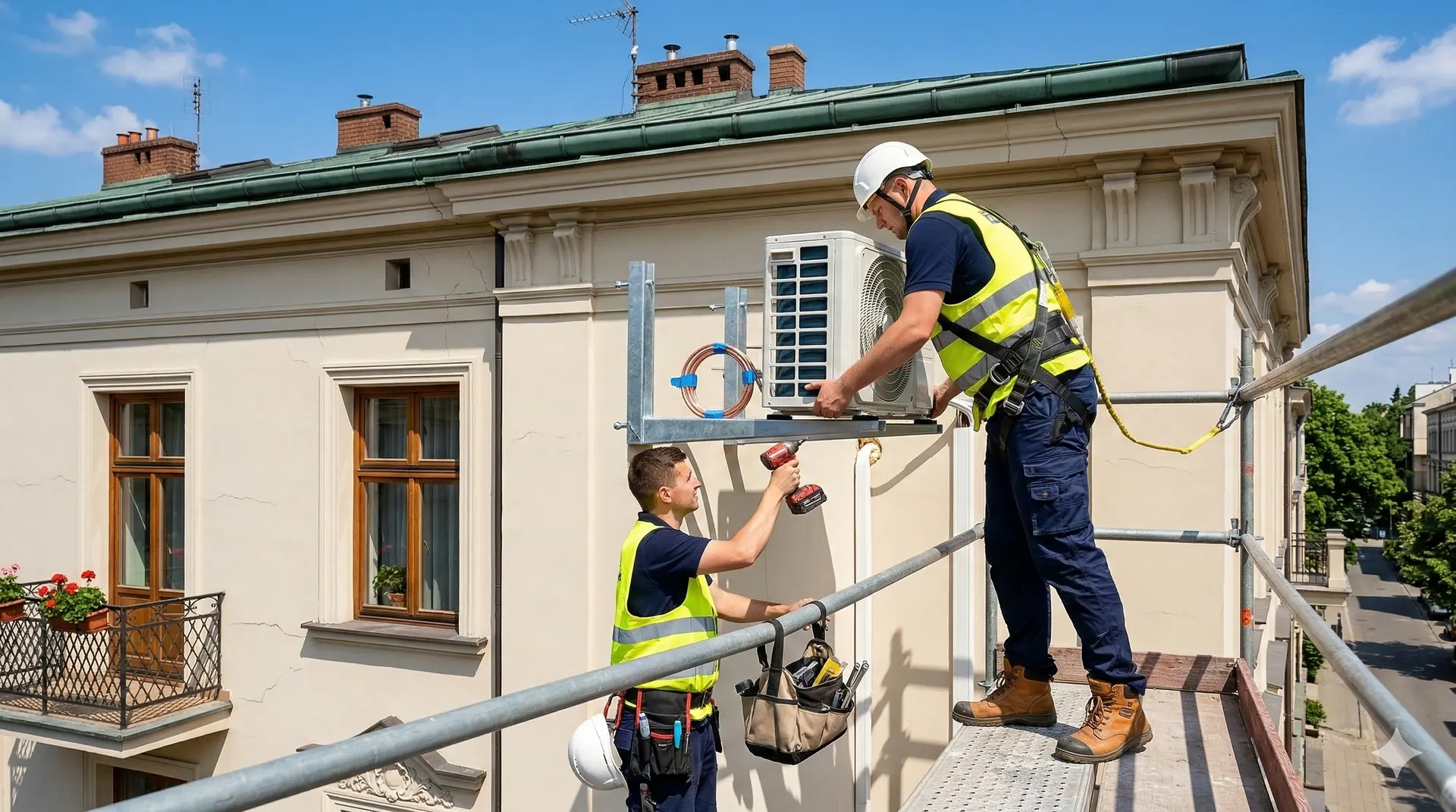
Thick exterior walls are one of the most underestimated problems when installing air conditioning in a Warsaw tenement house. In new construction, an installer often drills through 25–30 cm partitions and runs the standard refrigerant line without major complications. In a tenement house the situation is different: the brick wall may be 45, 50, or even 60 cm thick, and there are also layers of plaster, sometimes stucco, cornices, rustication, or later repairs from different periods. Making a passage through the wall stops being a minor installation step and becomes an operation requiring very precise planning. It is not enough to “make a hole for the pipes.” You have to check what is on both sides of the wall, how to create the slope for condensate, where the opening will emerge on the facade, and whether decorative plaster will be damaged, since restoring it may cost more than the installation labor itself. That is why diamond drilling, rather than impact chiseling, should be standard in tenement houses, because it reduces the risk of cracking and plaster detachment. A thicker wall also means a longer transition section for the refrigerant pipes, the power/control cable, and the condensate drain. This matters in practice. If the indoor unit is mounted on the front wall and the outdoor unit sits on a balcony facing the courtyard, the logic of the shortest route often loses to aesthetic and acoustic requirements, so the lines are routed the longer way through the hallway, a shaft, or the ceiling. Every extra meter is not just a material cost, but also a need to maintain the correct condensate slope and respect the manufacturer’s limits. For many split models, the standard route length without additional refrigerant charge is around 5 m, while total permissible lengths are usually 15–25 m in residential class systems. In a thick wall, vibration is another important issue. A poorly mounted installation, without protective sleeves and an elastic pass-through, can transfer vibrations to plaster and finishing elements. In older buildings, where the walls “work” differently than in a reinforced concrete block, this matters more than many investors realize. That is why a properly executed wall pass-through in a tenement house must combine refrigeration technique, construction caution, and respect for the historic substance.
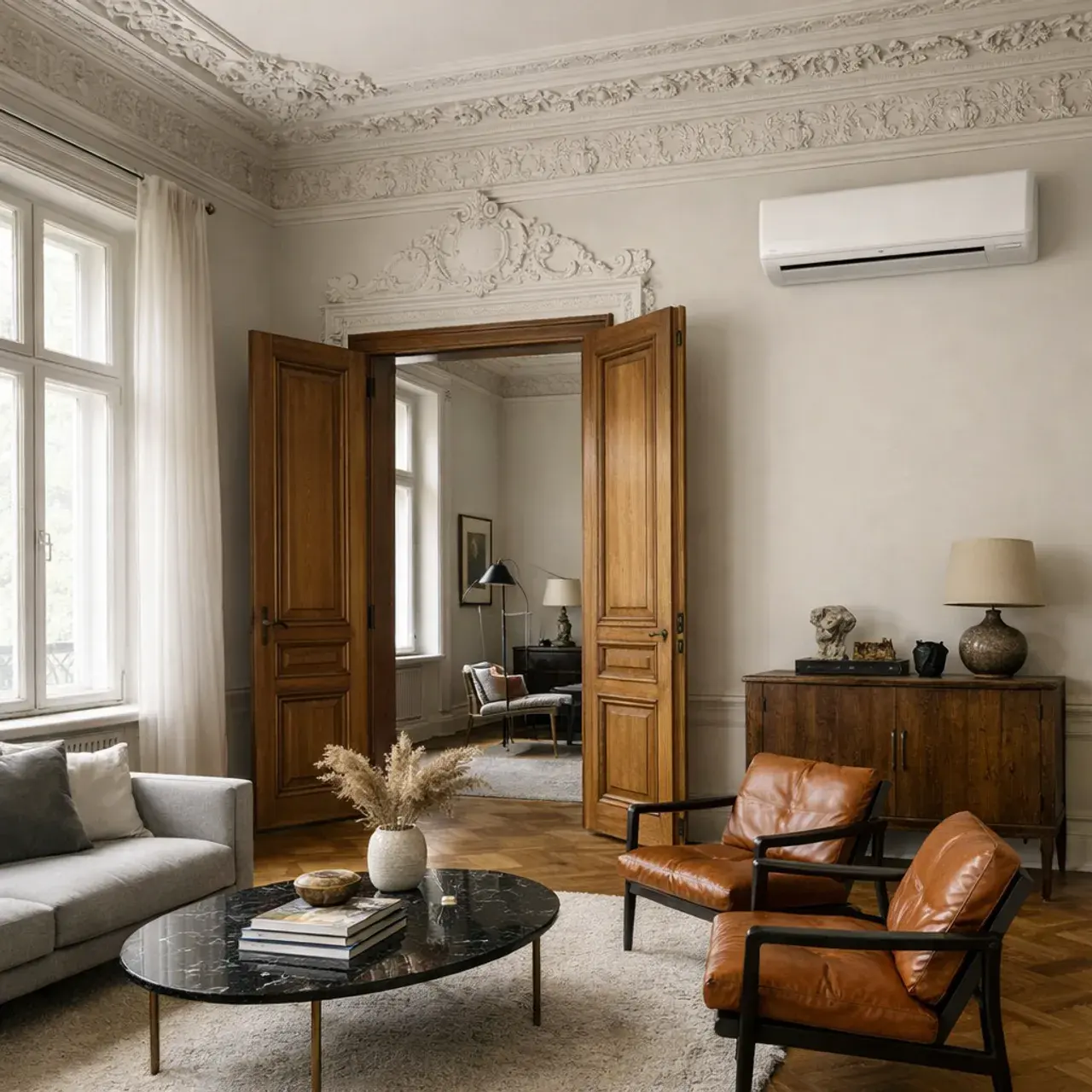
High ceilings in Warsaw tenement houses are both an advantage and a challenge for air conditioning. In apartments with a height of 3,2–3,8 m, air has more space to circulate, and the feeling of stuffiness is often lower than in units with a standard height of 2,6–2,7 m. From the comfort perspective, that is good news, because the cool air does not sit so heavily near the floor, and a room with sensible temperature control at 24–26°C can feel very pleasant even during heat above 30°C. At the same time, however, the larger volume changes the way demand is calculated and requires a different approach to indoor unit placement. A mistake that occurs regularly in tenement houses is the mechanical selection of power based only on floor area. A 30 m² living room with a height of 3,6 m has a volume of 108 m³, which is about 35–40% greater than a similar area in a new apartment with a height of 2,6 m. That does not mean the power has to be increased exactly proportionally, because insulation, exposure, and heat gains also matter, but ignoring volume often leads to under-sizing the unit. A high ceiling also complicates the operation of a standard wall-mounted unit installed 15–20 cm below the ceiling. The higher the air conditioner hangs, the more important the airflow vane setting and the choice of a model with the proper air throw range become. In practice, a cheap unit with weak airflow control may cool mostly the upper layer of air and produce a worse result in the occupied zone than a better model of the same power. That is why in tenement houses it is often worth choosing units from brands such as Daikin, Mitsubishi Electric, Samsung, or LG, with more precise control of airflow direction and modes that reduce drafts. An alternative, often very sensible, is a ducted unit hidden above a suspended ceiling in the hallway, dressing room, or part of the bathroom. In an apartment with a height of 3,5 m, lowering the ceiling by 20–25 cm in a selected zone does not reduce the sense of height, and it allows air to be distributed to several rooms through discreet grilles. This solution is more expensive, because in 2025/2026 we are usually talking about a budget starting at around 16 000 to 28 000 zł for a simple ducted system, but in many tenement houses it provides the best aesthetic result and the most even comfort.
Outdoor unit placement and line routing
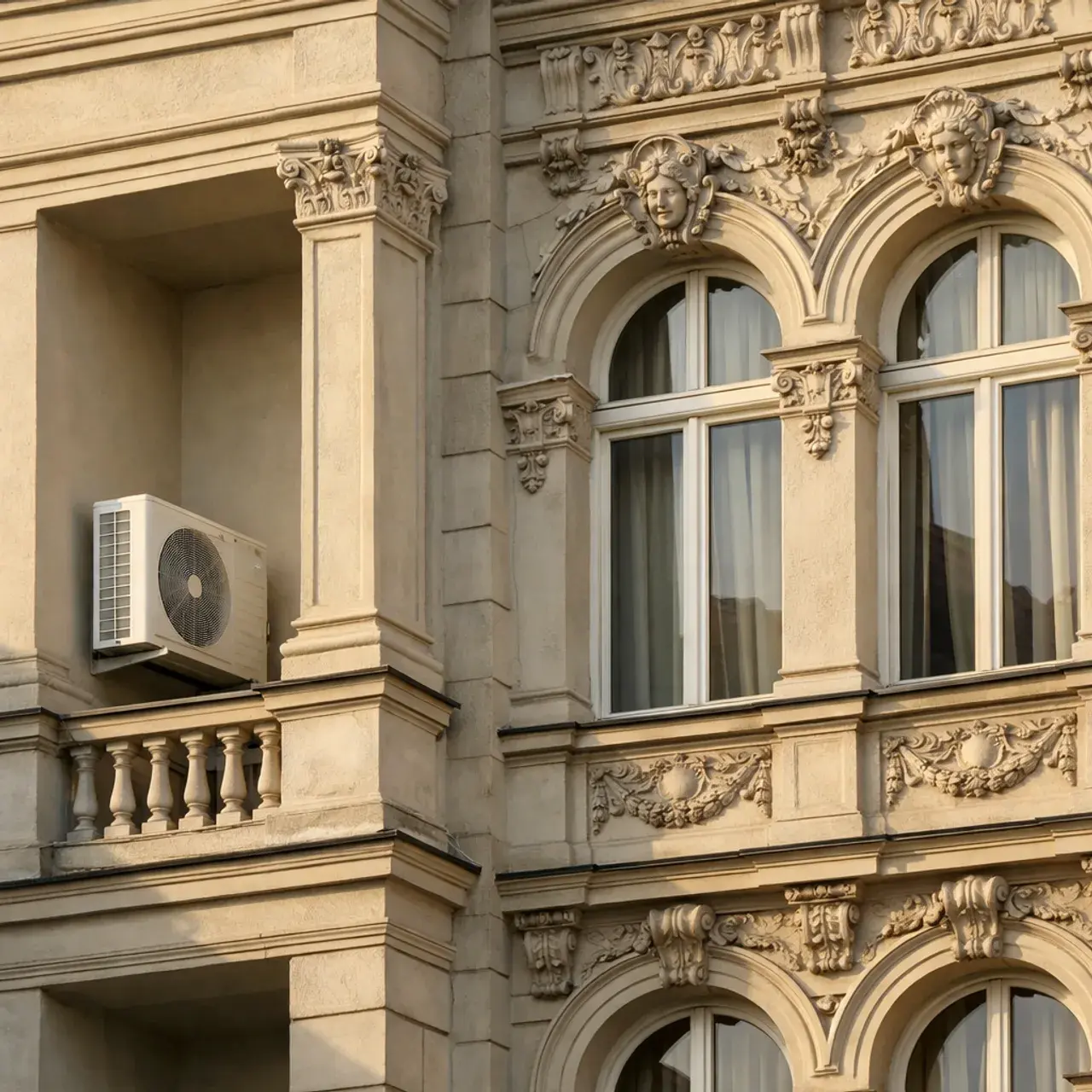
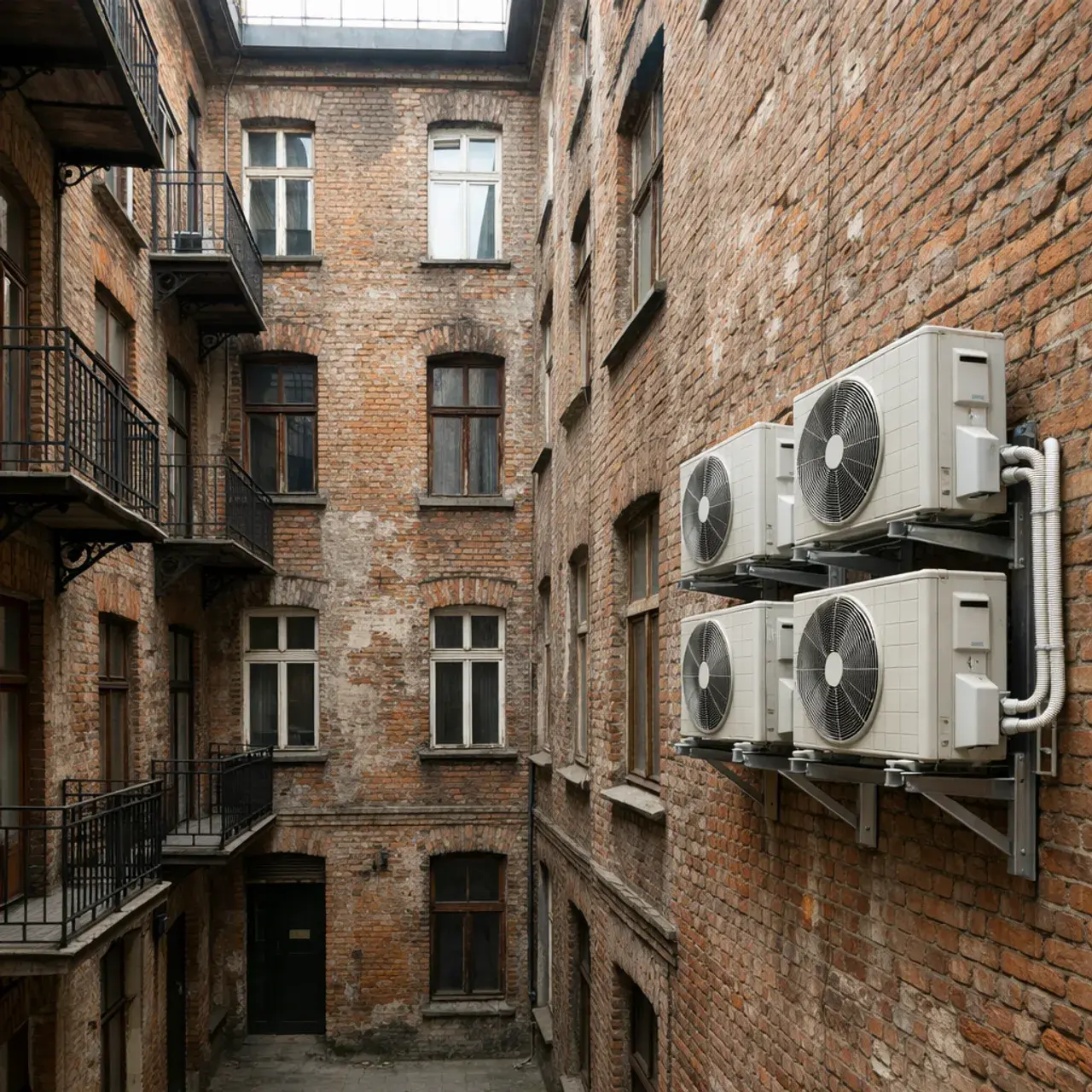
The location of the outdoor unit in a Warsaw tenement house usually determines whether the project is feasible, acceptable to the housing community, and comfortable for neighbors. In practice, four options are most often analyzed, each with its own advantages and disadvantages. The first option is the courtyard, outbuilding, or facade on the yard side. This is the most common choice, because the unit is invisible from the street, and acoustically such a location is often easier to justify than the front of the building. That does not mean the matter is simple, however. The housing community may forbid random installation on outbuilding walls, require a unified bracket system, or designate specific zones where equipment may be installed. Sometimes there is also an aesthetic problem: if there are already several outdoor units hanging haphazardly in the courtyard, a new installation may be allowed only on condition that the routes are tidied up and covers in the facade color are used. The second possibility is the roof. Technically it can be very good, because it moves the noise source away from apartment windows and helps preserve a clean facade, but it involves long refrigerant runs, additional elevation changes, and higher installation costs. In a flat on the second floor of a four-story tenement house, the route to the roof may mean 15–25 m of piping, and that requires checking the manufacturer’s limits, sometimes a larger pipe diameter, and additional refrigerant. Such a variant can make sense with higher-end Daikin, Mitsubishi, or LG models, but for a budget unit it becomes less economical. The third option is a light well. On paper it looks attractive because it is hidden, close to risers, and often near bathrooms, but acoustically it is usually a disaster. Sound bounces off the walls, resonates, and travels directly to neighbors’ windows, which is why many housing communities reject the idea outright. The fourth possibility is a balcony facing the courtyard, if the unit has one. This is often the best compromise: easy servicing, a shorter route, no interference with the main facade, and greater control over condensate drainage. You still need to maintain service clearances, not block movement on the balcony, and remember that even there the unit must not drip onto lower floors or transfer vibrations to the railing or balcony slab.
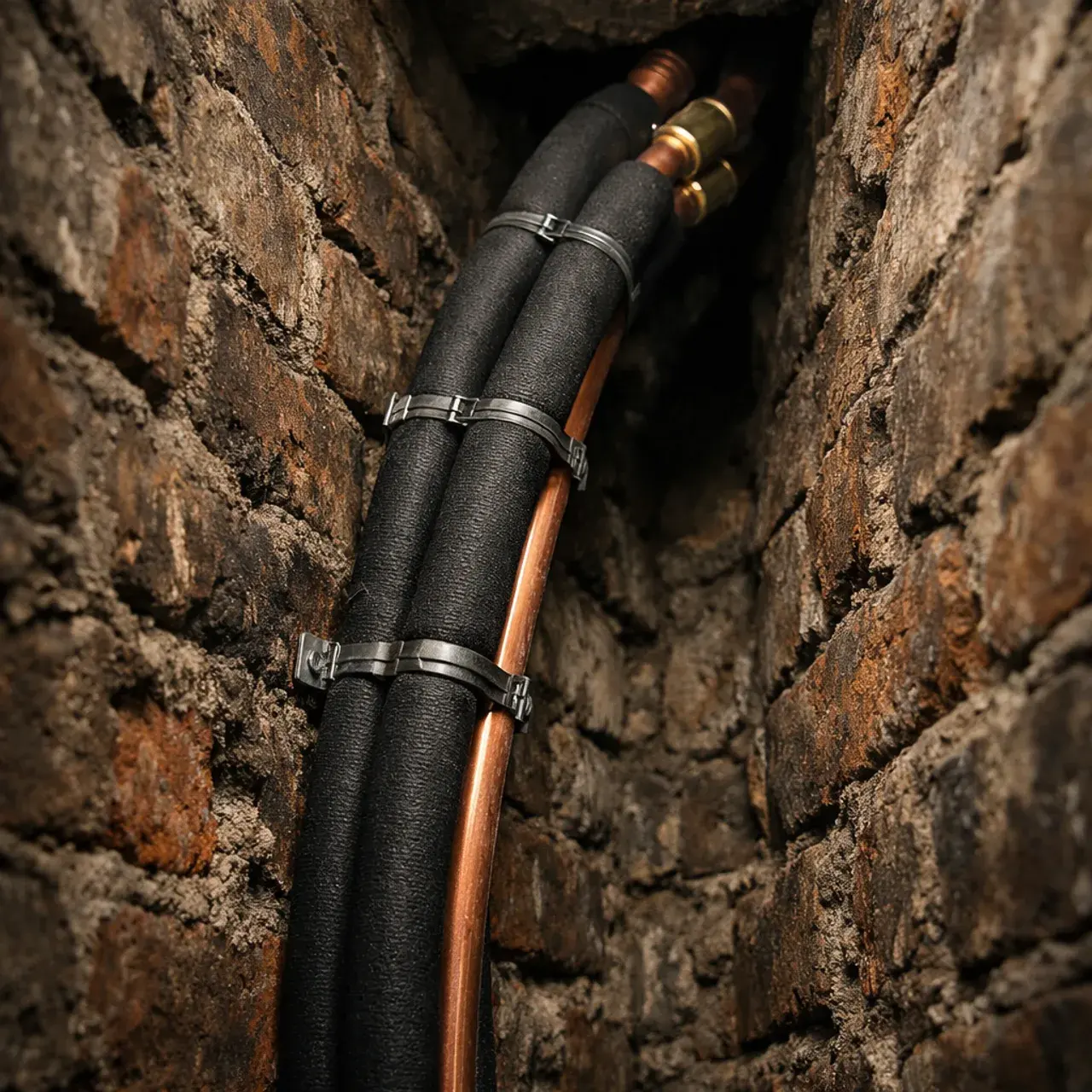
Routing refrigerant lines in a tenement house is a craft of its own, because the best solutions are rarely visible at first glance. In new construction, the installation often takes the shortest route: through the wall and along the facade, or in a simple technical riser. In tenement houses you have to think more flexibly and use the building’s existing infrastructure, as long as it is legal, safe, and approved by the manager. Old shafts, unused channels left from former installation risers, spaces near chimneys, and sometimes even former garbage chutes in buildings where they have been taken out of service and formally rebuilt can be especially valuable. The issue of unused flues after gas conversion or a change in the heating system comes up particularly often. For an investor, this looks like the ideal riser for running refrigerant pipes and control cables. Technically this may be possible, but it must not be assumed automatically. First you need to confirm that the duct is truly out of use, does not serve active ventilation or reserve functions for other apartments, and that its technical condition allows the installation to be run through without risk of damaging walls or causing condensation transfer. The legal use of an unused chimney or other riser usually requires the approval of the housing community or manager and often a chimney sweep’s opinion. Depending on the building, an opinion from a designer or fire protection specialist may also be necessary, especially if penetrations will be made through ceilings or fire separation walls. It is crucial to secure the penetrations with appropriate fire-resistant materials and maintain fire tightness. Refrigerant pipes in insulation, electrical cables, and the condensate drain cannot simply be “thrown” into the riser. The method of fastening, service access, and inspection possibilities have to be planned. In practice, a properly executed route in an existing riser allows the installation to be hidden almost completely and avoids long trunking on the apartment walls. That is a huge aesthetic advantage, especially in units with restored stucco and parquet floors. On the other hand, it is a more time-consuming and more expensive solution than standard installation. If a regular split with a simple route costs in 2025/2026 around 5000–9000 zł depending on the brand and scope of work, then installation with routing through a shaft, additional protections, and documentation can raise the budget by several thousand złoty. In a tenement house, however, these “invisible” elements often decide the quality of the whole project.
Acoustics in a tenement house courtyard is probably the hardest issue when planning air conditioning, because even very good equipment can become problematic if it is placed badly. Enclosed courtyards act like a resonance box: sound reflects off four walls, returns to the windows, and is often perceived as louder than the catalog data would suggest. That is why the argument “but the outdoor unit is only 48 dB(A)” does not always convince neighbors or the property manager. First, 48 dB(A) is usually a value measured near the source under specific operating conditions, not the noise felt at night by a resident one floor above or opposite. Second, the tonal character of the sound, structural vibrations, and the effect of multiple reflections can make a bigger difference than the number in the technical sheet. In tenement houses with a tight courtyard 8–12 m wide, even a unit from a reputable brand can be heard in an unpleasant way if it is placed directly opposite bedroom windows. That is why noise reduction has to be planned already at the stage of selecting the model and installation location. The first step is choosing an outdoor unit with a well-functioning night quiet mode. In practice, it is worth targeting units that can reduce operating noise to about 35–40 dB(A) under suitable conditions, instead of choosing based only on price. Good results in the residential segment are achieved, among others, by selected models from Daikin, Mitsubishi Electric, Haier Flexis, Samsung WindFree, or LG Dualcool, although each specific model should be compared individually. The second element is anti-vibration bases and proper mounting. A cheaply installed unit on poor brackets can transfer vibrations to the wall and amplify perceived noise more than the fan itself. The third issue is acoustic covers, but used wisely. A cover must not choke airflow or worsen unit efficiency; it should be designed for the specific model and maintain the required service clearances. The fourth factor is location relative to windows: it is better to move the unit away from the bedroom line, avoid recesses, and not mount the unit directly opposite a row of windows. Sometimes shifting it by 2–3 m to the side gives a bigger effect than paying extra for more expensive equipment. In tenement houses, good acoustics do not come from one trick, but from the sum of many small decisions made in advance.
In Warsaw tenement houses, the issue of air conditioning should always be considered together with gravity ventilation, because it is responsible for the basic air exchange in kitchens, bathrooms, and often also dressing rooms or former maid’s rooms. In practice, most buildings in Śródmieście, Stara Praga, or the older part of Mokotów have a layout based on chimney risers that work thanks to temperature and pressure differences. When we run the air conditioning in summer and cool the apartment intensively, we lower the indoor air temperature and thereby weaken the natural chimney draft. That does not mean air conditioning “breaks” ventilation, but a poorly designed system can genuinely disrupt it. The problem is especially visible in apartments after window sealing, with heavy internal doors and without ensured supply air. Then the bathroom stops removing moisture, odors linger longer in the kitchen, and condensation appears in the outer corners of the walls. Tenement-house walls, especially 45–60 cm of solid brick, have high thermal inertia. When a cold stream from the indoor unit repeatedly washes over a section of the outer wall, the surface locally cools down. If at the same time air exchange drops and relative humidity rises to 60–70%, dark patches begin to appear in corners, behind a wardrobe, at the lintel, or at the junction of wall and ceiling. That is why a project in a tenement house should account not only for the 2,5 or 3,5 kW unit power, but also for airflow direction, real fresh air supply, and how the occupants use the system. Good solutions include window or wall air inlets, bathroom door undercuts of at least 1,5–2 cm, setting the air conditioner’s louvers so they do not blow directly onto the exterior wall, and keeping the temperature no lower than 23–24°C during heat. In more demanding apartments, it is worth adding humidity-controlled inlets, periodic humidity measurement, and treatment of affected areas. At LeoKlima, we often also recommend checking the chimney draft before installation, because air conditioning in a tenement house is supposed to work together with ventilation, not against it.
Formalities: community and heritage conservator
Heritage protection in Warsaw is an issue that cannot be bypassed when installing air conditioning in a tenement house, even if the investor thinks it is “just a small outdoor unit facing the courtyard.” In practice, the scope of required approvals depends on the building’s location and status, but in the central part of Śródmieście, in Stara Praga, in the Saski area, and in parts of Mokotów, Żoliborz, and Ochota, one very often deals with supervision by the Municipal Heritage Conservator. In such areas, not only the front facade matters, but also the outbuildings, courtyards, and any elements affecting the architectural perception. Approval may be required for intervention in the facade, making an opening in an exterior wall, installing equipment visible from the street, changing the color of covers or installation trunking, and sometimes even the method of fixing the support structure. If the building is listed in the register of monuments, the matter moves to the Regional Heritage Office and the procedure becomes more formal, usually longer, and requiring better-prepared documentation. For a flat owner, the most important thing is to understand that air conditioning in a tenement house is not a “I order today, install tomorrow” purchase. First, you need to establish the building’s status, then check the rules of the housing community or cooperative, and then prepare a complete set of materials: technical description, outdoor unit location, installation route, acoustic parameters of the unit, condensate drainage method, and a visualization or photo with the planned installation marked. In practice, a well-prepared application significantly speeds things up. If the unit is to be invisible from the street, matched to the background color, mounted without damaging facade details, and with a low noise level, the chances increase. If someone wants to hang a white outdoor unit on the front wall of a tenement house on Marszałkowska or on a historic facade in Praga, the answer is usually predictable. It is also worth remembering that the absence of neighbor complaints does not mean the installation is legal. A poorly executed installation can end with an order to remove it, and then the loss is double: the cost of the unit and the cost of restoring the facade to its original condition. That is why in tenement houses it makes the most sense to plan the system from the outset for MKZ or WUOZ requirements, rather than trying to bypass them after the fact.

Formalities related to installing air conditioning in a Warsaw tenement house should be treated as a design process, not as an annoying add-on at the end of the investment. Most problems arise because the owner first buys the unit and only then learns that it cannot be installed in the chosen location. The proper procedure begins with a simple but crucial step: a conversation with the administration or housing community board. You need to determine whether the building has a resolution regulating installation on the facade, roof, or courtyard, whether specific acoustic guidelines are required, what the rules are for routing installations through common areas, and whether there are preferred locations for outdoor units. The second stage is checking the heritage status of the property. In Warsaw it is not enough to ask “is the tenement house a monument,” because the difference between a listing in the register of monuments, inclusion in the municipal heritage record, and being located in a conservation protection area has real procedural consequences. In Śródmieście this topic comes up very often, as it does in Praga Północ. Once we know the building’s status, we prepare a project or at least a reliable concept with a visualization of the outdoor unit location, route of the lines, and condensate drainage method. This matters because housing communities respond much better to a document showing a concrete solution than to a general request for “permission for an air conditioner.” The next step is a formal application to the housing community with technical documentation, noise parameters, drawings, and information about the installation method. At the same time, if the building or its surroundings are protected, an application is submitted to the city’s MKZ at ul. Nowy Świat or to WUOZ, depending on the scope of the case. In practice, the whole process in Śródmieście usually takes 2–4 months, because community meetings, document supplements, and official processing time all come into play. Outside the strictest heritage zone, in parts of Mokotów or Praga, it is sometimes faster and closes within 4–8 weeks. A well-run procedure saves stress later, because a legal installation approval in a tenement house is just as important as the quality of the equipment itself.
| Location | Community | MKZ/WUOZ | Typical timeline |
|---|---|---|---|
| Street-facing facade | Yes, written | Yes, often denied | 8–16 wk |
| Courtyard facade | Yes, written | Sometimes | 4–10 wk |
| Courtyard balcony | Yes, written | Rarely | 3–6 wk |
| Building roof | Yes + access | Depends on visibility | 6–12 wk |
| Airshaft / light well | Yes, restrictive | Typically no | Often denied |
| Interior only (ducted) | Notification | No if non-intrusive | 2–4 wk |
- Technical datasheets for indoor/outdoor units — capacity, class, noise level, dimensions.
- Photographic survey of facade / courtyard / rooms before works.
- Technical drawing of outdoor-unit location with dimensions relative to neighbors' windows and structure.
- Condensate drainage description — always to internal plumbing, never onto the facade.
- Installer's statement that insulation, structure and decorative detail will be preserved.
- In MKZ zones: application to the conservator with visualization and technical description.
- Acoustic measurement report if the courtyard is enclosed and over 4 storeys.
Costs, solutions and common mistakes
The second issue that regularly complicates air conditioner installation in tenement houses is the electrical system. On paper, a modern split looks harmless: power consumption during cooling often falls in the 0,7–1,3 kW range for 2,5–3,5 kW units, so many people assume it can simply be plugged into the first available outlet. In practice, that is a very risky approach in Warsaw tenement houses. In many apartments we still encounter old TN-C systems, partially modernized in the 1960s, 1970s, or 1980s, with aluminum wiring, a shared PEN conductor, and panels designed for a refrigerator, a radio, and a chandelier, not for several inverter devices running for hours during the summer season. Another frequent problem is undocumented tenant modifications: one circuit “upgraded” without junction boxes, extra outlets added in plaster, lack of protective device selectivity, and overheating connections. That is why when installing air conditioning in a tenement house, the standard should be a separate circuit from the distribution board, usually 16 A, and for larger systems 20 A, with a dedicated residual current device. For modern inverters, type A RCD is usually recommended, and in more demanding configurations or according to the manufacturer’s guidance, even type B. This is not an exaggeration, but real protection for the electronics and the users. In some buildings the apartment distribution board itself needs rebuilding, because there is no space for new devices or the system does not have a properly separated protective conductor. It also happens that the administration requires approval for the route of the new line through common areas, and the power utility suggests replacing the meter or modernizing the floor board if the apartment increases its connection capacity. The approximate cost of such electrical modernization is usually 1500–4500 zł, but in extreme cases, when a larger part of the accessories must be replaced, it can be higher. The good news is that a properly executed air-conditioning circuit organizes the whole installation and reduces the risk of tripping protection devices when the oven, washing machine, or dishwasher are running at the same time. In a tenement house, safe installation therefore starts not with a drill, but with measurements and an inspection by a licensed electrician.
Contrary to popular opinion, ducted air conditioning in a tenement house is not a premium-apartment whim, but a very sensible solution in a specific scenario: when the apartment is undergoing a full renovation and the investor accepts intervention in the ceiling. Ceiling heights in Warsaw tenement houses often range from 3,3–3,7 m, so lowering part of the surface by 25–30 cm does not necessarily mean losing the representative character of the interior. If we go from 3,5 m down to around 3,2 m, the apartment still retains breath and proportion, and we gain the ability to hide the ducts, plenums, insulation, and indoor unit out of the main field of view. This solution works particularly well in apartments on Aleje Ujazdowskie, in old Mokotów, or in renovated tenement houses in Śródmieście, where the investor wants to preserve the original aesthetic: stucco cornices, rosettes, high doors, herringbone parquet, and symmetry of the walls. With a well-prepared design, the ducts can be routed around valuable ceiling elements or run over bathrooms, dressing rooms, and hallways using existing technical spaces. Sometimes shafts near staircases or former installation risers can also be used legally and safely as part of the concept. The biggest advantage of a ducted system is air conditioning that is practically invisible: only discreet supply diffusers and return grilles remain in the rooms, and the architect does not have to “fight” wall-mounted units suspended between stucco and a bookshelf. This is especially important where any visual intervention triggers opposition from the conservator or the owner themselves. Of course, there are drawbacks as well. First, the system has to be planned before ceilings, lighting, and carpentry built-ins are made, because later changes are costly. Second, very reliable airflow and acoustic calculations are required, otherwise noise appears at the diffusers. Third, the cost can be about 40% higher than a comparable multi-split. If a standard system for a larger apartment would cost 24 tys. zł, the ducted version may reach 33–35 tys. zł, and with extensive built-ins even more. Still, in a well-renovated tenement house, it is often the only way to combine modern comfort with full respect for the historic interior.
In most Warsaw tenement houses, the most practical compromise between aesthetics, formalities, and budget remains a multi-split system. Its advantage comes not only from the technology, but from administrative realities. Instead of three separate outdoor units for the living room and two bedrooms, we install one outdoor unit and 2–4 indoor units. That means one formal point to agree with the housing community, administration, and, in heritage protection zones, also with MKZ or WUOZ. In practice, that is a huge difference, because it is easier to defend one carefully hidden unit on the roof, in a courtyard well, or on a less exposed outbuilding wall than several separate units spread across the facade. The high rooms of tenement houses also help aesthetically hide the indoor wall units. Mounted at a height of 2,6–2,9 m, above a door portal or along a less representative wall axis, they do not dominate the interior as much as in a typical apartment with a height of 2,55 m. For 65–80 m² apartments, systems with three indoor units are most often designed: for example, 3,5 kW in the living room and 2,0–2,5 kW in the bedrooms, connected to one outdoor unit of appropriate capacity. Among the brands most often chosen in this class, Mitsubishi Electric, Daikin, Samsung, LG, Haier, and Rotenso perform well, although in a tenement house the low noise level and wide range of permissible installation lengths are particularly important. You have to remember that refrigerant routes here are usually longer than in a block of flats, because the outdoor unit stands farther from the rooms, often in the courtyard or on the roof. For an apartment of around 70 m², the indicative budget for a multi-split in a tenement house today usually ranges from 18–30 tys. zł, whereas a similar setup in a standard apartment block would often be 12–18 tys. zł. The difference comes from more difficult pipe routing, longer risers, more demanding condensate drainage, and the need to work with delicate finishing materials. Despite this premium, multi-split remains the optimal solution because it gives independent temperature control in several rooms, limits facade intervention, and is usually the easiest to pass through community approvals.
The cost of installing air conditioning in a tenement house is clearly higher than in a block of flats, and it is worth saying this plainly already at the budgeting stage. Market experience shows that the so-called tenement premium is usually 30–50% above a standard installation in a typical large-panel building or a new apartment building. This is not an “extra for the prestige of the address,” but the sum of concrete technical and formal factors. The first is the length of refrigerant runs. In a block of flats, 5–10 meters of piping between the indoor and outdoor unit is often enough, while in a tenement house a distance of 15–25 meters is normal, especially when the outdoor unit is to be placed on the roof or on an outbuilding wall facing the courtyard. That means more copper pipes, more insulation, a larger amount of refrigerant, and longer work time for the team. The second component is drilling and passing through very hard, thick solid brick walls, sometimes with additional layers of later plaster. Diamond drilling and greater precision are often needed here so as not to damage decorative plaster or historic details. The third element is documentation: inventory, drawings, visualizations, technical descriptions for the housing community and conservator. There are also premium solutions related to noise and vibration, such as better anti-vibration bases, sound-dampening mats, acoustic covers, or special brackets. In some apartments you also have to factor in stucco restoration, recreation of a cornice after the installation pass-through, or painting repairs in a standard consistent with the character of the interior. Sometimes the team also needs to secure and restore the condition of the courtyard, staircase, or gate passage after transporting the equipment. As an indication, one can assume that a 35 m² studio in a tenement house costs around 9–14 tys. zł, an apartment of about 60 m² usually 15–22 tys. zł, and a large 110 m² apartment with three comfort zones and a more complex layout typically 30–55 tys. zł. The differences result from the brand of equipment, formal requirements, installation length, and the level of finishing. In practice, what is most expensive is not the air conditioners themselves, but their flawless adaptation to a difficult historic building.
Most problems with air conditioner installation in tenement houses do not stem from the technology itself, but from haste and a lack of understanding of the building’s specifics. The classic mistake number one is damaging decorative plaster or stucco while drilling. In a regular apartment, such a crack means a gypsum repair and repainting, but in a tenement house with an old cornice profile, lime plaster, or a preserved original rosette, the damage may be practically irreversible without the involvement of a conservator or a specialized stucco craftsman. The second common mistake is poorly handled condensate. Dumping it “somewhere,” onto the facade or the courtyard windowsill, ends with rust-colored streaks, damp plaster, and conflict with neighbors. In historic buildings, that detail is immediately visible and can become the reason for a complaint to the administration. The third problem is incorrect placement of the outdoor unit. A unit installed in a courtyard corner well or directly under a neighbor’s window can amplify sound through wall reflections. On paper the unit may have, for example, 48 dB, but subjectively it is heard much louder because the courtyard acoustics act like a resonance box. Another trap is drilling through a boundary wall without clarifying ownership and without the neighbor’s consent if the partition concerns the apartment on the other side. It also happens that the contractor focuses only on cooling and ignores gravity ventilation. The result is persistent humidity, weaker draft in the bathroom, and mold in the corners by the exterior walls after one or two seasons. A very costly mistake is also installation without housing community approval or without the required heritage consent. In Śródmieście and Praga there have been cases where the owner, after spending several thousand złoty, received an order to remove the outdoor unit because it had been mounted in a location not allowed for a protected building. There are also less dramatic but common errors: under-sized units, incorrectly selected pipe diameters, lack of service access to the outdoor unit, or running pipes along a representative staircase wall. In a tenement house every detail matters, which is why good installation is the sum of many small decisions made correctly the first time.
- Drilling through decorative stucco without pre-work photos and measurements — conservator-grade repair is PLN 3–8k per 1 m².
- Condensate dumped straight onto the facade — rust streaks, wet stucco, a fight with the community.
- Outdoor unit in a courtyard corner — the corner effect amplifies sound by 4–6 dB.
- Drilling into a neighbor's wall (walls were split decades ago) without their written consent.
- Ignoring gravity ventilation — disrupted draft, mold in corners within 2 seasons.
- Installing without MKZ approval in a heritage zone — forced dismantling plus an administrative fine.
- Undersized refrigerant-line insulation — condensation inside the thick wall, dampness problems.
Summary
Installing air conditioning in a Warsaw tenement house requires a project-based approach, not a quick, template installation. Here it is not enough to choose a unit based on floor area and find the first available spot for the outdoor unit. You need to check gravity ventilation, assess the condition of the electrical system, take into account housing community restrictions, the building’s conservation status, courtyard acoustics, condensate drainage, and the real possibilities for routing refrigerant lines without harming the historic substance. In practice, that is exactly why two apartments of identical area, for example 70 m², may require completely different solutions: in one tenement house the best option will be a quiet multi-split with a roof-mounted unit, in another a discreet ducted system planned together with a major renovation, and somewhere else only one wall-mounted unit installed on the courtyard side after obtaining administration approval. A good decision starts with an on-site inspection, because photos from a phone will not show wall thickness, chimney layout, the condition of the plaster, or whether the courtyard amplifies noise. At LeoKlima we have been working for years on apartments in Warsaw’s historic buildings and we know how different the realities of Śródmieście, Praga, and Mokotów are. During a free site visit we check the building’s conservation status, indicate real and formally safe locations for the outdoor unit, assess electrical supply possibilities, select low-noise equipment, and advise whether a split, multi-split, or ducted system will be best for the specific apartment. We also help prepare documentation for the housing community and the materials needed to submit an application to MKZ or WUOZ if the investment requires it. Thanks to this, the client knows from the outset not only the price of the equipment, but the full picture of costs, timelines, and limitations. If you are planning air conditioning in a tenement house and want to avoid mistakes that later cost the most, contact LeoKlima. Book a free site visit, and we will prepare a solution tailored to your specific apartment and your building’s realities. Call 502 010 010.