MVHR Mechanical Ventilation — 2026 Guide
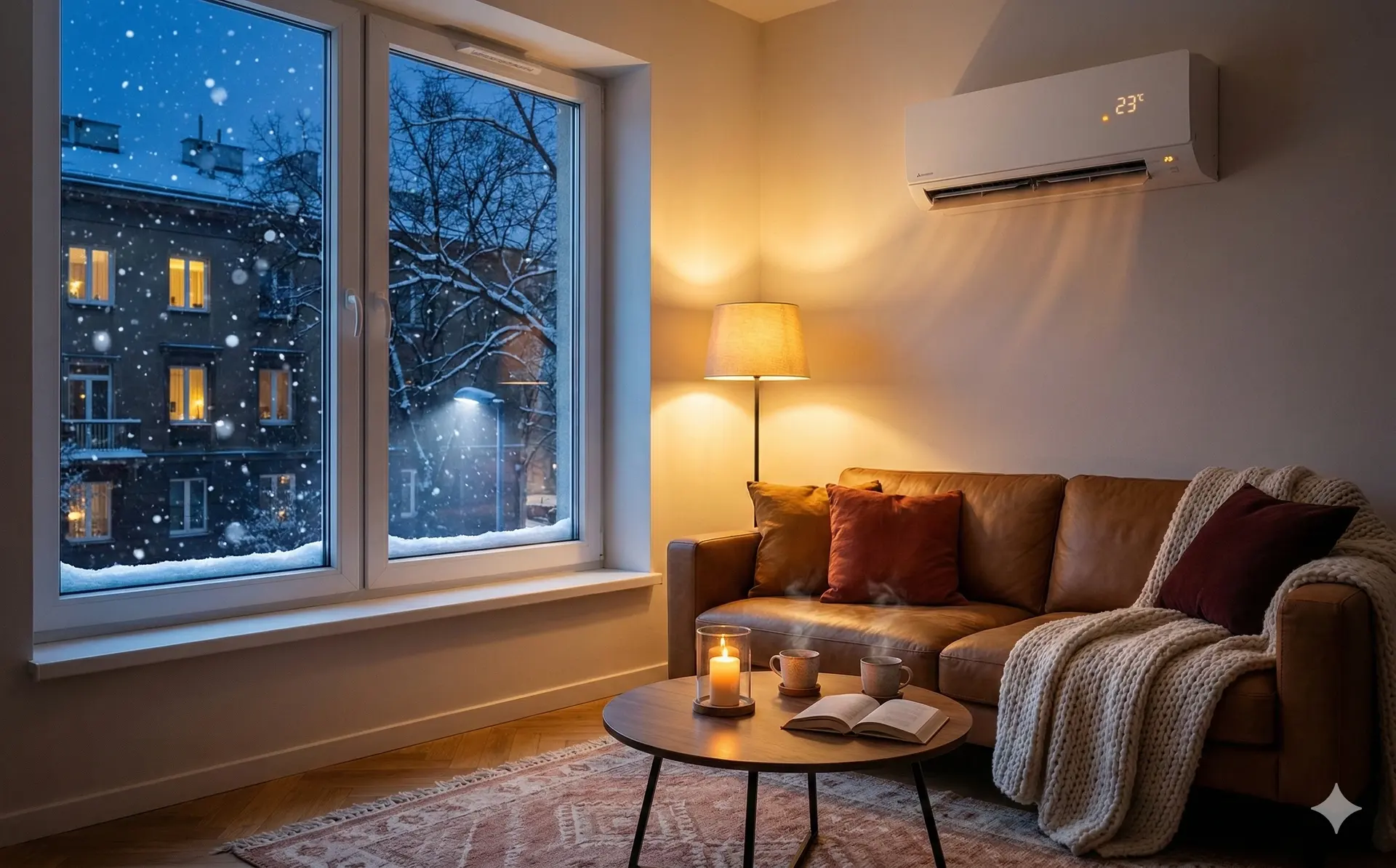
A February morning in a new single-family home outside Pruszków near Warsaw, 6:50 a.m., minus nine degrees outside, and on the sensor in the room of the three-year-old who has just woken up crying — 1,870 ppm CO₂. The house was commissioned three years ago to WT 2021 (the Polish technical regulations for buildings in force from 1 January 2021); a blower-door test confirmed n₅₀ = 0.84 1/h (air-tightness measured at a 50 Pa pressure differential, expressed as air changes per hour). The mother cracks the window for five minutes; the sensor drops to 720 ppm, but the thermometer on the wall loses 2.5 °C, the air conditioner has to catch up, and along with the cold air, fine particles from the neighbouring chimney enter the room — PM2.5 jumps briefly from 4 to 41 µg/m³. The question returns in every winter conversation with the architect: in a home this airtight, can you really get by without mechanical ventilation with heat recovery?
This guide walks through what actually decides whether MVHR succeeds or fails in a Polish home — when WT 2021 effectively requires it, how to choose between 75% and 92% recovery efficiency, whether an enthalpy core makes sense in the Polish climate, how to size duct diameters so the system doesn't hum or create draughts, what it costs in 2026, which subsidies apply and which installer mistakes recur in 30–40% of installations. The material is aimed at homeowners building new houses, those modernising older ones, and designers who want to see how the market has settled after the first full season under the new F-gas regulation (UE 2024/573 on fluorinated greenhouse gases) and the latest round of Czyste Powietrze (Clean Air, the Polish national heating-replacement subsidy programme).
What exactly is mechanical ventilation with heat recovery?
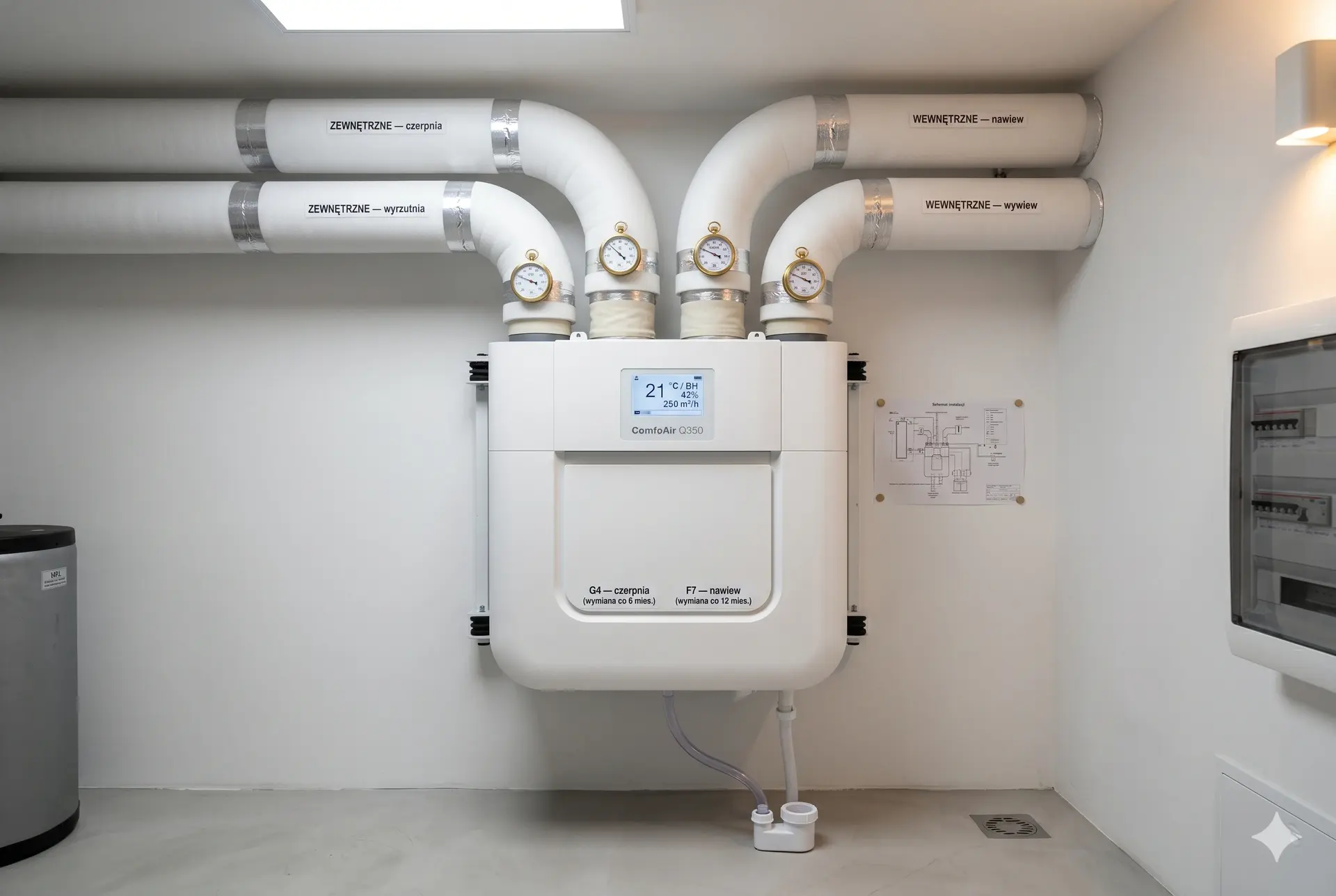
Mechanical ventilation with heat recovery (MVHR) is a system in which an extract fan pulls stale air from the kitchen, bathrooms and WC while a supply fan simultaneously delivers fresh outdoor air to the bedrooms, living room and study. Both air streams pass through a heat exchanger built into the central MVHR unit — and that is where the economics happen. Extract air (typically 20–22 °C) gives up its heat to supply air (cold, sometimes minus 15 °C in winter) through a thin, gas-impermeable partition. In a well-designed system the supply air enters rooms at 15–18 °C rather than freezing, and the energy loss is reduced to 10–25% of what escapes through natural ventilation.
This is not new technology — in Germany, Scandinavia and the Netherlands MVHR has been standard since the 1990s, and in Poland properly designed mechanical ventilation with heat recovery has dominated passive and low-energy houses for over a decade. What changed in 2026 is the scale: WT 2021 introduced air-tightness and EP (non-renewable primary energy demand) requirements that cannot sensibly be met without mechanical ventilation. Natural ventilation in an airtight building does not work — there is no thermal drive, the chimneys stand still, CO₂ rises. Extract-only ventilation (drawing from wet rooms while fresh air leaks through the building envelope) wastes energy. MVHR delivers three benefits at once: controlled airflow, low thermal losses and filtration of incoming outdoor air.
- Cross-flow — the simplest and cheapest core, 60–70% efficiency, typical in older units and budget models.
- Counter-flow — the most common core in new single-family units, 80–92% efficiency; in the enthalpy version it also recovers moisture.
- Rotary (wheel) — high efficiency (75–85%) and high moisture recovery, but typically used in commercial units above 500 m³/h.
- Enthalpy (membrane) — recovers 70–85% of heat and 50–70% of moisture, crucial for dry winter air when heating dries homes to 25–30% relative humidity.
Do you need MVHR in 2026?
The practical answer depends on whether you are building new or modernising an old building, and on the air-tightness standard you achieve or have already achieved. WT 2021 (the Polish technical conditions in force from 1 January 2021) introduced two key parameters for single-family homes: a maximum non-renewable primary energy demand EP ≤ 70 kWh/m²·year, and the requirement to verify the envelope with an n₅₀ blower-door test with a recommended value ≤ 1.5 1/h when mechanical ventilation is fitted. In practice at n₅₀ ≤ 1.5 1/h natural ventilation no longer works — air won't enter through micro-vents in the windows, and bathroom extracts won't pull through chimneys with no driving pressure. An architect designing a new home in 2026 therefore has a real choice: MVHR or mechanical extract-only ventilation with humidity-controlled window vents (the cheaper option, but one that wastes energy).
In older housing (built before 2000, n₅₀ often 6–10 1/h) natural ventilation still works — leaky joinery, wall cracks and chimneys provide enough flow. The decision to install MVHR in an older house is then economic rather than essential. The picture is different in a house after thermo-modernisation: external insulation, triple-glazed windows and a sealed roof can drop n₅₀ from 8 to 2–3 1/h. In such a house the owner has been complaining for months about damp bathrooms and CO₂ in the bedrooms — because natural ventilation no longer has its drive, while mechanical ventilation was never installed. This is the most common moment when MVHR stops being an option and becomes a rescue.
| Ventilation system | Energy loss (kWh/year) | Energy cost (PLN, at 0.80 PLN/kWh of heat) | Comment |
|---|---|---|---|
| Natural ventilation, n₅₀ = 8 1/h | ~5,800 | ~4,640 | Pre-2002 house, no airtight windows |
| Natural ventilation, n₅₀ = 2 1/h | ~3,200 | ~2,560 | Post-thermo-modernisation home, but weak chimney draught — CO₂ rises |
| Extract-only with humidity-controlled vents | ~2,400 | ~1,920 | Controlled flow, but energy wasted |
| MVHR, exchanger efficiency 75% | ~700 | ~560 | Mid-range unit, SEC class B |
| MVHR, exchanger efficiency 90% | ~280 | ~225 | SEC A+ class with counter-flow core, ~4,400 PLN/year savings vs. natural ventilation |
Recovery efficiency — what the numbers hide
Every manufacturer advertises a headline efficiency — Brink Renovent Excellent 400 cites 95%, Zehnder ComfoAir Q450 95%, Pro-Vent Mistral Slim 92%. The numbers are real but measured under narrow laboratory conditions per PN-EN 13141-7 (the Polish adaptation of EN 13141-7, the residential ventilation performance test): inlet temperature +5 °C, relative humidity 50%, no condensation. In a Polish winter at minus 15 °C with dry air, the effective efficiency drops to 75–82% even in the best units — which is why the Passive House Institute (PHI) certifies effective efficiency (η_eff) as the meaningful figure and requires ≥ 75% across the operating range.
Two parameters matter for the Polish climate: thermal efficiency (η_t) and moisture recovery. A counter-flow exchanger with a nominal 88–92% rating handles heat recovery beautifully but in winter dries the indoor air — moisture from the extract stream condenses on the cold side of the exchanger and is lost as condensate to the outside. After two weeks of winter heating the house sits at 22–28% RH (relative humidity), which irritates mucous membranes and dries out wooden floors. An enthalpy (membrane) exchanger transfers water vapour too — it recovers 50–70% of the moisture, maintaining a comfortable 35–45% RH throughout winter. A rotary wheel does the same, but its mechanical rotation means it is mostly used in commercial units above 500 m³/h.
Efficiency is not everything — exchanger frost protection matters just as much. At minus 7 °C with humid extract air, condensate on the exchanger starts to freeze; without countermeasures the core blocks and efficiency drops by 30–50%. Cheaper units solve this with an electric pre-heater (500–1,200 W consumption) — which eats up part of the recovery. Better units use rotational airflow redistribution (Brink Modulating Bypass, Zehnder ComfoFrost) or fan-speed modulation. The second feature is a summer bypass — a duct that bypasses the exchanger when night-time outdoor temperatures fall below indoor ones; without a bypass MVHR will warm the house by 1–3 °C in summer instead of cooling it.
| Exchanger type | Nominal efficiency (PN-EN) | Effective efficiency η_eff (Polish climate) | Moisture recovery | SEC class (ErP) | Unit price, 150 m² home |
|---|---|---|---|---|---|
| Cross-flow | 60–70% | 55–65% | none | B–C | 6,000–10,000 PLN |
| Counter-flow | 85–92% | 78–85% | none | A | 10,000–18,000 PLN |
| Counter-flow with bypass | 85–92% | 80–87% | none | A+ | 14,000–22,000 PLN |
| Enthalpy (membrane) | 78–85% | 72–80% heat + 50–70% moisture | yes, 50–70% | A | 16,000–26,000 PLN |
| Rotary (wheel) | 75–85% | 70–80% | yes, 60–80% | A | 18,000–35,000 PLN (≥500 m³/h) |
Sizing — output and airflow
Sizing an MVHR unit is not guesswork — it follows the Polish standard PN-83/B-03430/Az3, by summing the extract flows from wet rooms. The standard requires a minimum of: 70 m³/h in a kitchen with a gas hob, 50 m³/h with an electric hob, 50 m³/h in a bathroom with a bath, 30 m³/h in a separate WC, 15 m³/h in an internal room without a window (wardrobe, pantry). These flows add up — a typical 150 m² house with one kitchen, two bathrooms, a WC and a wardrobe gives 50 + 50 + 50 + 30 + 15 = 195 m³/h as the design extract flow. The supply flow must balance the extract within ±10% (the ventilation standard requires balance), so the unit has to handle 195–215 m³/h in normal mode.
The catalogue capacity of an MVHR unit is the maximum at 100 Pa external pressure — the number from the sales brochure. In a real installation with 25–40 m of ducting, bends, diffusers and an acoustic silencer, the resistance reaches 150–220 Pa and the capacity drops by 15–25%. The unit is therefore sized with a 30–40% reserve: for our 195 m³/h design figure you need a unit rated at 300–350 m³/h. Brink Renovent Excellent 300, Zehnder ComfoAir Q350, Pro-Vent Mistral 350 — all fit. A 200 m³/h unit would in theory suffice, but it would run at 95% capacity for 5,200 hours a year, fan noise would be continuous and the filter would block twice as often.
MVHR is not just about a single capacity number — it is about flexibility. Modern class A+ units modulate fan speed: night mode reduces flow by 30–40% (people are asleep, CO₂ rises more slowly), intensive mode raises it by 50% (cooking, showering), a 3-hour pause mode cuts supply when nobody is home for a longer stretch. CO₂ and humidity sensor control automates this without owner input: a sensor in the living room detects rising CO₂ when four guests arrive, the unit switches to boost, and returns to eco mode after they leave. That is 15–20% energy savings compared with a constant-flow regime.
| Floor area | Occupants | Minimum extract (m³/h) | Design flow + 15% (m³/h) | Recommended unit capacity |
|---|---|---|---|---|
| 80–100 m² | 2–3 | 100–130 | 115–150 | 180–230 m³/h |
| 120–150 m² | 3–4 | 130–175 | 150–200 | 220–300 m³/h |
| 150–200 m² | 4–5 | 175–220 | 200–250 | 280–350 m³/h |
| 200–250 m² | 5–6 | 220–280 | 250–320 | 350–450 m³/h |
| 250–300 m² | 6+ | 280–350 | 320–400 | 450–550 m³/h |
Ducts, distribution and noise attenuation
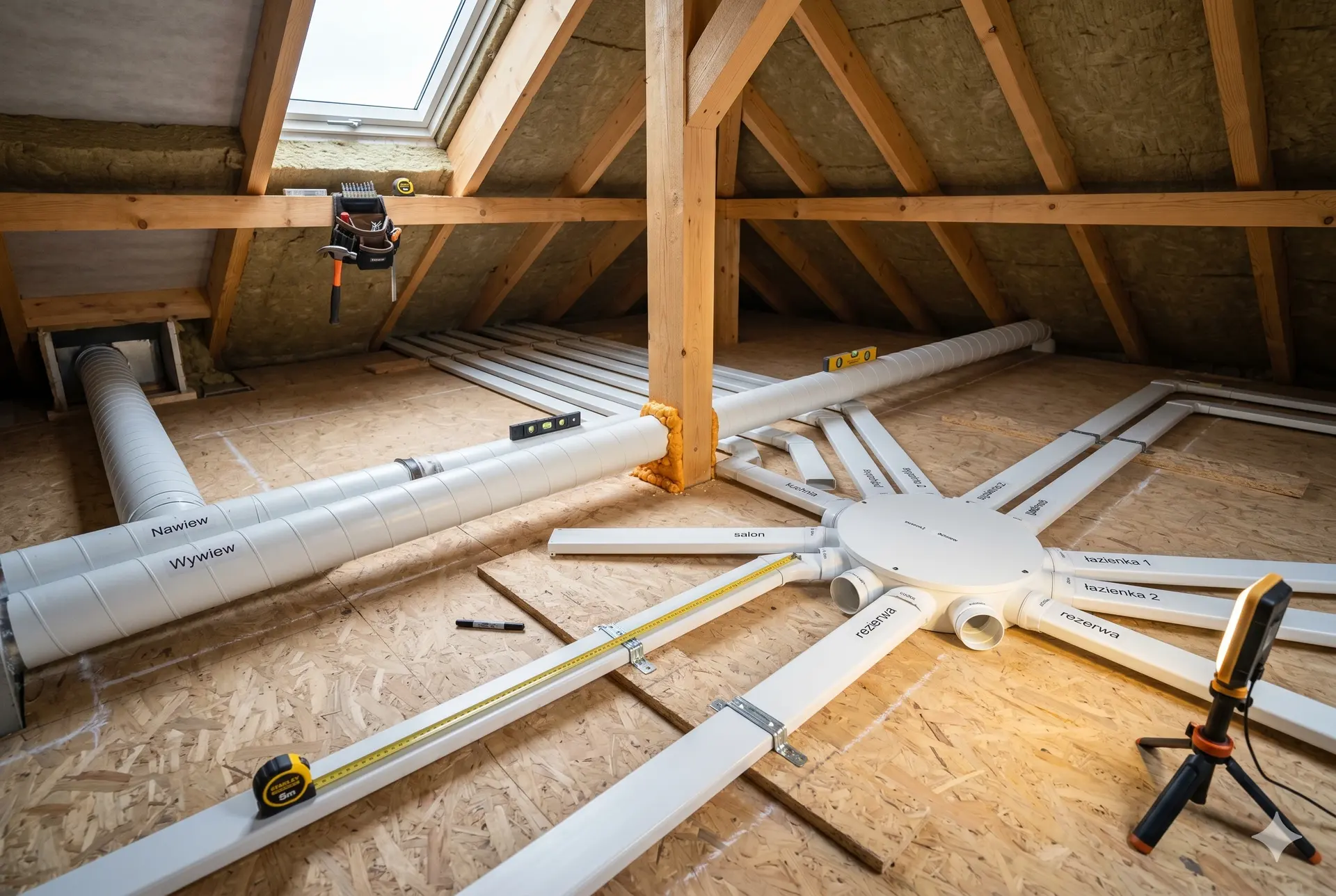
The duct network that distributes the air is the second critical element after the unit, and it decides whether the bedroom will be quiet. Three approaches dominate new builds in 2026: traditional spiral ducting (round, Ø160 for the main trunk, Ø75–100 for room distribution), flat plastic ducts (50×100 mm or 60×220 mm, designed to run within slab thickness or under a screed), and 'ladder' systems (small rigid Ø75 tubes fanning out from a central distribution box). Each has trade-offs — spiral is the most capacious and cheapest but needs 18–25 cm of clear height; flat fits in 5–7 cm of screed but costs more; the ladder system eliminates crossing ducts but requires longer runs.
Noise in MVHR has three sources. First — the unit itself (fan, compressor, bearings). Modern class A+ units generate 35–42 dB(A) at nominal output measured 1 m from the casing — quiet in the utility room, practically inaudible 2–3 m away in the living room. Second — airflow inside the ducts. Above 3 m/s (typically when a designer 'saves' on diameter) you hear a hiss that wakes light sleepers. Third — flow through diffusers and supply grilles; poorly sized diffusers whistle like little flutes, properly sized ones are silent.
Duct cross-section is sized so that air velocity stays at 2–2.5 m/s in the main trunk and 1.5–2 m/s in the distribution branches. Every diameter reduction doubles the velocity — narrowing Ø160 down to Ø125 takes velocity from 2 to 3.3 m/s, from quiet to noisy. The second rule: bends attenuate noise but absorb pressure — the designer should plan a route with as few bends as possible and use gentle radii of 1.5×D rather than sharp 90-degree elbows. Third: acoustic silencers (600–1,200 mm long, matched to duct diameter) on every outlet from the unit and on every duct serving a bedroom — that is the standard, not a luxury.
- Unit location: utility room, garage or unused attic; a minimum of 1 m of ducting (and a silencer) between the unit and the nearest diffuser in a living space.
- Main trunk routing: Ø160 to the distribution box, then Ø75 or flat 50×100 to each room.
- Insulation: every duct passing through an unheated zone (attic, garage) is insulated with 30–50 mm of mineral wool inside a vapour-tight jacket — otherwise condensate floods the ceilings below.
- Acoustic silencers: 600–1,200 mm on each side of the unit, plus one on every duct routed to a bedroom; flexible duct only as the last 30 cm before the diffuser (for installation tolerance).
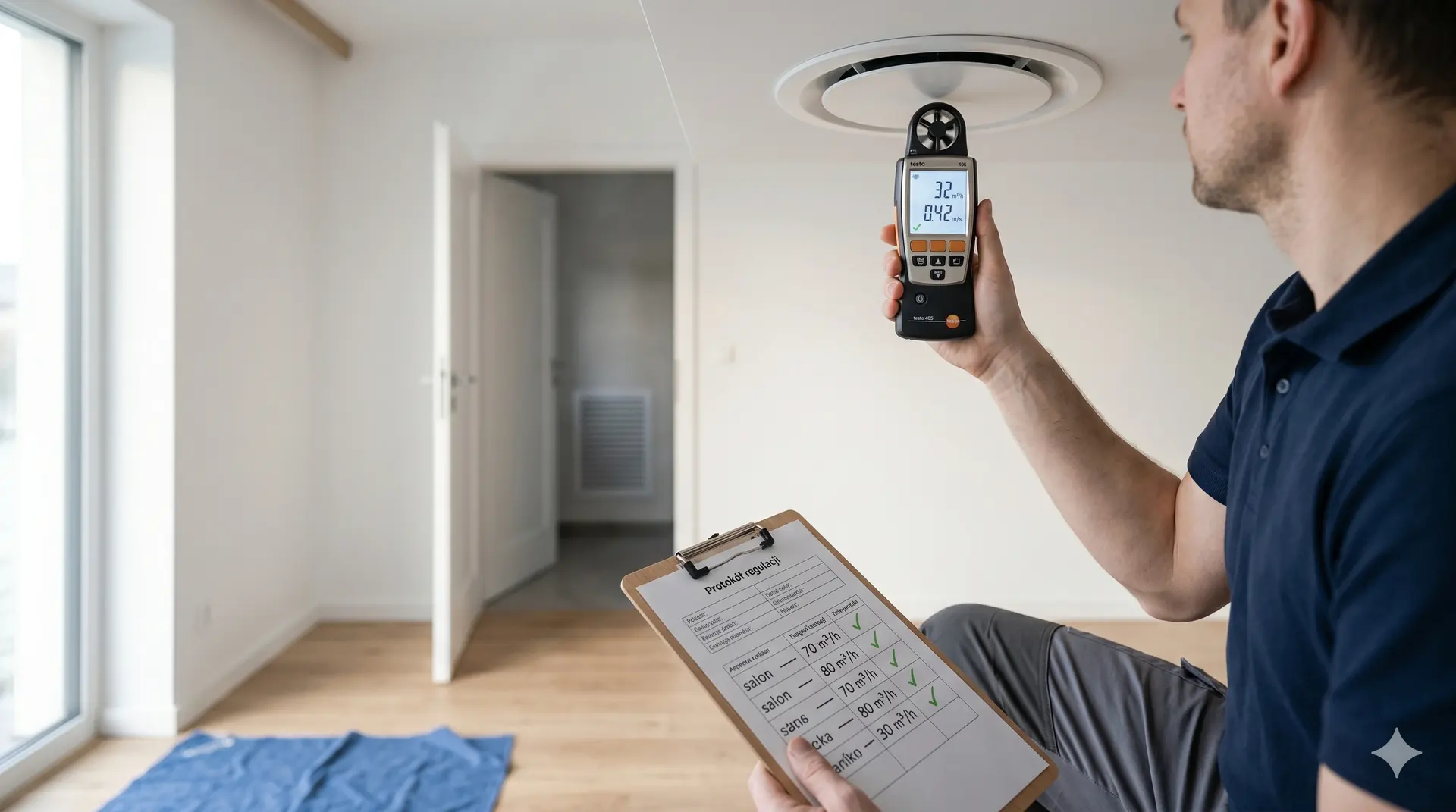
- Measurement ports: every main duct must have a measurement spigot (a 50 mm capped branch) for an anemometer — without it commissioning is impossible.
- Distribution box: the central unit with branches to every room, accessible for damper regulation.
Filters and indoor air quality
MVHR in Polish conditions is not just about energy recovery — it is also about filtering outdoor air, which is often clearly worse than indoor air. The annual mean PM2.5 in Warsaw is 18–25 µg/m³ (WHO 2021 guideline: 5 µg/m³ annual), winter daily peaks reach 60–90 µg/m³, and in Kraków and other smog basins they can hit 120–180 µg/m³. The filter inside the unit traps pollen, smog particles, mould spores and dust. The PN-EN ISO 16890 standard (harmonised with the EU since 2018) classifies filters by the percentage of particles captured in three fractions: ePM₁ (≤ 1 µm — the most harmful to lungs), ePM₂.₅ (≤ 2.5 µm) and ePM₁₀ (≤ 10 µm).
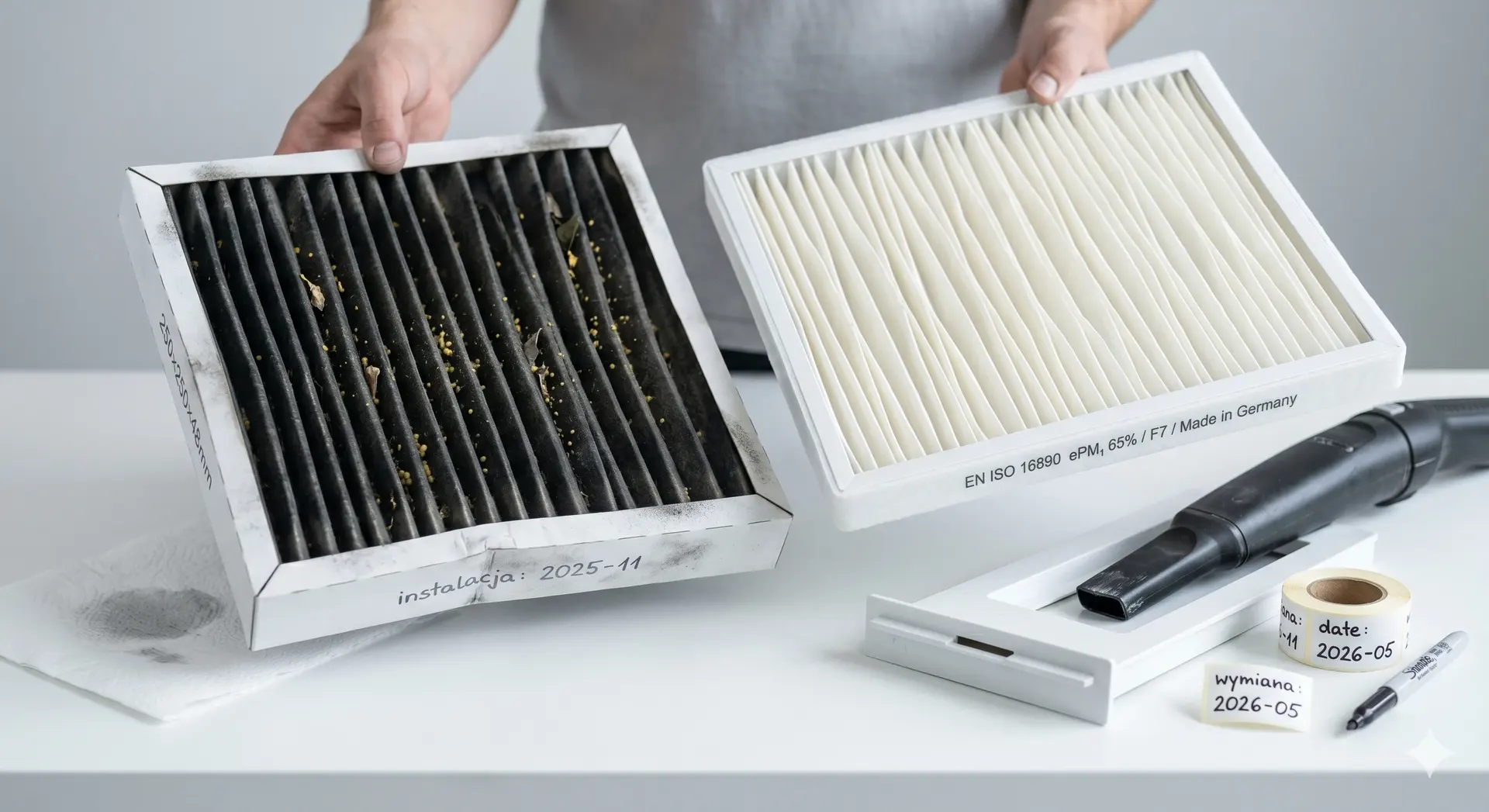
The standard 2026 set for a single-family home is a G4 filter (class ePM₁₀ 30–40%) on the intake — protecting the exchanger and the duct network from coarse contaminants — and an F7 filter (class ePM₁ 50–65%) on the supply — protecting the occupants. Homes with pollen-allergic residents or homes in smog-prone cities upgrade the F7 to F9 (ePM₁ 80–90%) or add a second HEPA H13 (>99.95% ePM₁) stage in the supply box. HEPA increases energy cost (a higher pressure drop forces higher fan speed → 5–8% more energy) and needs replacement every 12 months at 220–350 PLN — but for a family with an asthma case the cost is negligible.
| Filter class (EN ISO 16890) | Captures | Typical use | Price per filter | Replacement interval |
|---|---|---|---|---|
| G4 (Coarse 60%) | dust, insects, larger pollen | every intake — exchanger protection | 25–45 PLN | every 3–6 months |
| F7 (ePM₁ 50–65%) | fine pollen, low-concentration smog | standard supply filter for single-family home | 60–110 PLN | every 6–12 months |
| F9 (ePM₁ 80–90%) | most PM2.5 smog, pollen, mould spores | families with allergies, smog cities (Kraków, GZM agglomeration) | 90–160 PLN | every 6–9 months |
| HEPA H13 (ePM₁ >99.95%) | viruses, PM1.0 particles, allergens | asthma, COPD, post-COVID recovery | 180–320 PLN | every 12 months |
| Activated carbon filter | gases, volatile organic compounds (VOCs), odours | homes near busy roads or factories | 140–260 PLN | every 6 months |
- Mounting seal — the best filter slipped past its frame filters nothing; the frame should have a soft gasket and be clamped down.
- Replacement cadence — an F7 after a year of Polish winter is already at 40–50% of its initial efficiency; the schedule is not a recommendation, it is a requirement.
- Intake bypass in summer — some cheaper units bypass the filter in summer; check the datasheet to confirm whether the bypass covers the exchanger or also the filter.
- Outdoor intake grille condition — a grille blocked by leaves or settled snow reduces flow; inspect twice a year.
GWC, summer bypass and supply zones
A ground heat exchanger (GWC — gruntowy wymiennik ciepła) is an optional add-on to MVHR in which intake air first passes through an underground loop 1.5–2.5 m deep. The ground sits at 8–12 °C in summer and 4–7 °C in winter, so cold and hot air are pre-tempered. Two types are common in Poland: an air-based GWC (Ø200 PE-RT pipes laid around the foundation, 30–50 m long) and a glycol-based GWC (a horizontal or vertical collector circulating glycol fluid to a coil in the MVHR intake). The glycol type is more expensive (4,000–9,000 PLN plus installation) but avoids the mould and radon issues that can affect air ducts buried in soil.
GWC economics in 2026 look different from ten years ago. When MVHR exchangers achieved 70%, GWC added meaningful percentage points to winter recovery and protected against exchanger freezing. Today, with class A+ exchangers at 88–92%, GWC raises effective efficiency by just 2–4 percentage points — and the payback from heat recovery alone is 15–20 years. The more compelling case is the summer cooling effect: GWC pre-cools intake air by 4–8 °C on hot days, easing air-conditioning load and improving comfort in bedrooms without dedicated AC.
Independently of the GWC decision, two other optional MVHR features are worth weighing at the design stage. The first is the summer bypass — a duct that routes around the exchanger automatically when night-time outdoor temperatures drop below indoor — cool night air enters directly, cooling the structure for the whole day. This is 'passive night cooling' which in shoulder seasons (May, September) replaces air conditioning. Bypass is now standard (an ErP 1253/2014 ecodesign requirement), but implementation quality varies — some cheaper units have an 'on/off' bypass, the better ones (Brink, Zehnder, Vallox) modulate in five steps. The second is supply zones — a distribution box with electrically actuated dampers controlled by thermostats, allowing a larger airflow to the room you are actually using. That is 10–15% heating energy savings and local comfort.
Integration with heat pump, air conditioning and PV
MVHR and a heat pump are today the classic pairing of a new Polish single-family home. The cooperation is passive — the MVHR unit delivers fresh air, the heat pump heats the water in the central heating loop or the air via an air conditioner, and both systems keep them at their respective set-points. The benefit is calculated not from magic but from physics: a home with MVHR loses 280–700 kWh of heat per year through ventilation, a home without it 3,200–5,800. The heat pump has to make up the difference — costing 600–1,100 PLN per year. Investing in MVHR shortens the payback on the heat pump by 1–2 years. As we discussed in our air-to-water heat pump guide, you size the pump for a building after thermo-modernisation and with mechanical ventilation — otherwise you oversize it.
With a split air conditioner, MVHR cooperates on a different dimension. The air conditioner cools the recirculated air in a room, MVHR delivers fresh air — and through the night bypass it passively cools the building fabric. Importantly: a home with MVHR needs fewer AC units, because fresh air doesn't require an additional stream. The classic setup is a multi-split air conditioner with 2–3 indoor units in the bedrooms plus MVHR throughout the home — we described this approach in detail in our multi-split system guide for apartments, and the logic for a single-family home is similar.
Photovoltaics with MVHR, however, are not an obvious pairing. An MVHR unit draws 50–150 W (class A+ Brink, Zehnder) or 200–400 W (cheaper models). For a 350 m³/h unit running for most of the heating season that is 250–1,800 kWh/year. With PV self-consumption you cover 60–70% of that figure across the year — but in January, when the MVHR works hardest, PV produces 8–12% of its annual yield, so realistically you cover 5–10%. Net result: MVHR consumes about as much energy as two fridges, PV softens that figure but doesn't zero it out.
- Control via Home Assistant or Loxone — the heat pump, the MVHR unit and the air conditioner see each other and don't work against one another (the AC won't cool a room the MVHR has just preheated with fresh air).
- Shared CO₂ sensor — controlling MVHR output from the heat pump's automation saves 10–15% energy without losing comfort.
- Combined thermodynamic schematic — the designer should hand over a single schematic covering heating, DHW, AC and MVHR; without it, an installer five years from now stares at separate documents and doesn't know how the zones interact.
- Air conditioner refrigerant choice — MVHR is not covered by F-gas rules, but air conditioning in a home with MVHR should use R32 or R290 per UE 2024/573 (from 2027 a ban on new splits ≤ 12 kW with GWP ≥ 150).
Purchase and installation costs in 2026
The cost of MVHR in a single-family home in 2026 has four components: the central unit, distribution materials (ducting, insulation, silencers, diffusers, distribution boxes), labour (installer), and optional add-ons (glycol GWC, supply zones, smart controls, additional HEPA filtration). The unit is 35–45% of total cost, materials 25–35%, labour 20–30%, add-ons 0–25% depending on configuration. The premium tier (Zehnder Q450 + glycol GWC + 4 zones) raises the cost 50–70% over mid-range (Brink Renovent Excellent 300 + standard distribution), but the energy difference over a 15-year life cycle is 8–12 thousand PLN, and the comfort difference you feel from the first night.
For a 150 m² home the typical range is 25,000–45,000 PLN gross including installation; for 200 m² 30,000–55,000 PLN; for 250 m² 38,000–65,000 PLN. The upper end includes an enthalpy core, F9 supply filter, supply zones and smart controls. Retrofit (ducting installed after finishing) raises the cost by 30–50% — because routes have to go through chases, suspended ceilings or even external ducting. MVHR is cheapest when installed during the first-fix stage alongside electrics and plumbing. In a new home MVHR represents typically 2.5–4% of the total build cost.
| Floor area | Mid-range (Brink/Pro-Vent class A) | Premium (Zehnder/Vallox class A+ with GWC) |
|---|---|---|
| 100 m² | 18,000–26,000 PLN | 28,000–38,000 PLN |
| 150 m² | 25,000–35,000 PLN | 38,000–55,000 PLN |
| 200 m² | 30,000–42,000 PLN | 48,000–68,000 PLN |
| 250 m² | 38,000–52,000 PLN | 58,000–82,000 PLN |
| 300 m² | 45,000–62,000 PLN | 70,000–95,000 PLN |
2026 subsidies — Czyste Powietrze and thermo-modernisation relief
Programme status and amounts as of May 2026 — programmes change during the year and are sometimes paused while rules are revised. Before signing a contract always check current terms on czystepowietrze.gov.pl, mojprad.gov.pl and the websites of the National Fund for Environmental Protection (NFOŚiGW) and your regional fund (WFOŚiGW). MVHR in 2026 is covered by three main funding sources: Czyste Powietrze (or municipal Stop Smog), the Polish thermo-modernisation tax relief in personal income tax (PIT), and indirectly Mój Prąd 6.0 via energy storage support. Moje Ciepło (My Heat) applies to HEAT PUMPS and is not a direct MVHR funding source.
In practice most homeowners choose between two paths. The first is the comprehensive thermo-modernisation package under Czyste Powietrze, where MVHR is one of many components (insulation, windows, heat pump) under a combined limit of 66,000 / 99,000 / 136,200 PLN depending on income tier. The second is partial modernisation with a separate MVHR grant of up to 5,000 PLN plus deduction of the remainder under the thermo-modernisation tax relief. The two paths do not combine on the same piece of equipment, so a choice is required.
- Czyste Powietrze (comprehensive thermo-modernisation package) — MVHR can be one of many eligible costs; condition: replacing or already having an efficient heat source (heat pump, condensing boiler until the gas-boiler enrolment closes in 2025), plus a full thermo-modernisation covering walls, windows and roof. Requirement: home commissioned before 1 January 2009.
- Czyste Powietrze (partial modernisation) — MVHR as a standalone eligible cost up to 5,000 PLN refund, combined with other single-element works; condition: replacement of an old heat source or meeting EP after modernisation.
- Polish thermo-modernisation tax relief (PIT) — deduction of expenses on mechanical ventilation with heat recovery up to 53,000 PLN per person (106,000 PLN per married couple). Expenses settled over 6 years from the end of the year with the first invoice, provided the investment is completed within 3 years. Independent of other subsidies.
- Stop Smog (municipal) — in some municipalities (especially Kraków, the Górnośląsko-Zagłębiowska Metropolis, Wrocław), 50–80% co-financing of ventilation modernisation for buildings from before 1989; rules vary, usually income-restricted.
- Mój Prąd 6.0 — does not directly cover MVHR, but supports an energy storage system (up to about 28,000 PLN), helping you better use PV to power the MVHR in winter.
Most common installation mistakes
MVHR is like any other system — it works only as well as it was designed and installed. At LeoKlima we regularly come back to installations done by 'one-off' firms and see the same mistakes: unbalanced airflow, uninsulated ducts, missing silencers, filters not changed in a year. Most of these mistakes don't require expensive repairs — they require somebody to sit down with an anemometer, the as-built drawings and an hour's patience. Six recurring problems in 30–40% of installations completed before 2024:
- No flow commissioning after installation — the installer walked out without running the anemometer. Result: 80 m³/h in one room, 20 in another, reverse flow in a third. The bedroom diffuser hisses, nothing is felt in the living room, CO₂ rises. Commissioning is 2 hours of work with an anemometer; without it the system is only theory.
- Missing acoustic silencer — spiral ducts running straight from the unit to bedrooms. Fan noise propagates down the pipe, you hear 35–40 dB(A) at night — disturbing for light sleepers. Adding a 1 m silencer costs 350–500 PLN; skipping it is a saving that costs every night.
- Uninsulated ducts in unheated zones — ducts run through a cold attic without thermal insulation. Condensate forms on the outside of the duct, drips onto the ceiling below, in extreme cases causing cracks and mould. Insulation with 30–50 mm of mineral wool in a vapour-tight jacket adds 800–1,600 PLN — essential on every attic route.
- Intake and exhaust too close together — the intake (where the unit draws fresh air) and the exhaust (where it pushes the stale air) must be at least 3 m apart, ideally on different elevations. The consequence of placing them close together: the exhaust stream (with kitchen, bathroom, cat-litter smells) is recirculated. The characteristic 'breakfast cutlets' aroma.
- Filter on a 'once a year' regime — F7 designed for 6–12 months used for 24–36, combined with a missed G4 replacement, drops the airflow to 60–70% of design, raises energy use by 15–20% and degrades air quality. A filter set costs 80–180 PLN every six months — a healthy-home subscription.
- Unit located in a habitable room — a poorly thought-out wardrobe or hallway placement without wall acoustic insulation. You hear the unit through the wall — 25–35 dB(A) in the bedroom. The unit should be in a utility room, garage or attic separated by a wall with acoustic class Rw ≥ 45 dB.
Operation and maintenance
MVHR is low-effort in operation, but zero effort doesn't exist. Three routine categories: filter replacement (owner), unit inspection (installer every 24 months), flow rebalancing (installer after 2–3 years or after a room layout change). The G4 intake filter is replaced every 3–6 months depending on the season (more often in winter when smog is higher), the F7 supply filter every 6–12 months. A filter is a standard 250×250 mm or 200×400 mm cassette; it slides out without tools, the set costs 60–180 PLN, replacement takes 5 minutes. Not replacing it is not a cosmetic issue — it cuts airflow, raises energy use and degrades air quality.
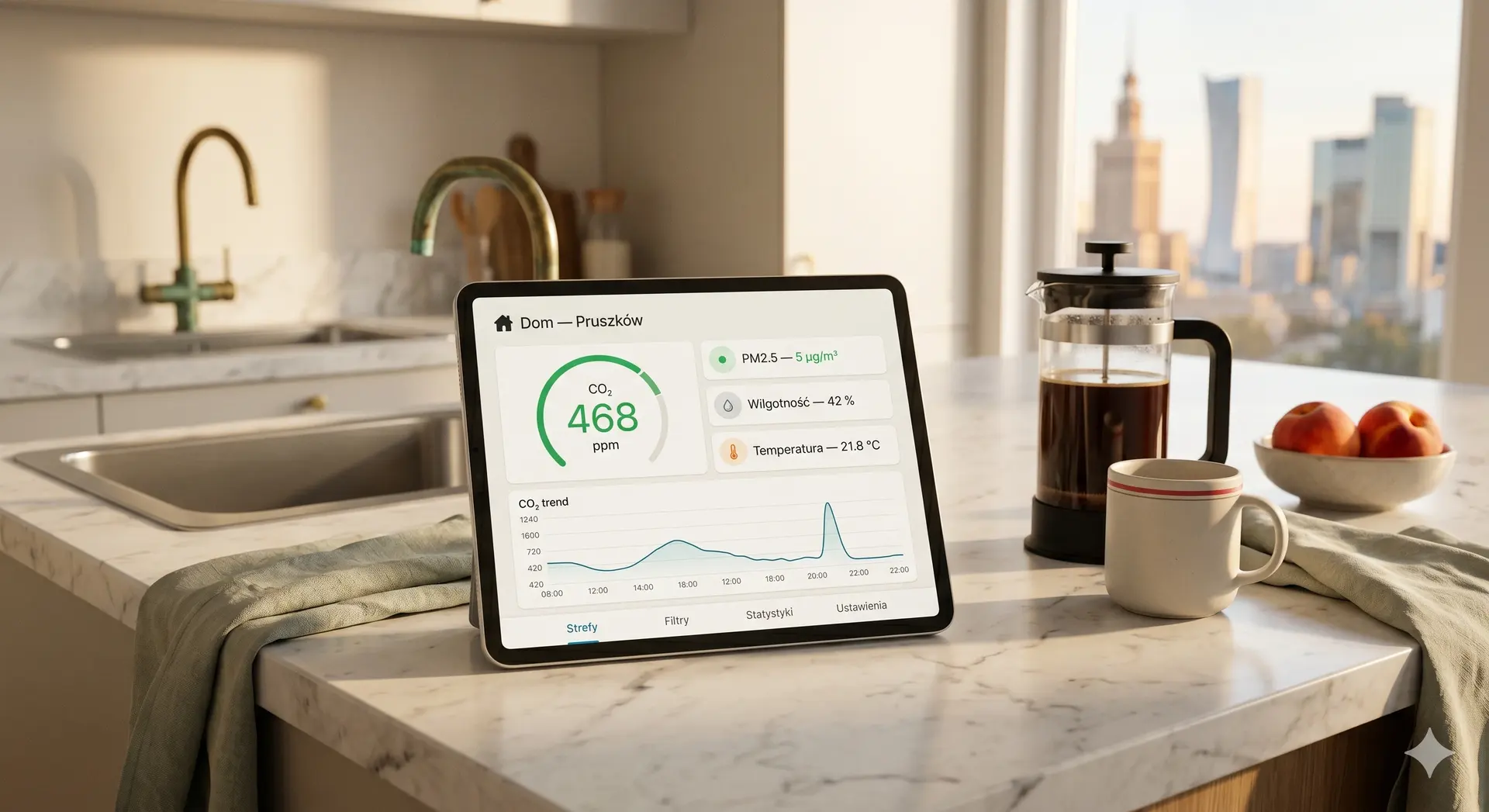
Modern units (Brink, Zehnder, Vallox, Aereco) now ship with a Wi-Fi module and a mobile app — myComfoControl, Brink Air Control, Vallox MyVallox. The app sends filter alerts (based on hours of operation or pressure drop), shows current airflow, CO₂, RH and temperature, and lets you change modes remotely. Integration with Home Assistant or Loxone opens the next layer — CO₂ sensor control in individual rooms (Eve Room, Aqara, Netatmo) modulating airflow in real time, absence detection from phone geolocation cutting the unit to minimum, monthly reports exported as CSV.
- Every 3–6 months (owner): replace the G4 intake filter, check the filter cover gasket, vacuum the outdoor intake grille.
- Every 6–12 months (owner): replace the F7 supply filter, check the condensate trap.
- Every 12 months (installer): clean the exchanger (slide it out, wash with detergent, dry), check the fans, inspect the electronics.
- Every 24 months (installer): rebalance airflow with an anemometer, disinfect ducts if mould was detected, check the condensate trap.
- On alarm: filter warning after >2,000 hours without replacement, pressure alarm (blocked duct), thermal alarm (exchanger freezing in winter).
FAQ — most common client questions
Is MVHR very loud?
A well-designed MVHR system is practically inaudible in habitable rooms. The unit itself generates 35–42 dB(A) at nominal output and usually sits in a utility room with acoustic insulation. A diffuser in a room should be quieter than 25 dB(A) — the acceptable limit for a bedroom. You typically hear MVHR when: silencers were skipped, the designer narrowed duct diameters (velocities above 3 m/s hiss), or the unit sits in an uninsulated room. Models with night mode automatically lower output by 30–40%, further quieting the system between 22:00 and 06:00.
Can I retrofit MVHR in an existing finished home?
Yes, but the cost rises by 30–50% compared with new build, and compromises are required. Three options: routing ducts in a dropped ceiling (lowering ceilings 25–30 cm in corridors and utility areas), chasing into walls (loud, dusty, 7–14 days), or retrofit systems with narrow 50×100 mm channels embedded in screed (if the screed is new or planned). The unit often ends up in an unheated attic (with proper insulation) or in a utility room. Realistic retrofit cost for a 150 m² home: 38,000–55,000 PLN, time 5–10 working days. Hardest in homes with prefabricated flooring and a fully finished ceiling — there the alternative is sometimes extract-only ventilation with humidity-controlled vents in the windows.
Does a ground heat exchanger (GWC) still make sense in 2026?
Less and less often. Ten years ago, when MVHR units had 70–75% efficiency, GWC added meaningful percentage points and protected against exchanger freezing. Today, with class A+ exchangers at 88–92%, an air GWC raises effective efficiency by just 2–4 percentage points — payback on heat recovery alone is 15–20 years. A glycol GWC (4,000–9,000 PLN plus installation) makes sense if you want summer intake cooling (passive 4–8 °C reduction on hot days), you are avoiding installing AC, or you live with allergy-sensitive residents (an air GWC can become a reservoir of mould and radon — a glycol one does not). In a new home with AC and a counter-flow A+ exchanger, GWC is usually skipped.
Does MVHR replace air conditioning?
No. MVHR exchanges air and recovers heat; an air conditioner cools the air. These are two different functions that can work together. MVHR's summer bypass enables 'passive night cooling' — between 22:00 and 06:00, when outdoor air drops below 20 °C, the unit bypasses the exchanger and brings in cool night air, pre-cooling the building for the whole day. That is enough in a passive climate (Germany, Scandinavia), but in a Polish August (35 °C by day, 22 °C at night) it is not full air conditioning — only relief. If you want 22 °C in the living room on hot days, a split or multi-split air conditioner is essential; MVHR won't replace it, but it will cut the required AC capacity by 10–20% (less recirculated air to cool, because the fresh air is already pre-conditioned).
What happens during a power cut — does the home 'suffocate'?
In practice, no. A power cut stops the MVHR fans, but a house — even a very airtight one — has its air reserves. A typical 150 m² home holds 400–500 m³ of air; four occupants use oxygen and produce CO₂ at a rate that takes CO₂ from 450 to 1,500 ppm over 4–6 hours. Uncomfortable, but not dangerous. Practical strategies: leave a window in the first locking position in 1–2 rooms (handle micro-ventilation), fit a UPS for the MVHR unit (350–800 PLN for a small 500 W inverter giving 4–8 hours), or simply wait — typical Polish power cuts last 2–4 hours. A full 24-hour outage is a scenario for opening windows in 2–3 rooms.
Summary and the next step
Three takeaways. First: in a home built to WT 2021, MVHR is not an option but a basic component — natural ventilation in an airtight building physically does not work, and extract-only loses 80–90% of heating energy in the season. Second: the difference between cheap and good is not double — it is 1.4–1.6× in price, but over a 15-year life cycle it shows up in energy bills and in the air quality you breathe every winter night. Third: subsidies (Czyste Powietrze, the thermo-modernisation tax relief) shorten real payback from 9–13 years to 6–9, but MVHR is not only ROI — it is also a quality of life that doesn't show up in a spreadsheet.
At LeoKlima we design and install MVHR systems in single-family homes and apartments in Warsaw and the surrounding area. We specialise in class A+ units (Brink Renovent Excellent, Zehnder ComfoAir Q, Vallox 145 MV) with full design from airflow balancing, through hydraulic schematic, to flow commissioning after installation. If you're building a new home and want MVHR done properly during the first-fix stage — or your home has been thermo-modernised and you see symptoms of poor ventilation (condensation on windows, morning CO₂ above 1,200 ppm, dry skin) — book a free site visit. We'll walk through the airflow balance, unit selection and sensible duct routing together. Call: 502 010 010 or write through the form on /kontakt.