Air dehumidification in Warsaw — from the RH reading to a dry building
We size and install condensation dehumidifiers, desiccant dehumidifiers and ventilation systems in flats, pre-war tenements, cellars, warehouses and offices. We start with a free on-site humidity survey and finish with calibrated hygrostats and a service plan. We cover the whole of Warsaw and the surrounding area.
How does air dehumidification work in a flat or basement?
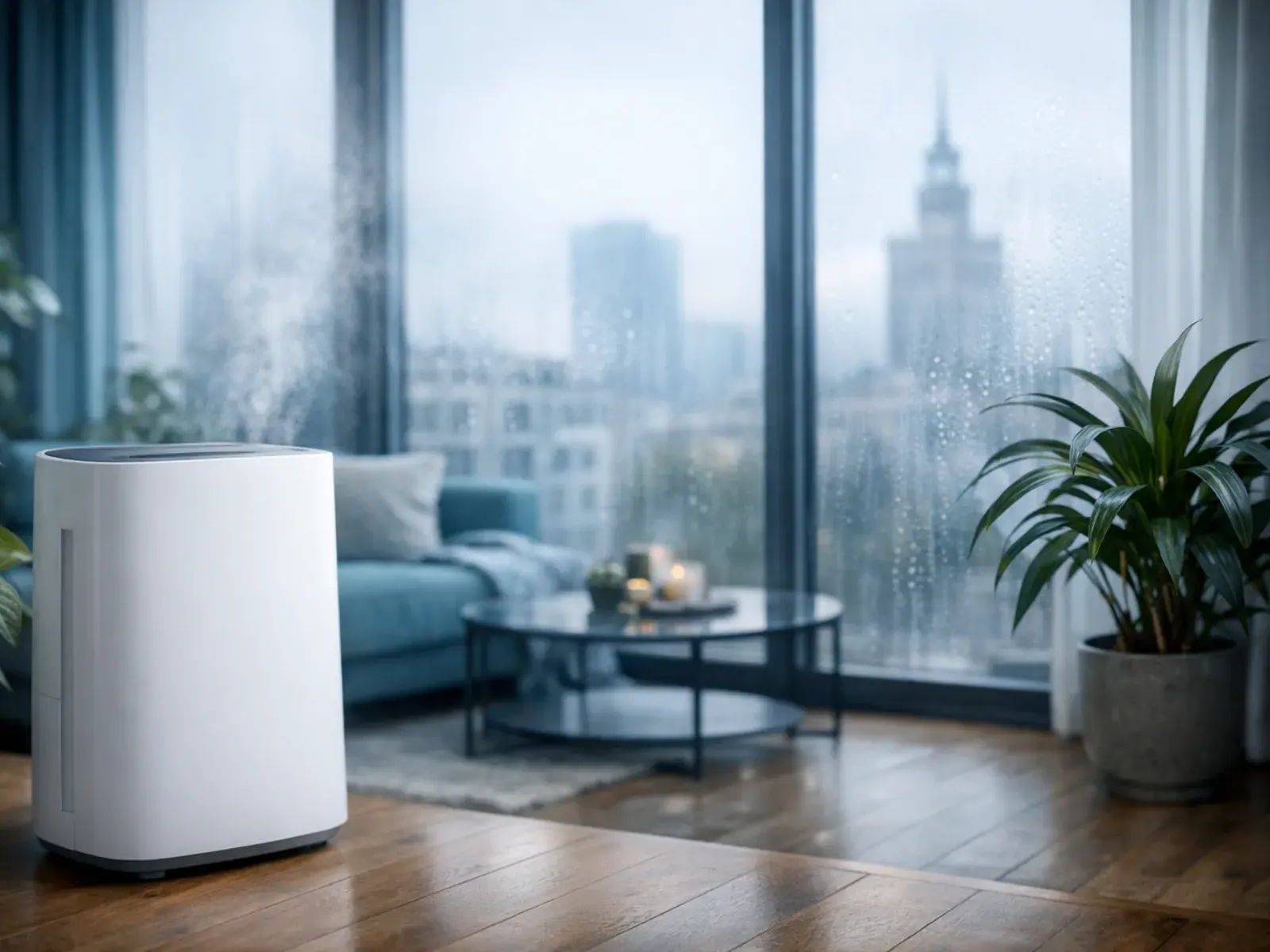
Warsaw sits on awkward ground under an awkward sky. On one side the river and the flat floodplain on the Praga bank; on the other the high escarpment above Mokotów and Bielany; and on top of that an oceanic-continental climate with an average annual humidity above 78%. In November, December and January the outdoor relative humidity stays well above 85%, and in cellars and ground-floor flats of pre-war tenements it climbs to 95% at temperatures of just a few degrees. That is exactly the environment mould needs: warmth from the flat, moisture from the ground, and a thermal bridge at the joint between the wall and the floor. The second issue is the housing stock built in the 1960s and 70s — the great-slab blocks have thin external walls with leaky joints, and most insulation work was only done in the 21st century, unevenly and without any dew-point check. The third issue is the pre-war tenements in Śródmieście and Praga — they sit on solid-brick foundations with no horizontal damp-proof course, so moisture rises by capillary action several metres up the walls. At LeoKlima we do not sell off-the-shelf dehumidifiers. First we measure surface temperature, RH, water-vapour partial pressure and dew point at several points in the room, and only then choose a method. In one flat a 20 L/24h condensation unit is enough; in another we have to bring in a desiccant rotor and clear the ventilation at the same time; in a third we have to fix the root cause first — say, a cracked rainwater downpipe. That is why our RH survey starts with a coffee and ends with a paper report listing exact figures and costs. Without that, sizing a dehumidifier is guesswork.
85%average RH in Warsaw from November to February
320+
buildings dehumidified in Warsaw
Why us
What you get that an online shop can't give you
We measure, we engineer and we take responsibility for the outcome — not just for delivering a box.
01
On-site RH and dew-point reading
We arrive with a calibrated hygrometer, an infrared thermometer and a water-vapour pressure sensor. We measure in corners, by windows, where wall meets floor and down in the cellar or up in the attic. You get the result on paper — exact numbers, the spots at risk of mould and a priority list. Without it, sizing a dehumidifier is a lottery.
02
Three methods, one decision
We do not push a single technology. If the room temperature never drops below 15°C, we go for condensation. If the dehumidifier has to work in a 4°C cellar, we bring in a desiccant unit. If the real problem is no air exchange, we sort out the ventilation — and a dehumidifier may not be needed at all.
03
Capacity sizing based on numbers, not gut feel
We calculate dehumidifier output from a moisture balance: room volume, starting RH, target RH, temperature, inflow from the ground and through air leakage. The client gets a table with three capacity options and the time needed to reach 50% RH. A cheaper unit that cannot keep up is money wasted.
04
Hands-on experience with Warsaw stock
We have dried cellars in Stara Praga tenements, archive warehouses on Targówek, flats below the escarpment in Mokotów and offices in Wilanów. We know where the conservation officer will say no to a duct in the façade and how to route the condensate pipe behind a renovation render. That context is not something you can buy in a shop.
05
Hygrostat calibrated to your building
After installation we calibrate the hygrostat so the dehumidifier does not run non-stop and yet still catches the morning and evening humidity peaks. We set the hysteresis, check how the unit reacts to an open window and show the client when to suspect a fault and when the weather has simply changed.
06
Service care, not just a sale
After the install we stay in touch. We remind you about filter changes every six months, check the condensate drain, clean the evaporator or replace a worn-out desiccant rotor. The client does not have to remember the schedule — we remember it for them, because we sized the unit and know exactly how it runs.
Dehumidification methods
Which dehumidifier should you choose: condensation or desiccant?
Three completely different physics behind the same problem. The choice of method decides effectiveness and running costs for years to come.
Condensation
Flats, offices, shops at 18–30°C
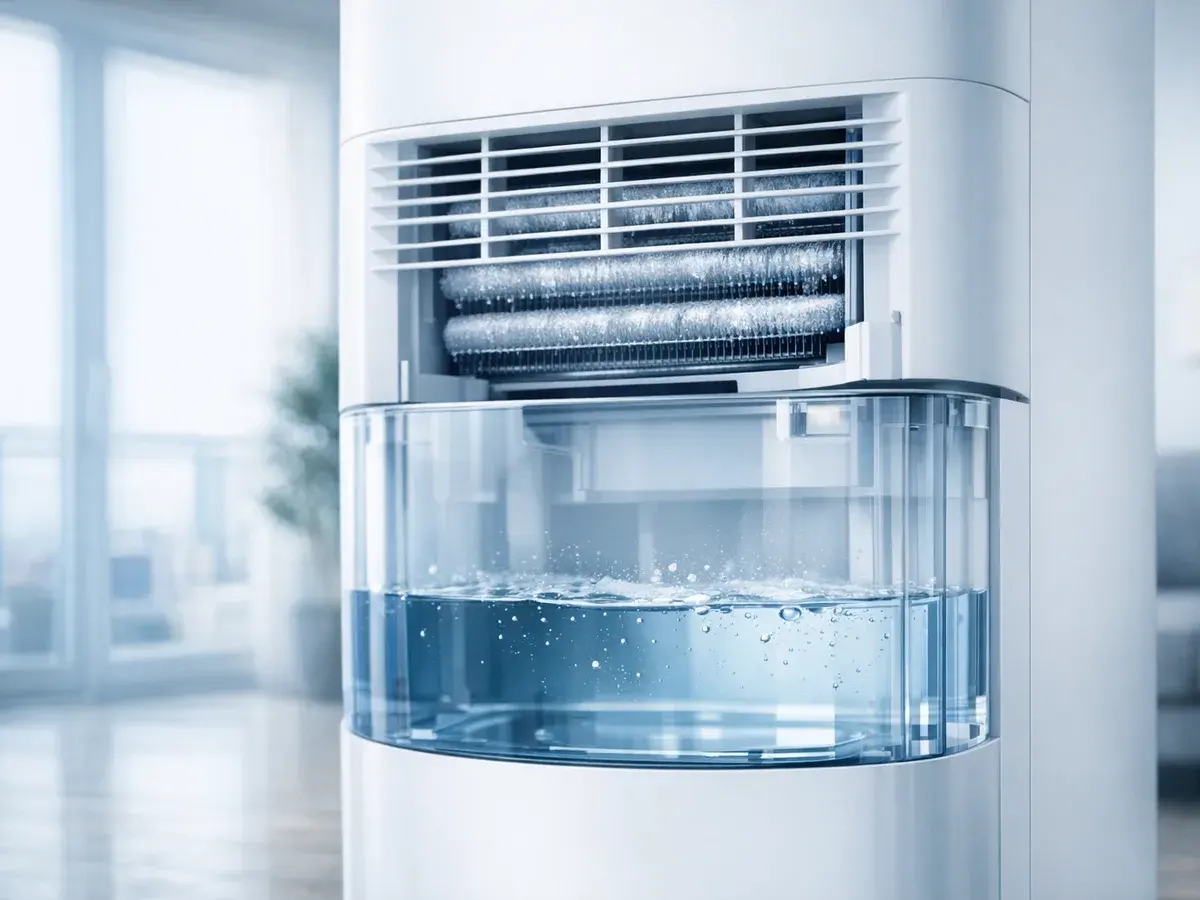
A condensation dehumidifier works like a small fridge. Damp air passes over an evaporator chilled below the dew point, water vapour condenses into droplets, the water drains to a tank or to the waste pipe, and the dry air returns to the room, slightly warmed by the condenser. It offers the best purchase-cost to result ratio as long as the room stays above roughly 15°C. Below that the coil starts to ice up, the defrost cycle eats energy and capacity can drop by half. For a flat, a study, a shop, a car showroom or a hall at room temperature — it is the first choice. In renovated Warsaw tenements and in 1970s blocks with new windows it solves around 80% of the problems we see. The standard outputs we work with are 12, 20, 30 and 50 litres per 24 hours. Larger 90–150 L/24h units go into warehouses, production halls and underground car parks.
Pros
Low purchase and running cost at room temperature
Quiet operation on modern inverter models
Easy service — filter and condensate drain
Reaches around 40% RH without effort
Cons
Capacity drops below 15°C
The defrost cycle pulls extra power in winter
Will not go below roughly 35% RH in typical conditions
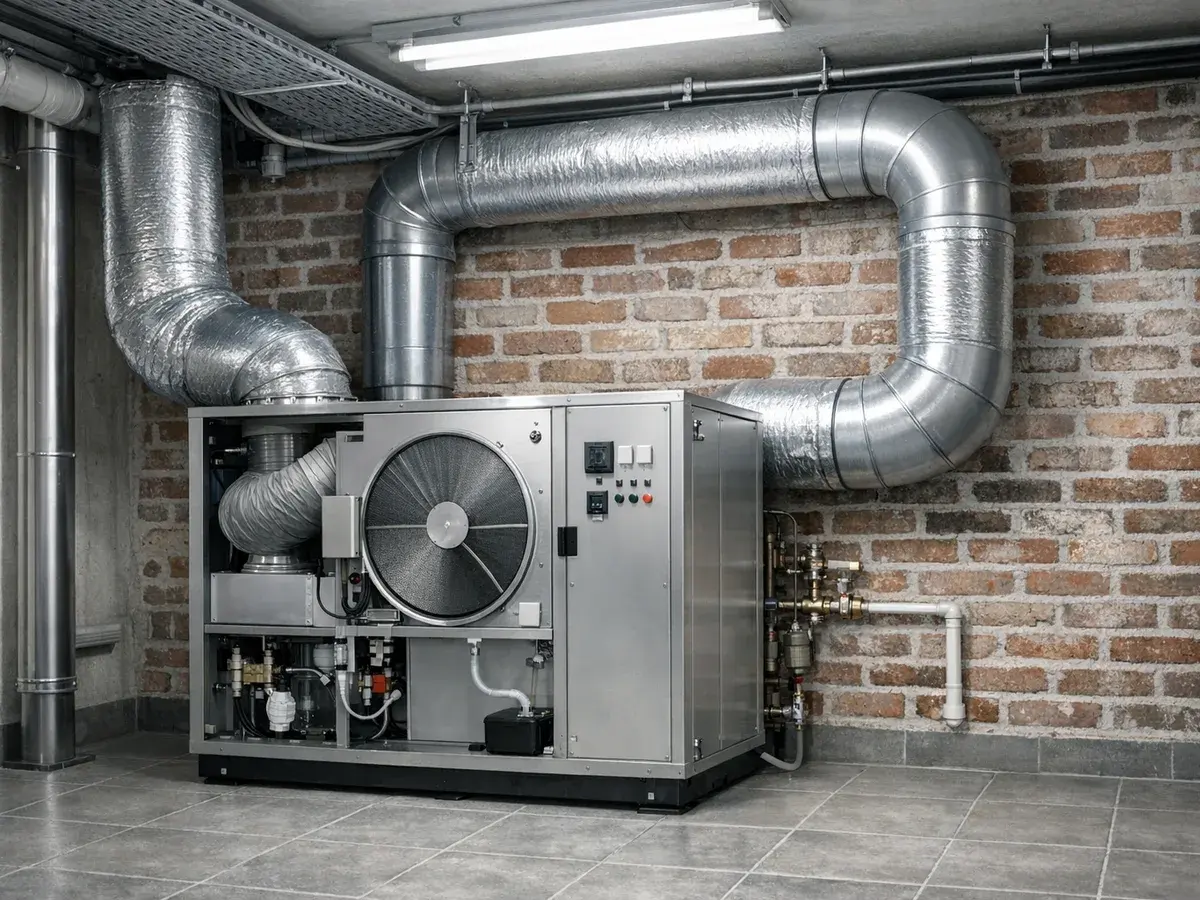
Instead of cooling the air, a desiccant dehumidifier uses a slowly rotating wheel of hygroscopic molecular sieve — most often silica gel or lithium chloride. Air passes through the rotor, water molecules bond to the sorbent and the dry air returns to the room. A second, smaller air stream is heated to 100–140°C and regenerates the rotor — it strips the moisture out and discharges it outside the building through a short duct. Desiccant has two clear advantages over condensation. First, it still works effectively at temperatures around zero, so it is the only sensible technology for cellars and archives. Second, it can take the humidity down to 20–25% RH where condensation stops at 35%. The trade-offs are higher electricity use for the regeneration heater and a louder fan. In Warsaw we install desiccant units most often in cellars of pre-war tenements, in archives at law and accounting firms, in electronics warehouses, in rooms with timber and plywood, and anywhere the winter temperature drops below 12°C while the client needs steady, low RH all year round.
Pros
Works effectively below 10°C
Drives RH down to 20% if needed
No refrigerant — simpler build to service
Low weight and easy to move on industrial models
Cons
Higher electricity use due to the regeneration heater
Needs an exhaust duct to the outside
Fan noise on industrial models
Ventilation + heating
Seasonal backup, natural air exchange
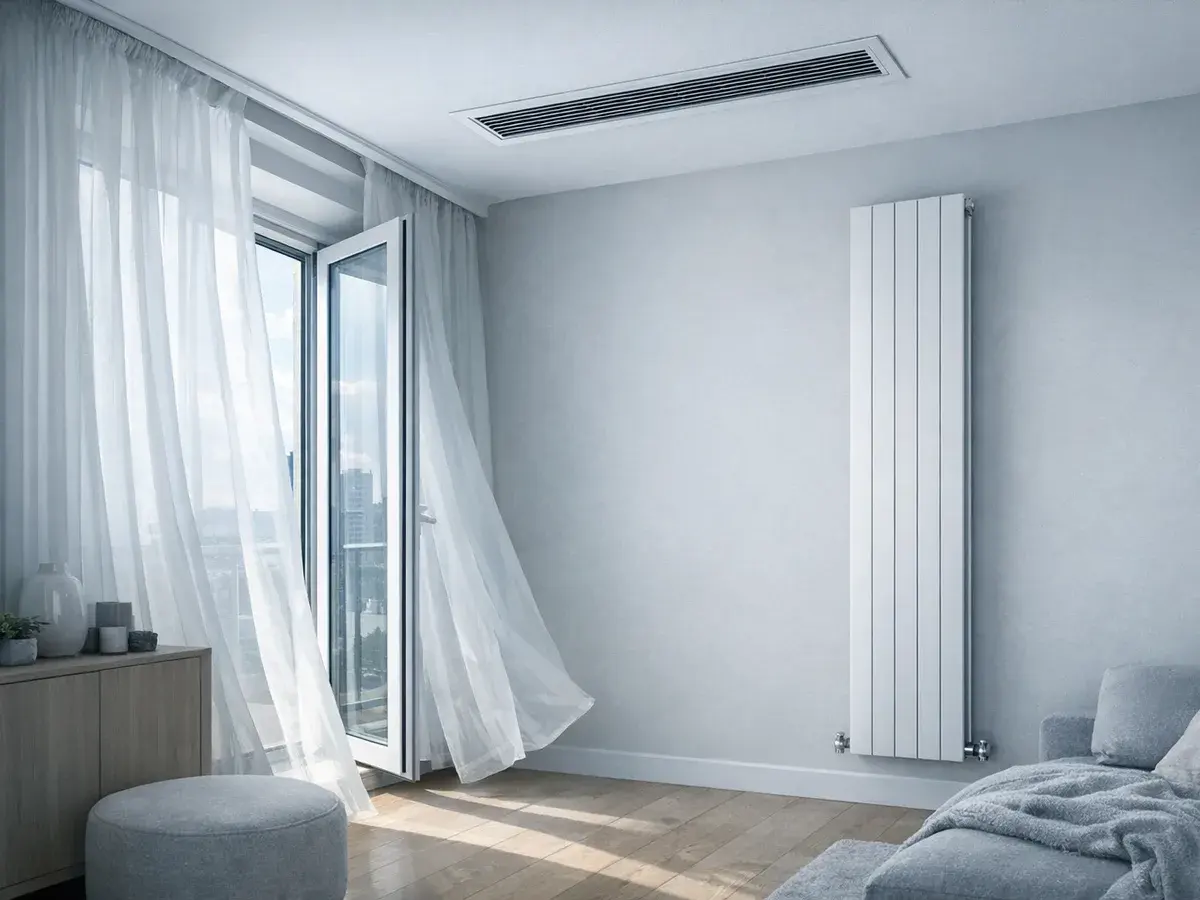
Sometimes you do not need a dehumidifier — you need proper air exchange and a few extra degrees. If the room has working passive ventilation and the indoor humidity is higher than outdoors, fresh air plus heating is enough. Warm air holds more water vapour, so lifting the temperature from 15°C to 21°C at the same absolute water content drops the RH from 80% to about 55%. It works as seasonal support — in two-person flats with low heating settings and in single-family houses with heat-recovery ventilation, where the HRV unit mixes the air and naturally evens out humidity. In Warsaw blocks after a window swap the gravity ventilation often dies — the flue stops drawing, the flat goes airtight, and moisture from occupants, cooking and showering stays trapped inside. The fix is usually to clear the inlet ventilation, perhaps add window trickle vents, and a dehumidifier becomes a supplement rather than the main answer. The survey decides which comes first — ventilation or the dehumidifier.
Pros
Often does not require new equipment
Natural, low-energy solution
Improves overall air quality, not just humidity
Cons
Only effective when outdoor RH is lower than indoor
Will not work in a cellar or warehouse in winter
Requires working ventilation — often has to be cleared first
Which method is for you? A scored comparison
Five criteria that actually decide how happy you are with dehumidification a year in. Scale 1–5, where 5 is best.
Metoda
Effectiveness
Running cost
Quiet operation
Low-temperature performance
Energy use
Condensation
4/5
4/5
4/5
2/5
4/5
Desiccant
5/5
3/5
3/5
5/5
2/5
Ventilation + heating
2/5
2/5
5/5
3/5
1/5
Condensation
Effectiveness
4/5
Running cost
4/5
Quiet operation
4/5
Low-temperature performance
2/5
Energy use
4/5
Desiccant
Effectiveness
5/5
Running cost
3/5
Quiet operation
3/5
Low-temperature performance
5/5
Energy use
2/5
Ventilation + heating
Effectiveness
2/5
Running cost
2/5
Quiet operation
5/5
Low-temperature performance
3/5
Energy use
1/5
Condensation: The best choice for flats and offices above 18°C. Inverter models run quietly and efficiently.
Desiccant: Stronger performance, lower achievable RH, works in cold rooms. You pay more for electricity and accept a louder unit.
Ventilation + heating: Fits cases where outdoor RH is lower than indoor. Cheap but limited — usually a supplement, not a standalone fix.
Device types
Fixed, portable or central?
The form factor of the unit shapes daily comfort as much as the technology behind it.
Fixed
A dehumidifier permanently wired to power and a condensate drain, usually with the hygrostat set to the healthy 45–55% band. It runs automatically, starts only when the humidity crosses the threshold and stops once the target is reached. This is the option for people who want to forget the problem — installed once, calibrated once, running quietly in the background for years. In Warsaw flats we most often install 20–30 L/24h units in a utility room, a hallway or a dedicated technical cupboard. In tenement cellars we use industrial 50–90 L/24h units with the condensate going straight to the floor drain.
Pros
Automatic operation via the hygrostat
Continuous condensate drain — no tank to empty
Lower electricity use under steady operation
Cons
Needs space and a drain connection
Higher installation cost
Portable
A wheeled unit with a condensate tank that you move wherever dehumidification is needed right now. Ideal for one-off jobs: after a flood, during a renovation, to dry out a fresh screed, to dehumidify a guest bathroom once a month. Also for single-family houses where you dehumidify the laundry today, the cellar tomorrow and the garage next week — one mobile unit covers all three. The downsides are emptying the tank every 12–24 hours (unless you connect a gravity hose to a drain) and louder operation, because these units are compact and use a smaller fan wheel.
Pros
Move it to wherever the problem is
No installation needed
Excellent for one-off jobs — floods, renovations
Cons
You have to empty the tank
Louder than fixed units
Central (integrated with HRV)
The top tier — a dehumidifier integrated with a mechanical heat-recovery ventilation unit. The air supplied to the rooms is dried at the HRV unit and you never see equipment anywhere. In single-family houses in Wilanów, Wesoła and around Warsaw we install Daikin, Komfovent and Salda HRV units with a dehumidification module. This solution has to be planned in at the ventilation design stage, but the payoff is no-fuss comfort: the whole building stays at uniform RH for twelve months of the year, with no unit in the living room and no duct sticking out in the cellar. Installation costs more, but day to day it works out cheaper than two fixed dehumidifiers, plus you get heat recovery from the exhaust air.
Pros
Hands-off — humidity managed centrally
No visible unit inside the rooms
Combines ventilation, heating, cooling and dehumidification
Cons
Highest installation cost
Requires a mechanical ventilation design
How we work
How we work — 7 steps from survey to aftercare
A clear process where every stage ends with a tangible deliverable on paper or a working unit on the wall.
1
On-site RH survey
We come within 48 hours of your call, walk the building from cellar to roof, listen to the story and ask the right questions — when did the mould appear, was there recent external insulation, were the windows replaced?
2
Humidity and dew-point reading
We measure RH, surface temperature, water-vapour pressure and dew point at several points. We locate the thermal bridges, the condensation hotspots and the leaks in the ventilation.
3
Capacity and method selection
We calculate the moisture balance, pick the technology (condensation, desiccant, ventilation) and the unit capacity. The client sees three priced options and a concrete time to reach 50% RH.
4
Installation and connection
We fit the unit, route the condensate drain to a floor drain or the waste line, install the outside exhaust duct for desiccant units, and connect power and controls.
5
Hygrostat calibration
We set the switching thresholds, the hysteresis and the operating modes. We test how the unit reacts to an open window, to a sudden change in weather and to night-time operation — so it runs quietly while you sleep.
6
Handover and instruction
We show the client the remote, the app (if the unit supports one), how to change the filter and how to spot the common faults. We hand over the warranty cards and the survey report.
7
24-month service care
For two years we keep an eye on the schedule. We remind you about filter changes, check the condensate drain, clean the evaporator. The client does not plan — we plan on their behalf.
Service scope
Service scope — included vs. extras
Included in the standard price
On-site RH survey
Humidity, temperature and dew-point readings at several points in the room with a written report.
Capacity and technology selection
Moisture balance, unit selection and three priced options with a time-to-50%-RH estimate.
Standard fixed installation
Mounting or placing the unit, connecting to a socket up to 3 metres away.
Gravity condensate drain
Routing the condensate hose to the nearest floor drain or waste line — up to 5 metres of run.
Hygrostat calibration
Setting the thresholds, hysteresis and operating modes, testing the response and walking the client through the controls.
24 months of service care
Service reminders, drain and filter checks in the first year, a service phone line during working hours.
Paid add-ons
Desiccant exhaust duct through the wall
Core drill and installation of the moist-air exhaust duct for a desiccant unit — priced individually after measuring the wall thickness.
Condensate pump
Installation of a quiet pump where gravity drainage is impossible — for example in cellars below the sewer level.
WiFi RH sensor with app
A wireless hygrometer with app readouts and push alerts when the threshold is crossed — for clients who like data.
Window trickle vents
Installation of humidity-controlled trickle vents in existing windows — a passive ventilation boost for blocks after window replacement.
Render renovation after mould
We work with a renovation firm — mould removal, renovation render, repainting. We project-manage the whole job.
Warsaw context
Warsaw context — four building types
Four kinds of buildings where the damp problem looks completely different and demands a different method.
01
Block of flats
Great-slab blocks from the 60s and 70s become airtight once the windows are replaced. Passive ventilation stops working, bathroom RH spikes to 90% after a shower, condensation forms on the window reveals and mould appears in the corners. The fix is a 20 L/24h condensation dehumidifier in the hallway plus a clear inlet ventilation path. In blocks from the 1990s and later a dehumidifier on its own is usually enough — the ventilation is in better shape.
02
Cellar and garage in a tenement
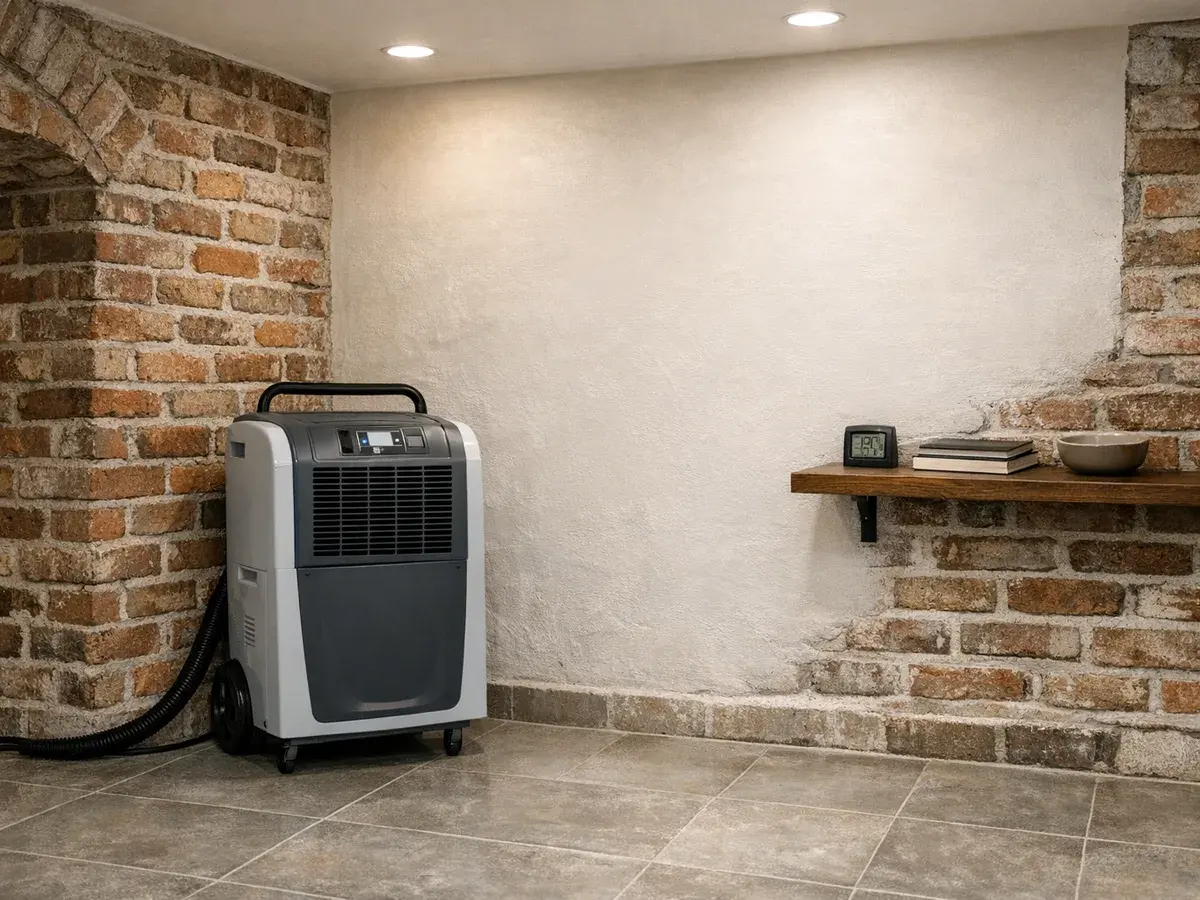
Pre-war tenements from the 1920s and 30s have no horizontal foundation damp-proof course. Moisture rises by capillary action several metres up the walls, the cellar drops to 4–8°C in winter and the RH passes 90%. Condensation will not work here — you need a 30–50 L/24h desiccant unit with an exhaust duct outside, usually through a side wall facing the courtyard. Sometimes a renovation render and mould removal join the job.
03
Warehouse or archive
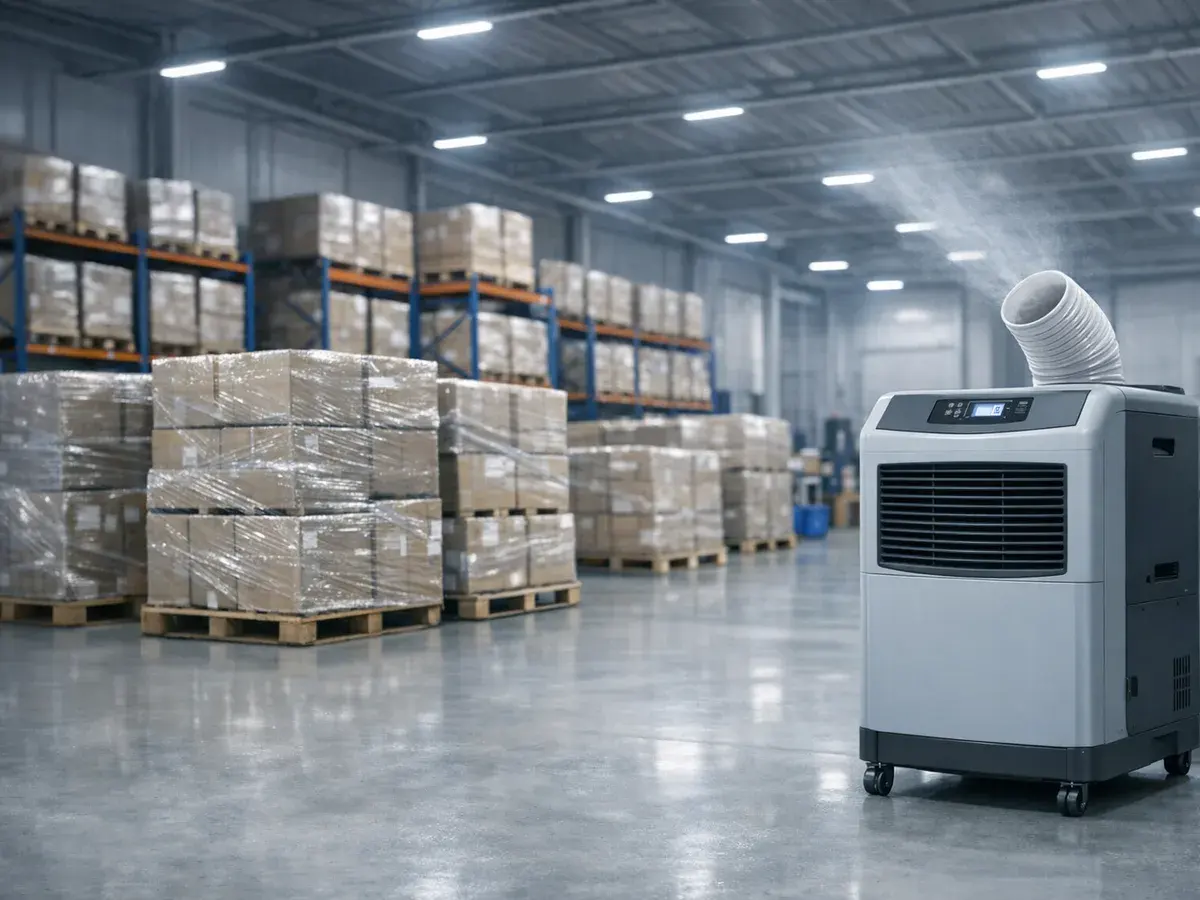
Warehouses on Targówek and in Włochy have large volumes, oversized doors that open several times a day and goods that are sensitive to moisture — electronics, documents, plywood. The job is to keep the RH in the 40–50% band for twelve months. We install 90–150 L/24h desiccant or condensation units, sometimes combining both technologies — desiccant in winter, condensation in summer.
04
Office and open-space
Warsaw offices have a different problem — dry in winter, damp in summer, plus a lot of people and equipment. A thirty-person open-space can hit 65–70% RH in July despite the air conditioning. The right answer is to integrate the dehumidifier with the mechanical ventilation — either a dedicated dehumidification module, or a 50 L/24h condensation unit on the return duct, controlled centrally from the BMS.
Capacity sizing
Dehumidifier sizing calculator
A quick indicative sizing of the unit. The exact capacity is confirmed during the on-site RH survey.
Suggested capacity
8
L / 24h
An indicative figure. In rooms with moisture rising from the ground or heavy air exchange, the actual capacity needed to hold 50% RH may be 20–40% higher.
Four projects that show how different dehumidification looks in a flat, a cellar, a warehouse and a house with heat recovery.
Stara Praga
Cellar of a 1932 tenement
A cellar with brick-and-timber walls and capillary damp rising from the ground. RH 92%, temperature 6°C. We installed a 50 L/24h desiccant dehumidifier with an exhaust duct through the wall to the courtyard. After six weeks the RH had dropped to 55% and the mould on the walls stopped spreading.
Targówek
Warehouse with electronics
An 800 m² hall storing electronic components. The brief was to hold RH below 50% for twelve months. We installed two 90 L/24h condensation dehumidifiers on the ventilation return duct, controlled centrally. Steady 45% RH confirmed in a follow-up survey one year later.
Mokotów
600 m² office on the third floor
An open-space for forty people; summer RH hit 68% despite VRF air conditioning. We integrated a 50 L/24h condensation dehumidifier with the mechanical ventilation return and added RH sensors in three zones. The RH now settles in the 45–52% band and the air conditioning has stopped getting overloaded during heatwaves.
Wilanów
House with a heat pump and mechanical ventilation
A new 280 m² house with a Komfovent HRV unit. The client reported humidity swings between 35% in winter and 65% in summer. We added a dehumidification module to the ventilation unit and set the hygrostat to 50%. The RH stays in the 45–55% band all year, with no equipment in the living room.
Brands
Brands we work with
We work with dehumidifiers we know from day-to-day installation and service — Aerial, Trotec, Master, Cotes, Munters, Fral, Mitsubishi. We recommend the brand and model that fit the room, the budget and your expectations.
Brands We Work With
Authorized service and installation
After the install
Warranty, service and aftercare
On the dehumidifiers we install we pass on the manufacturer warranty — usually 24 months, on selected industrial models up to 60 months. On the installation and calibration itself we offer a written 24-month warranty. We track the service schedule for you — SMS reminders every six months for the filter change, and once a year we check the condensate drain, clean the evaporator or replace the desiccant rotor.
24 months
warranty on every dehumidifier we install
Warranty, service and aftercare
24–60-month manufacturer warranty
Depending on the model and the brand — industrial kit usually comes with 36 months, consumer portable units with 24.
Written warranty on the work
24 months on the installation, calibration and condensate routing — separate from the manufacturer's warranty on the unit.
Service reminders
An SMS before each filter change and before the annual service — the client does not have to track the calendar.
Filter and rotor replacement
We work with original manufacturer filters. On desiccant units we replace the rotor every 3–5 years depending on duty cycle.
12-month warranty on out-of-warranty repairs
Every post-warranty repair carries a 12-month warranty on the replaced parts and the work performed.
Seasonality
Warsaw humidity month by month
Average outdoor RH in Warsaw together with practical tips on what to watch for each month.
January
85%
Frosts and dry outside air can drop indoor RH to 30%. Switch the dehumidifier off, and consider a humidifier in the bedroom.
February
82%
The coldest month — the dew point on external walls comes close to the surface temperature. Check the corners.
March
78%
Thaw and capillary rise in cellars. Run the desiccant in the cellar for a full week.
April
72%
The best time for an RH survey — temperature and humidity are close to the annual averages, so readings are representative.
May
68%
Time to swap dehumidifier filters after the heating season. Check the condensate drain before summer.
June
70%
The first heatwaves — bathroom RH spikes after a shower. Hygrostat at 55% and check the bathroom ventilation.
July
72%
Peak summer. The cellar dehumidifier runs flat out — this is when most of the condensate is produced.
August
74%
Storms and heavy rain. Check the cellar windows for leaks and the rainwater drains around the foundations.
September
78%
A transition month — temperature drops, humidity climbs. Time for a second RH survey if you skipped the spring one.
October
83%
The heating season starts — radiators dry the air out, but not everywhere. Keep the hygrostat on in the bathroom.
November
88%
The worst month for mould — outdoor moisture meets low surface temperatures. Run everything you have.
December
89%
Fog and smog. Cut back on window ventilation but do not stop it — the dehumidifier takes over as the RH regulator.
Glossary
12 terms worth knowing
A short glossary of dehumidification, building-physics and ventilation terms — in plain language, no jargon.
Dew point
The temperature at which water vapour in the air starts to condense. When the surface temperature of a wall drops below the dew point, dew appears — and, in time, mould.
Relative humidity (RH)
The ratio of water vapour in the air to the maximum the air can hold at that temperature. The healthy band for a flat is 45–55%.
Hygrometer
An instrument for measuring air humidity. A good calibrated digital hygrometer costs 200–400 PLN and is the basic tool for every RH survey.
Hygroscopicity
A material's ability to absorb moisture from its surroundings. Hygroscopic materials include wood, paper and gypsum plaster — anything that softens or swells in damp rooms.
Sorption
The process where a porous substance (the sorbent) binds water molecules from the air. Used in desiccant dehumidifiers — most often silica gel or lithium chloride.
Adsorption
The binding of water molecules onto the surface of a sorbent — without penetrating its structure. Reversible, which is why the rotor in a desiccant unit can be regenerated with heat.
Absorption
The penetration of water molecules deep into the sorbent material — for example into a solution of a hygroscopic salt. More common in industrial use than in domestic units.
Hygrostat
A humidity sensor that controls the dehumidifier. It starts the unit once RH crosses the threshold and stops it when the target is reached. The single most important component for comfortable operation.
Condensation
The change of water vapour into liquid water. In a condensation dehumidifier, controlled condensation on a cooled evaporator is the core of how it works.
Evaporator
The heat exchanger in a condensation dehumidifier where water vapour turns into droplets. Cooled below the dew point.
Refrigerant
The gas circulating through the refrigeration circuit of a condensation dehumidifier — most often R290 (propane) or R32. It cools the evaporator.
Heat-recovery ventilation
Mechanical ventilation with heat recovery. Exhaust air transfers its heat to the incoming supply air, and a dehumidification module can be integrated into the same unit.
Frequently asked questions about air dehumidification
Concrete answers to the questions we hear most often during surveys in Warsaw.
Does a dehumidifier use a lot of electricity?
A typical 20 L/24h condensation dehumidifier draws 300–400 W, which means running an average of 8 hours a day it uses around 90 kWh a month — 70–90 PLN at current rates. Desiccant units draw more — 500–800 W because of the regeneration heater. Inverter condensation models can cut consumption by up to 40%, because they modulate power instead of cycling on and off.
How quickly will I notice the effect?
The first sign — a 5–10 percentage-point drop in RH — is visible after 6–12 hours of operation in a typical flat. Pulling a 30 m² room from 75% to 50% takes 2–3 days of continuous operation. In a cellar with capillary moisture rising from the ground it is slower: 4–8 weeks to a stable 55–60% RH, after which the unit only ticks over in maintenance mode.
Does dehumidification help with allergies and asthma?
Yes, significantly. Dust mites and mould are the two biggest allergens you find in flats — and both need RH above 60% to thrive. Holding RH in the 40–50% band practically stops them reproducing, and allergic household members usually notice an improvement within 2–3 months. Pulmonologists routinely tell patients to control bedroom humidity.
What if the RH drops too low?
Air that is too dry (below 35%) is the other end of the problem — dry mucous membranes, dry eyes, charged-up furniture. Every unit we install is configured with a hygrostat that does not let RH fall below 45%. In winter, when heating dries the air on its own, we sometimes switch the dehumidifier off for the whole season — or, in extreme cases, fit a humidifier in the bedroom.
Dehumidifier or air conditioner — which one?
An air conditioner dehumidifies as a by-product of cooling — but only when it is cooling. It works in summer, not in winter. A dehumidifier runs twelve months a year and does not have to cool the room. If your problem is moisture after a shower and cooking, the air conditioner's dry mode is enough. If the problem is the cellar, a warehouse or a flat after deep insulation work, you need a dedicated dehumidifier.
Is a dehumidifier loud at night?
Modern inverter condensation dehumidifiers run at 38–45 dB — quieter than a fridge. That is acceptable in a bedroom, although we suggest placing the unit in the hallway or utility room and only running the RH sensor to the bedroom. Desiccant units are louder — 50–60 dB — and do not belong in sleeping rooms, but they work brilliantly in a cellar beyond the living space.
How often does a dehumidifier need service?
The pre-filter is cleaned or replaced every 3–6 months depending on dust levels. Once a year we recommend a full check: the evaporator, the refrigeration circuit, the condensate drain and the hygrostat calibration. On desiccant units the rotor is replaced every 3–5 years depending on duty cycle. We send SMS reminders, so the client does not have to track it.
What does the full job cost?
The RH survey with a written report is 350 PLN — free of charge if the client books the dehumidification with us. A standard fixed 20–30 L/24h condensation installation with condensate drainage is 600–900 PLN. A desiccant unit with an exhaust duct through the wall: 1,200–1,800 PLN. The dehumidifier itself is an additional 1,800–4,500 PLN depending on brand and capacity. After the survey you get a concrete quote.
Do you install in tenements under conservation protection?
Yes, regularly. In Śródmieście, Praga and Mokotów many tenements are listed. We design the desiccant exhaust duct to pass through a wall facing the courtyard rather than the street, and to be as discreet as possible. Where the procedure requires it, we file an application with the conservation officer — we have experience writing those technical submissions.
How long does the installation take?
A standard fixed dehumidifier install with condensate drainage takes 2–3 hours. A desiccant install with an exhaust duct through the wall takes 4–6 hours including the core drill. A portable unit needs no installation as such — we bring it in, plug it in, calibrate the hygrostat and we are done within 30 minutes. We fit the appointment to you — evenings and Saturdays included.
What if the mould is already there?
A dehumidifier on its own will not remove existing mould — it will stop it spreading, but the dead spores on the wall remain. In those cases we first mechanically remove the mould with a fungicide, then apply a renovation render or an anti-mould coating, and only then install the dehumidifier to prevent a return. We partner with a renovation firm and can quote the whole job.
Do you guarantee the result?
Yes — our contract guarantees RH at or below 55% in a residential room within 14 days of installation, provided the windows stay closed and there is no leak from the water installation. For cellars the window is 6 weeks, for warehouses 4 weeks. If the unit does not hit the target, we swap it for a higher-capacity model at no extra cost.
Which Warsaw districts do you cover?
All 18 districts of Warsaw and the surrounding towns within 30 km of the city limits — Piaseczno, Konstancin, Józefów, Wesoła, Radzymin, Marki, Łomianki, Pruszków, Piastów. Inside Warsaw we usually survey on the same working day or the next; for the surroundings allow up to two working days.
Can you invoice a company with VAT?
Yes. We issue 23% VAT invoices and work with sole traders as well as large firms. We have experience with warehouses, law-firm archives and corporate offices. Payment by bank transfer with 14-day terms, or cash or card on the day of installation. For corporate orders above 10,000 PLN we sign framework agreements with a scheduled inspection plan.
We come within 48 hours, measure the humidity and dew point, hand over a written report and a concrete quote. The survey is free if you book the dehumidification with us.