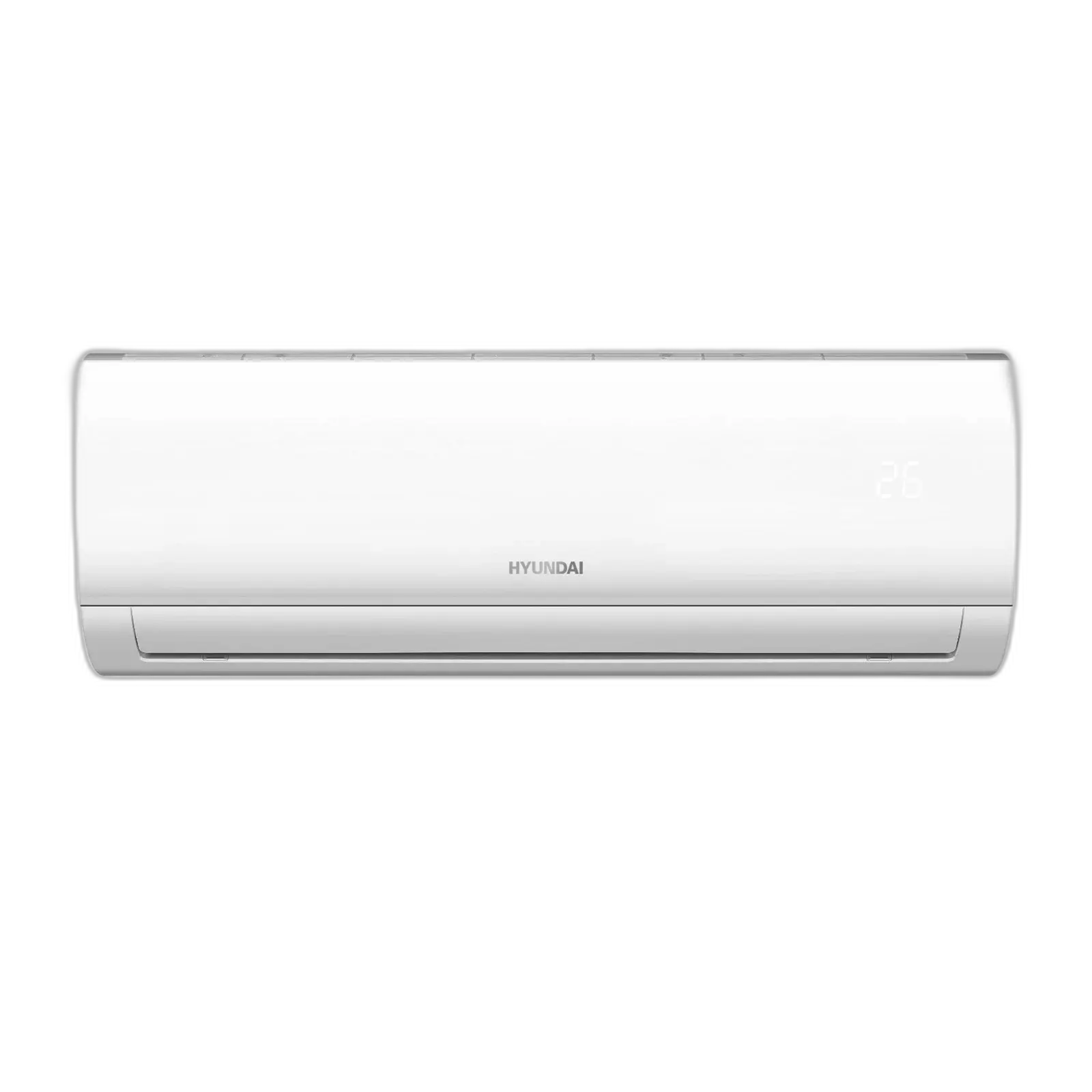
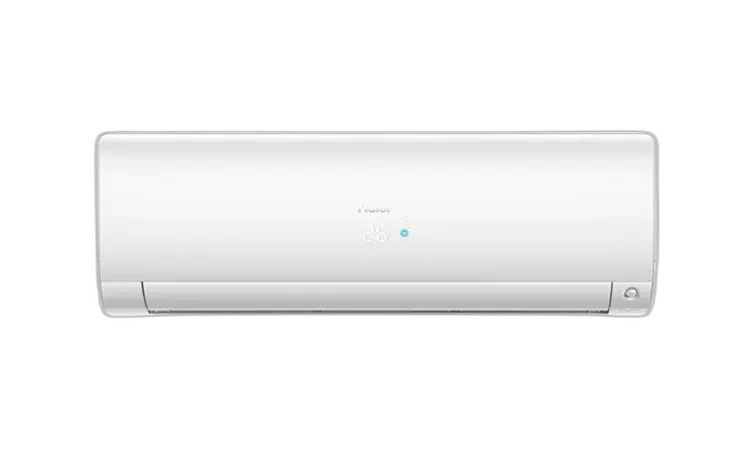
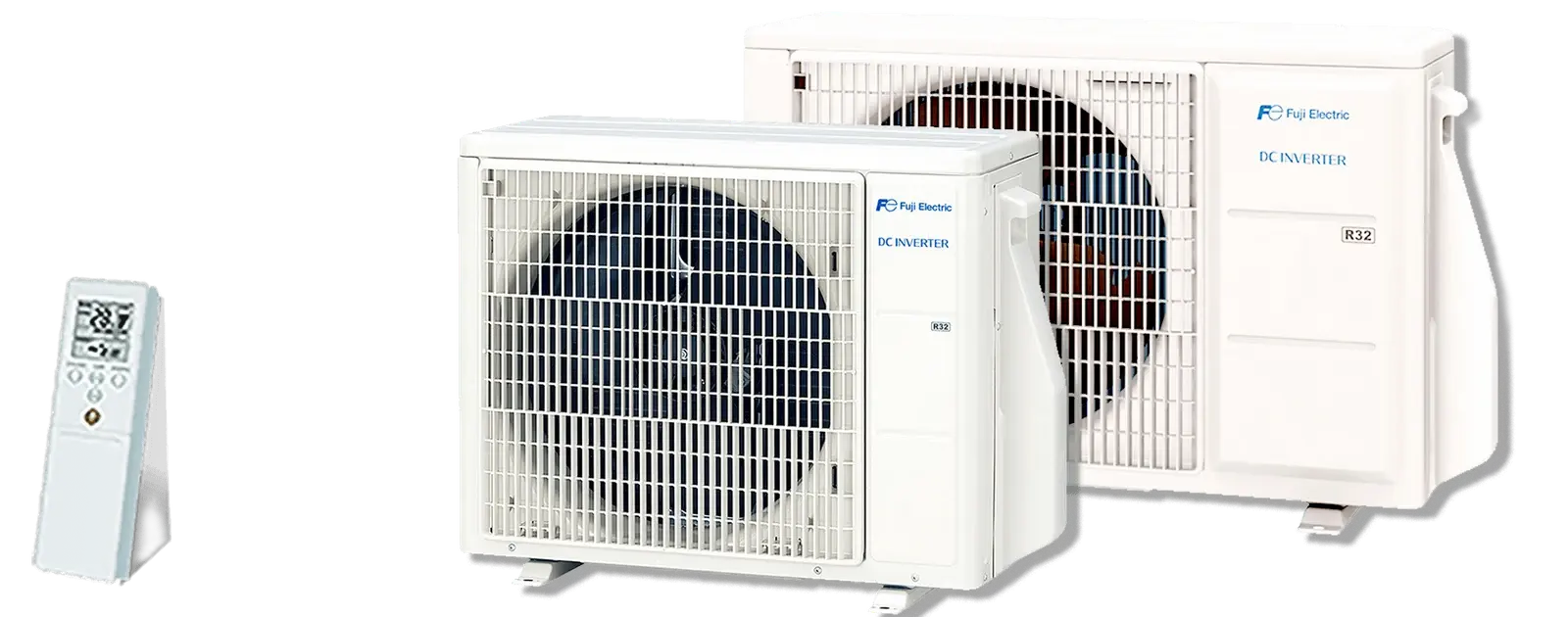
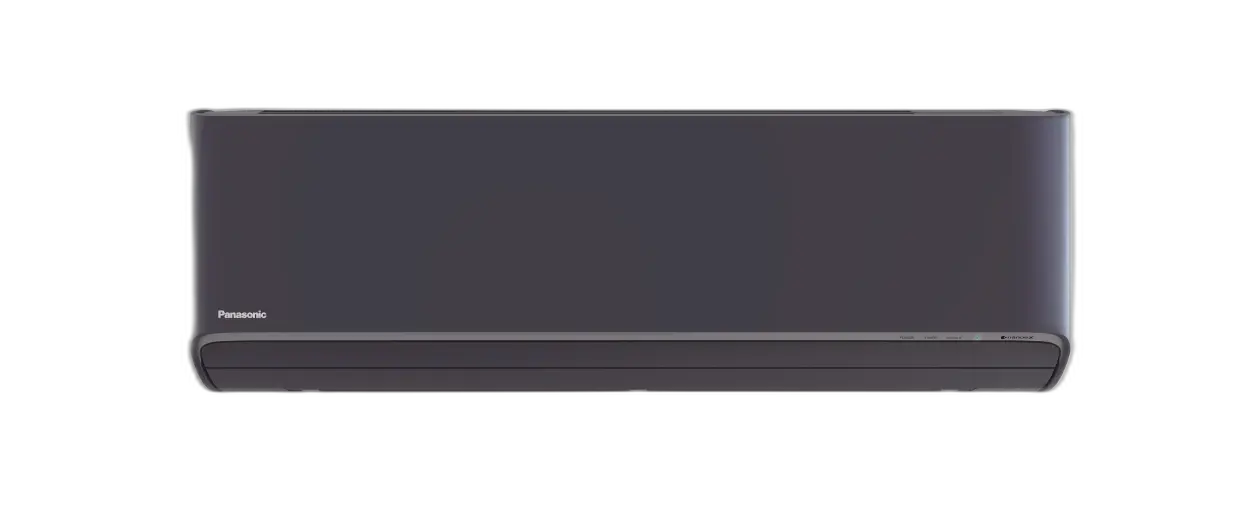
Air conditioning with heating — air-to-air heat pump down to -25°C
We size and install heat-pump air conditioners that genuinely warm a Warsaw flat even when it is -20°C outside. Hyper Heating, DC inverter, COP 4–5 in typical heating months — cheaper than gas, cleaner than an electric heater, ready to work with PV. Full thermal audit, design, installation and service from a single number.
heating installations in Warsaw and the surrounding area
Why heat with AC
Air conditioning with heating — why Warsaw residents are switching from gas and electric heaters
An air conditioner with heating function is not a compromise or an emergency element — it is a fully fledged air-to-air heat pump that, in the Warsaw heating season, delivers 3–5 times more heat energy than it draws from the socket. In practice every 1 kWh of electricity gives you 3–5 kWh of heat in the living room. No other heating source available to a typical flat on Puławska, Marszałkowska or in Wilanów has this kind of cost arithmetic.
There are several reasons why customers in Warsaw choose a heat-pump air conditioner, and they all come down to numbers. First — the electricity tariff is far more stable today than the price of gas, and for homes with PV it is practically free from March to October. Second — installing the AC takes one day and requires no chimney, no boiler, no tank and no water installation design. Third — the same unit cools in summer, so you buy one device and use it 12 months a year. AC with heating is the only piece of HVAC equipment that pays back not only in energy but also in comfort.
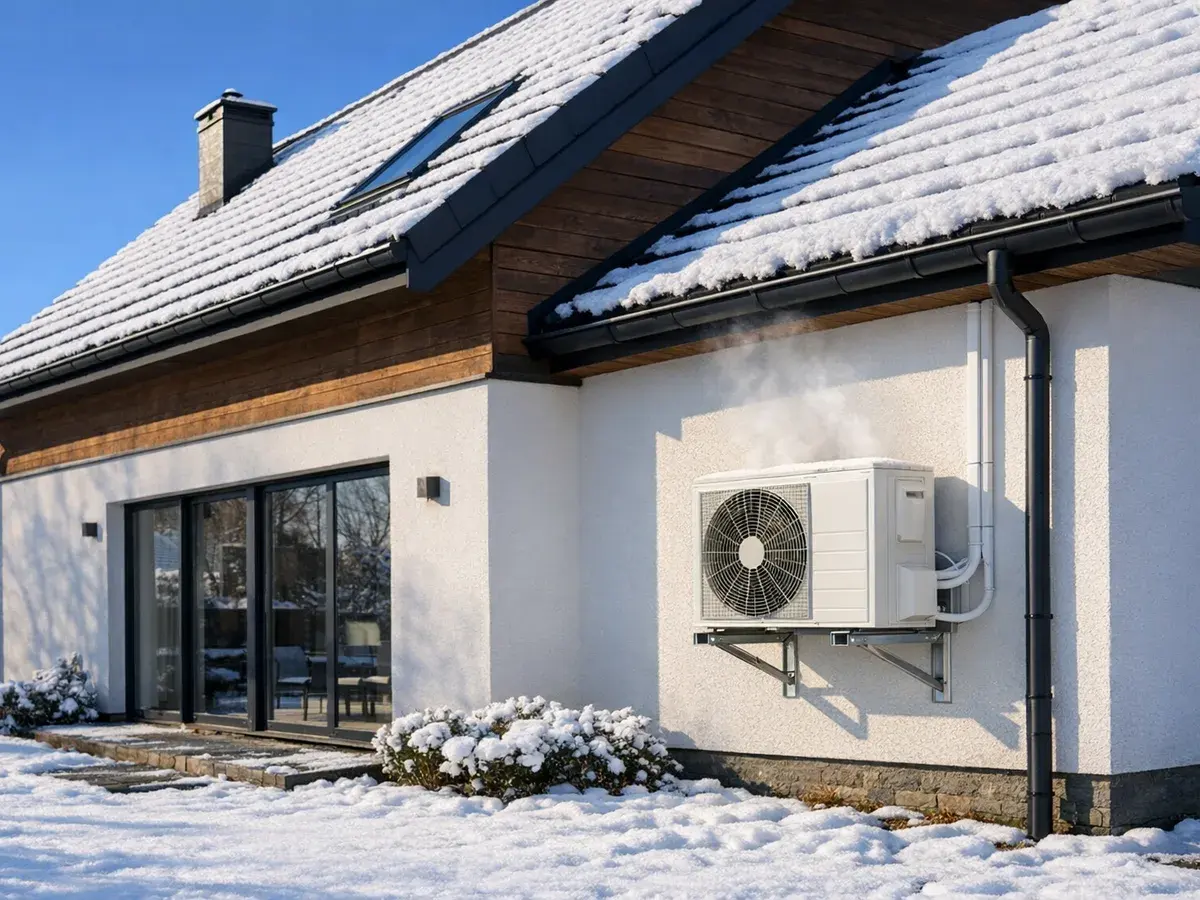
The most common myth — 'AC won't heat at -15°C' — is simply no longer true. A heat-pump air conditioner with Hyper Heating technology (Mitsubishi Electric, Daikin Bluevolution, LG Therma V Heating) maintains full heating capacity down to -15°C and can run down to -25°C without shutting off. Entry-level inverter models cope down to -10°C — and that covers 95% of Warsaw winters in the last ten years, with an average January of -2°C. -20°C frost in Warsaw happens 2–4 days per season, and even then a modern air conditioner keeps heating, just at a lower COP.
At LeoKlima we do not sell AC units from a brochure. We start with a thermal audit of the flat or house — we calculate the heat demand, check the insulation, assess window exposure, analyse the electricity tariff. Only then do we size the capacity and choose the model. In a 60 m² flat in Mokotów a single 3.5 kW split for heating is usually enough. In a 150 m² house in Białołęka we work with a 5+1+1 kW multisplit or a ducted system above the ceiling. Every decision is justified in numbers, and the client receives a report comparing four heat sources — AC, gas, electric heater and an air-to-water heat pump.
SCOP 4.5average seasonal coefficient of a modern heat-pump air conditioner in the Warsaw climate
-25°C
minimum Hyper Heating operating temperature
Why us
What you get that a high-street AC shop cannot give you
A shop will sell you an AC. We size the heating capacity to the real heat losses of your flat and take responsibility for it being warm in winter.
01
Thermal audit before the quote
We arrive with a surface thermometer, an anemometer and a thermal camera. We measure the real heat losses through walls, windows, balcony, roof (if a house). The result: specific heat demand in kW for each room. Without it, sizing a heat-pump air conditioner is guesswork, and an underestimate by 1 kW means the flat will not reach 22°C in January.
02
Hyper Heating where it is needed
We do not push expensive Hyper Heating models on everyone if they are not necessary. In a renovated Downtown tenement a standard Haier or AUX inverter is enough. In a house outside Warsaw, where the temperature can drop to -22°C, we install a Mitsubishi MSZ-LN with a guarantee of full capacity down to -15°C. The decision is based on the climate zone and the real lows of the last 10 winters, not on a catalogue.
03
Comparison of four heat sources
Every client gets from us a table with operating costs of heat-pump AC, a gas boiler, an electric heater and an air-to-water heat pump — for their specific flat, tariff and climate. These are financial data, not marketing — and it often turns out that Hyper Heating AC beats an air-to-water heat pump on small areas up to 90 m².
04
Experience with Warsaw specifics
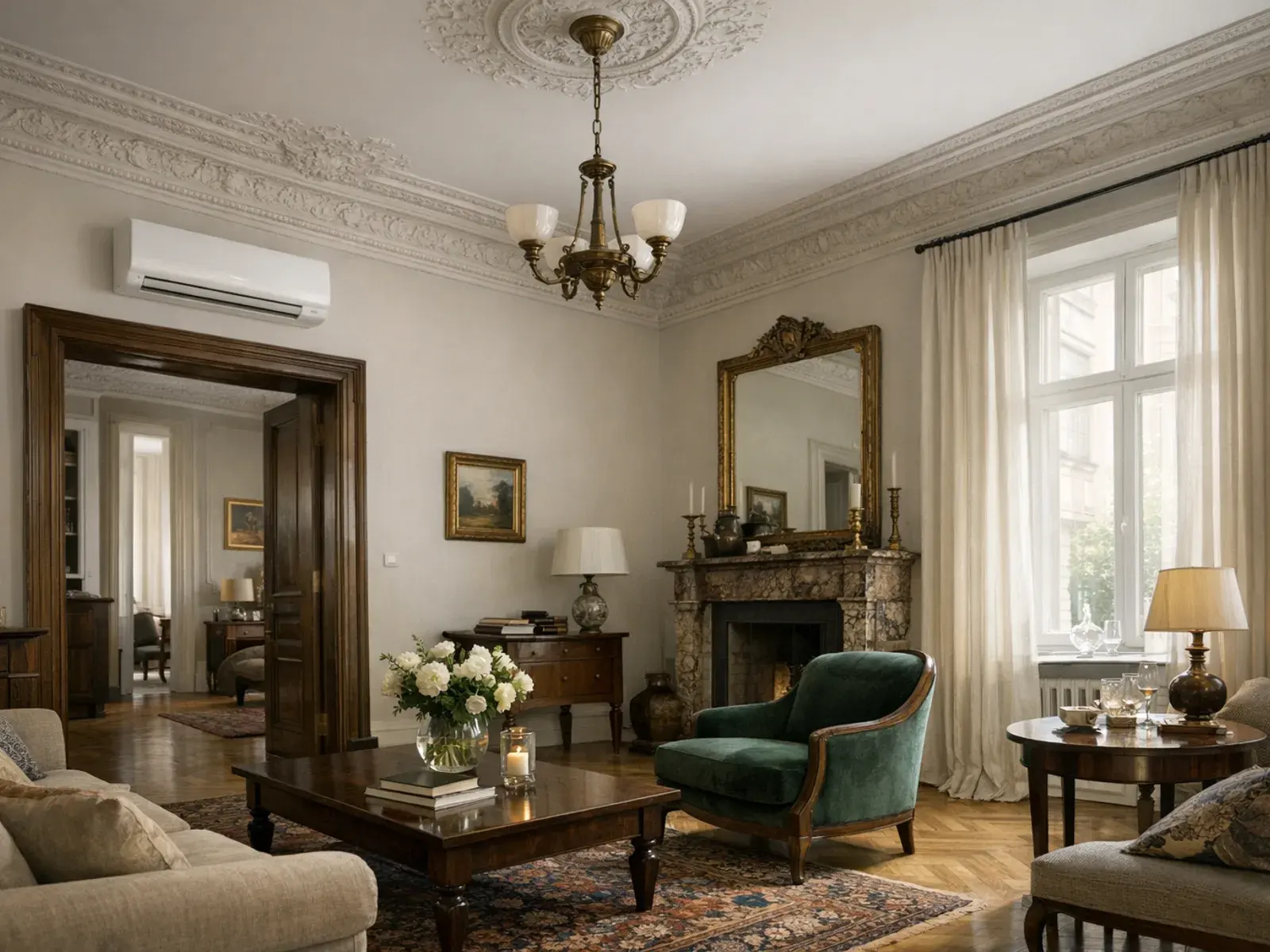
We have installed heat-pump air conditioners in pre-fabricated blocks in Ursynów, in heritage tenements in Downtown, in new apartments in Wilanów and in detached houses in Wesoła, Marki and Łomianki. We know where the heritage officer will say 'no' to a unit on the front elevation and how to hide it on a balcony or in a ventilation shaft.
05
Integration with photovoltaics
If you have PV, a heat-pump air conditioner is the best way to raise self-consumption. In March, April and October the panels produce surpluses that the washing machine and fridge cannot absorb alone — the AC in heating mode can 'soak up' the excess and turn it into free heat. We configure controllers that switch heating on automatically when PV production exceeds a threshold.
06
Service and a guarantee on the result
We give a 5-year warranty on the equipment (Mitsubishi, Daikin, LG) and a 5-year written warranty on the installation. During the first winter we carry out a results check — we verify that the COP in the cold matches what we promised in the contract. If not, we adjust the settings or replace the unit at no extra charge. You won't find this at any equipment wholesaler.
Technology
How does air conditioning with heating mode work?
Every heat-pump air conditioner is an air-to-air (A2A) heat pump. It works on the same principle as a fridge, only in reverse: the refrigerant (R32 in 95% of new units) takes heat from the outdoor air, gets compressed and heated in the compressor, and in the indoor unit releases heat into the room. The magic is that -10°C outdoor air is still 'plenty of heat' for thermodynamics — absolute zero is -273°C, and even on a frosty day in Warsaw the air contains huge amounts of energy that simply need to be compressed and transferred.
The COP (Coefficient of Performance) tells you how many kWh of heat you get for 1 kWh of electricity. At an outdoor temperature of +7°C a good heat-pump air conditioner reaches a COP of 4.5–5.0. At 0°C — 3.5–4.0. At -10°C — 2.5–3.0. At -20°C — 1.8–2.2. Note: even in frost the AC still has COP > 1, which means it is cheaper than a plain electric heater that by definition has COP = 1. That is why a heat-pump air conditioner beats every resistive heating method outright — even in record Warsaw frost.
SCOP (Seasonal COP) is the weighted average COP for the whole heating season in a given climate. For the Average climate zone (which covers Warsaw and nearly all of Poland) the SCOP of the best Hyper Heating models is 5.0–5.1. Standard entry- and mid-range inverter models — 3.8–4.3. This is the figure that really counts when estimating annual heating costs — and the one you should compare with the efficiency of a gas boiler (typically 0.90–0.95 for a condensing boiler).
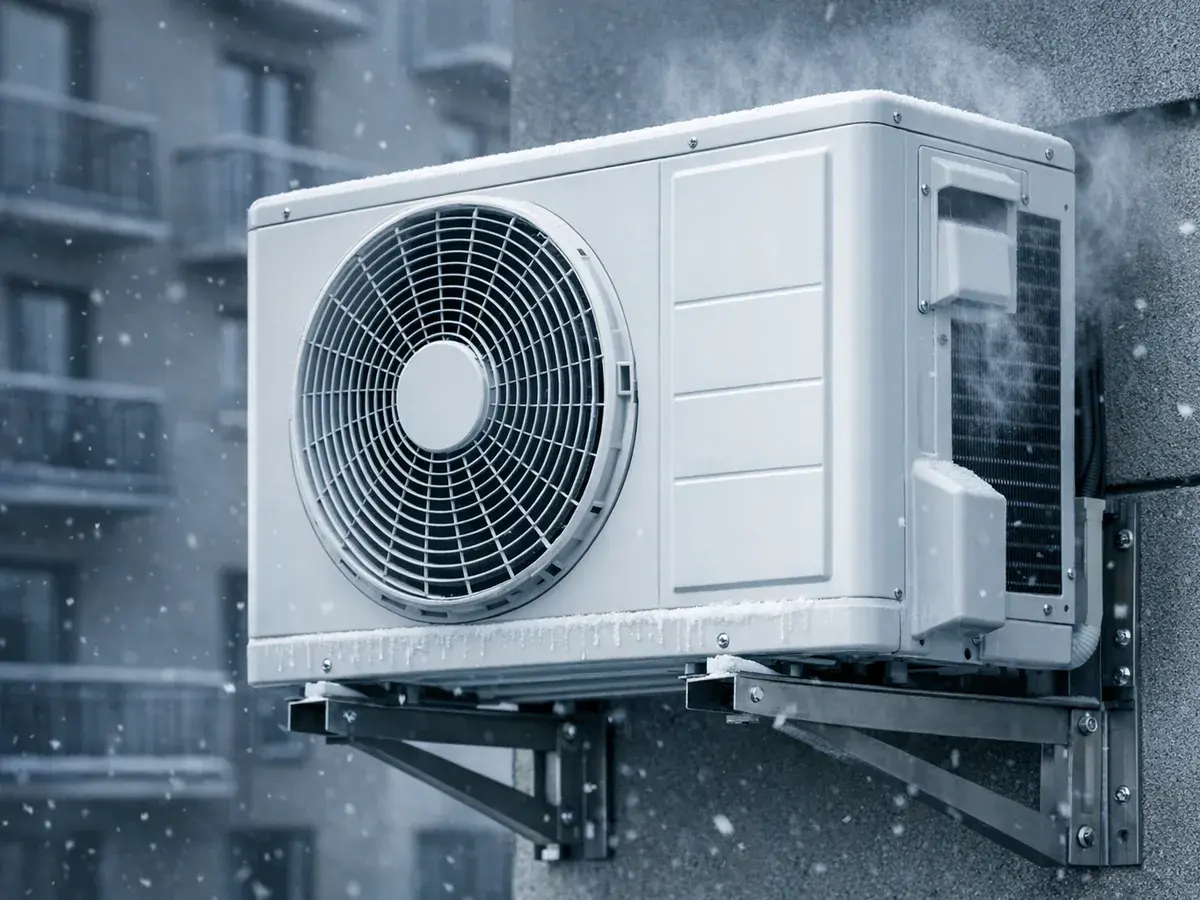
Hyper Heating technology in a heat-pump air conditioner is not marketing but a set of concrete technical solutions: increased compressor displacement, second refrigerant injection, intelligent oil distribution, oil-sump heater, larger heat exchangers. The effect: full nominal heating capacity maintained down to -15°C (instead of a typical drop to 60–70% at 0°C in standard models) and operation down to -25°C without shutdown. In Warsaw Hyper Heating makes sense for detached houses and top-floor flats with large northern exposure. In an ordinary block flat a good inverter is usually enough.
COP
Coefficient of Performance — the ratio of heating output to the electrical input drawn at a given moment. COP 4 means that for 1 kW of electricity you get 4 kW of heat. The value changes with outdoor temperature.
SCOP
Seasonal Coefficient of Performance — averaged COP for the whole heating season in a given climate zone. For Warsaw the SCOP in the Average zone matters. The best heat-pump air conditioners reach SCOP 5.0–5.1.
Hyper Heating
Air-to-air heat pump technology that holds full heating capacity down to -15°C and operation down to -25°C. Introduced by Mitsubishi Electric, also used in premium Daikin and LG models.
A2A (air-to-air)
Air-to-air heat pump. The refrigerant collects heat from the outdoor air and releases it directly into the indoor air — no water, no radiators, no hydraulic installation.
DC inverter
A compressor with stepless speed regulation driven by direct current. Instead of cycling on and off, it matches its output to current demand. Electricity consumption is 30–40% lower than in on/off models.
BTU
BTU (British Thermal Unit) — a unit of thermal energy. 1 BTU/h ≈ 0.293 W. Air conditioner capacity is often given in BTU/h; e.g. 12,000 BTU/h ≈ 3.5 kW. Standard in US and Asian catalogues.
What does SCOP mean and how do you pick the right heating capacity?
Comparison of the Hyper Heating and standard DC inverter curves. Numbers based on manufacturer laboratory data (Mitsubishi MSZ-LN, Daikin Perfera, LG Standard Inverter), rounded to one decimal place.
Hyper Heating
Standard inverter
typowa zima w Warszawie (-5 do -15°C)
Indicative values for air with 70% relative humidity. The real COP depends on the model, load and indoor temperature setting. In the Warsaw heating season you most often operate in the -5°C to +10°C range — there the gap between Hyper Heating and a standard inverter is typically 0.5–0.8 COP points.
Heat source comparison
Heat-pump AC vs gas vs electric heater vs air-to-water heat pump
Four real alternatives for heating a Warsaw flat or house, assessed across five dimensions that actually decide your satisfaction after five years of use.
Źródło ciepła
Installation cost
Operating cost
CO₂ emissions
Quiet operation
Reliability at -20°C
Hyper Heating AC
3/5
5/5
5/5
4/5
4/5
Condensing gas boiler
4/5
3/5
1/5
3/5
5/5
Electric heater (resistive)
5/5
1/5
2/5
5/5
5/5
Air-to-water heat pump
2/5
5/5
5/5
4/5
4/5
Hyper Heating AC
Installation cost
3/5
Operating cost
5/5
CO₂ emissions
5/5
Quiet operation
4/5
Reliability at -20°C
4/5
Condensing gas boiler
Installation cost
4/5
Operating cost
3/5
CO₂ emissions
1/5
Quiet operation
3/5
Reliability at -20°C
5/5
Electric heater (resistive)
Installation cost
5/5
Operating cost
1/5
CO₂ emissions
2/5
Quiet operation
5/5
Reliability at -20°C
5/5
Air-to-water heat pump
Installation cost
2/5
Operating cost
5/5
CO₂ emissions
5/5
Quiet operation
4/5
Reliability at -20°C
4/5
Hyper Heating AC: Cheapest to run, fastest to install, also cools in summer. Requires sensible insulation and space for the outdoor unit.
Condensing gas boiler: Proven standard in houses with natural gas. Operating cost in 2025 visibly higher than AC. Requires a chimney, design, gas fitter and annual inspections.
Electric heater (resistive): Simplest installation, highest operating cost (COP = 1). Sensible only in 30–40 m² flats on the night G12 tariff with good insulation.
Air-to-water heat pump: Excellent in detached houses with underfloor heating. In block flats practically impossible to install without rebuilding the whole CH system.
Installation cost
Complete turn-key, 60 m² flat or 120 m² house at 2025 prices
Operating cost
Annual heating cost of a 60 m² flat in Warsaw (7-month season)
CO₂ emissions
Relative to the average of the 2025 Polish energy mix
Quiet operation
Subjective assessment of indoor noise during operation
Reliability at -20°C
Ability to hold the set temperature in -15 to -25°C frost
Cost calculator
How much can you save by heating with AC instead of electricity or gas?
Enter the parameters of your flat or house and the calculator will compare the monthly heating cost from four heat sources: Hyper Heating AC, a gas boiler, an electric heater and an air-to-water heat pump. Data averaged for the Warsaw heating season.
Hyper Heating AC
194 PLN/mies.
sezon: ~1166 PLN
Gas boiler
254 PLN/mies.
sezon: ~1521 PLN
Electric heater
778 PLN/mies.
sezon: ~4666 PLN
Najtaniej
Air-to-water heat pump
173 PLN/mies.
sezon: ~1037 PLN
Monthly heating cost
The calculator is indicative. Assumptions: AC SCOP 4.0, gas boiler efficiency 0.92, electric heater efficiency 1.0, air-to-water heat pump SCOP 4.5. The real cost depends on usage patterns, building exposure and household habits. You will get an accurate estimate after a thermal audit.
Four types of heat-pump air conditioners — for flats, houses and offices
The choice of installation type has just as much impact on heating comfort as the choice of model. Each of the four types has its niche and its limits.
Wall split
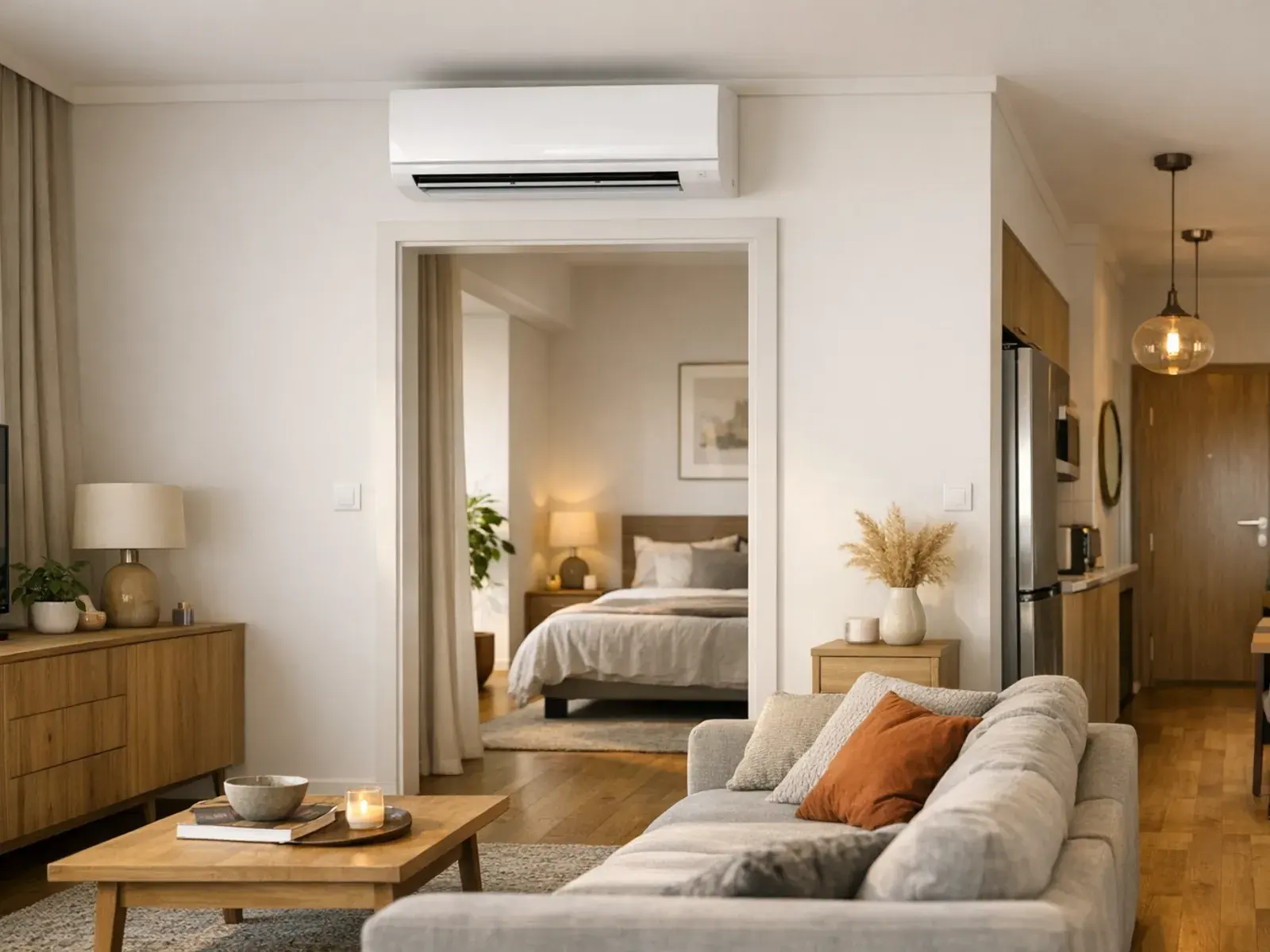
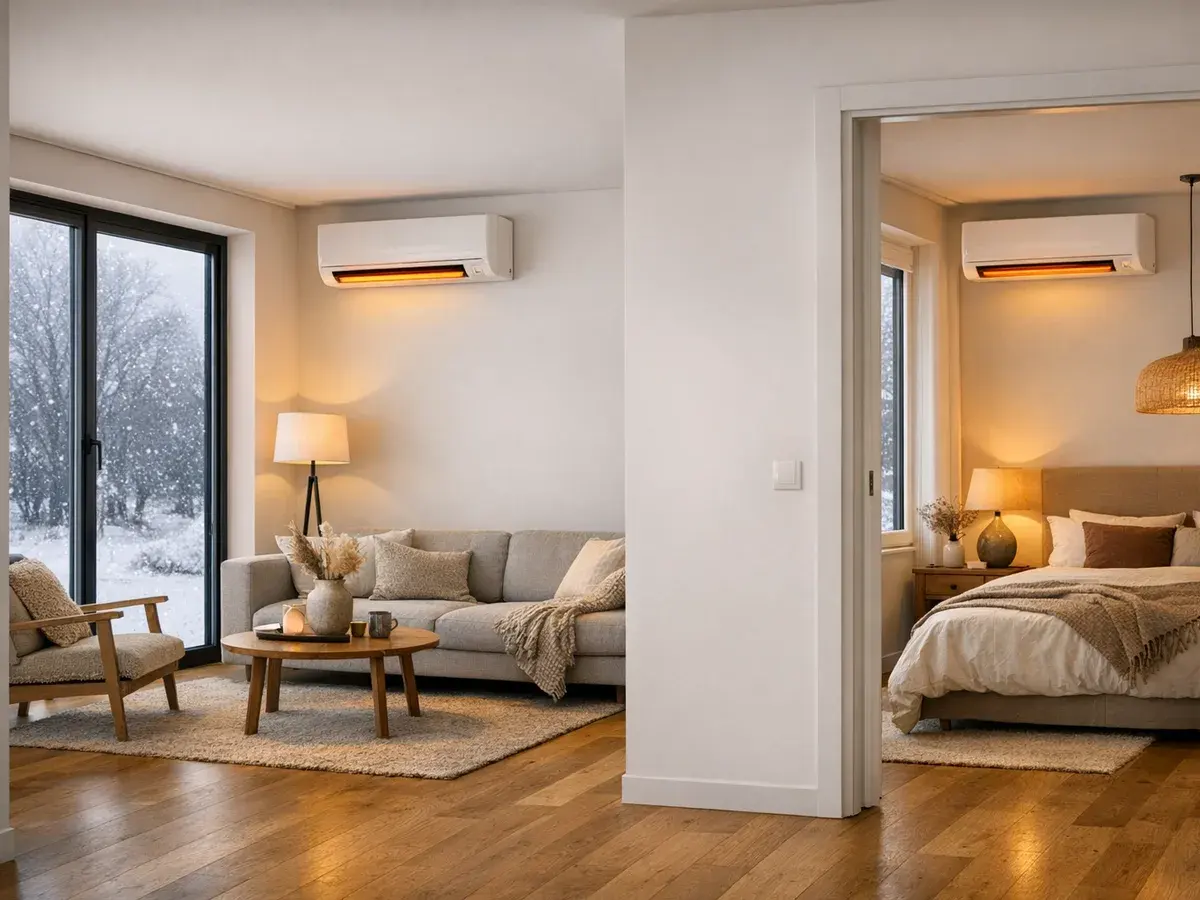
The classic wall-mounted indoor unit paired with a single outdoor unit. Cheapest, simplest, most often installed. In heating mode it works very well in 30–80 m² flats as the only or main heat source in the room where it is mounted. Heat spreads by natural convection, so a kitchen or bathroom far from the split in the living room will be cooler.
Studios and open-space flats 30–80 m²
In heating mode the heat falls from above — choose a model with a 'heating airflow' function that directs the stream towards the floor, otherwise you have warm ears and cold feet.
Multisplit
A single outdoor unit serves 2–5 indoor units in different rooms. Each unit has its own remote and its own set temperature. Ideal for 3-room flats and houses up to 150 m² when you want separate heating control in the living room, bedroom and children's room. Note: heating and cooling cannot operate at the same time in different rooms (except on top-end VRF models).
3–5 room flats, detached houses up to 150 m²
A multisplit with heating function needs a more powerful outdoor unit — design with a 20% capacity margin over the sum of the indoor units.
Ducted AC
The indoor unit is hidden in a suspended ceiling or a technical shaft, and warm (or cool) air is blown through ceiling or wall grilles. Aesthetics are ideal — nothing hangs on the wall, just discreet ceiling grilles. In heating mode the airflow reaches every room evenly, eliminating the 'cold feet' effect. The best option in houses with suspended ceilings and in new apartments.
Premium apartments 80–250 m², houses with suspended ceilings
In heating mode the duct needs at least 25 cm of ceiling drop — full acoustic and thermal insulation of the ducts is essential.
Cassette AC
The indoor unit is built into the suspended ceiling with four-way airflow of warm or cool air. An office classic, rare in flats. In heating mode it works best in large rooms (over 40 m²), where four-way air distribution eliminates cold zones. In conference rooms, showrooms and consulting rooms — unbeatable aesthetically and acoustically.
Offices 40–200 m², service premises, consulting rooms, conference rooms
A cassette in heating mode has excellent air distribution — use the 3D Auto Swing function, which directs the stream downward first and then spreads it horizontally.
Capacity sizing
Heating capacity calculator
A quick sizing of the nominal capacity of a heat-pump air conditioner based on area, insulation, exposure and window area. A full thermal audit we will do on site — this is only a starting point.
Indicative value. The real capacity depends on heat losses, thermal bridges and exposure. Top-floor and ground-floor flats need 15–25% more capacity than a middle flat. We confirm the exact sizing after a thermal audit with a thermal camera.
Three building types
Heat-pump air conditioning in three types of Warsaw properties
Three real situations in which heat-pump AC fundamentally changes the economics of heating — from a block in Ursynów to a short-term rental.
01
Flat in a 1970s block
58 m² flat in Ursynów with district heating (Veolia) and bills of 380–450 PLN per month in season. The client has no control over the temperature set by the housing co-op — 19°C in January, 25°C in March because the radiators do not regulate. We installed a Mitsubishi 3.5 kW split with Hyper Heating; the client cut off the radiators for winter. AC heating cost: 180–240 PLN / month. In summer the same unit cools for 80 PLN / month. ROI: 3.5 years, after that pure savings.
02
Detached house outside Warsaw
145 m² house in Wesoła, until now heated by a 2008 gas boiler. The client faced a choice: replace the boiler (12 000 PLN) or switch to an air-to-water heat pump (45 000–55 000 PLN). We installed a Daikin 12 kW multisplit with 5 indoor units in Hyper Heating technology. Installation cost: 32 000 PLN. AC heating for the 2024/25 season: 1 850 PLN vs 3 400 PLN on gas in 2023/24. In summer the house is cooled at no additional investment cost.
03
Short-term rental flat (Airbnb)
42 m² apartment in Powiśle let on a short-term basis. Previously electric heaters, bills 600–800 PLN per month in winter, guests complained about the cold and noise. We installed a Haier 3.5 kW split with heating, WiFi control and temperature settings synced with the reservation calendar. Heating cost fell to 220–260 PLN / month, comfort reviews 4.9/5. The investment paid back in 14 operational months.
Warsaw specifics
Air conditioning with heating in Warsaw reality
The Warsaw climate is friendlier to a heating air conditioner than it might seem. The average January temperature in the capital is -2.1°C, February -1.3°C, March +2.8°C. Across the entire heating season (October–April) a heat-pump air conditioner spends over 80% of its operating hours at temperatures above -5°C, where COP stays at 3.5–4.5. Frost below -15°C, where capacity drops, occurs 5–12 days per season in Warsaw. Hyper Heating covers you on those days, but even without it a modern inverter will manage — electricity consumption rises 30–40% for a week, but the AC does not shut off.
Warsaw building stock poses three installation challenges. First: the heritage officer in Downtown, Praga Północ and the listed area — outdoor units may not hang on front elevations. Solution: balcony (if there is one), courtyard, roof (less often), ventilation shaft. We have experience drafting heritage applications and know the office's preferences. Second challenge: pre-fabricated blocks from the 1960s–70s — thin walls, thermal bridges, leaky windows. Here the heat-pump AC must be sized with a 20–30% capacity margin. Third: new developer apartments with strict HOA rules — they often require uniform colours and outdoor unit locations on the courtyard side, sometimes you have to write to the manager.
Warsaw districts have very different profiles for heating AC. In Wilanów and Wesoła new houses with PV dominate — Hyper Heating AC + 6 kWp panels + an energy storage unit is today's standard for informed investors. Heating cost then drops to 600–900 PLN per year. In Mokotów and Ursynów flats in blocks often have district heating with unregulated temperatures — the AC becomes a way to regain control and at the same time cut bills by 40%. In Downtown, Powiśle and the Wilanów escarpment the fashionable trend is Hyper Heating ducted AC in 80–150 m² apartments — looks like nothing, heats everything.
How we work
Seven steps from thermal audit to guaranteed comfort
A transparent process where each stage ends in a concrete result on paper or a working device. We work quickly but never skip the thermal audit — it is the foundation of accurate sizing.
1
Thermal audit on site
We arrive within 48 hours of your request, measure wall and window surface temperatures with a thermal camera, check the insulation and assess room exposure. The result: specific heat demand in kW for each room. Audit costs 250 PLN, free if you order the installation.
2
Thermal design and source comparison
We calculate the heat balance, size the nominal capacity of the heat-pump air conditioner and compare costs with three alternatives (gas, electric heater, air-to-water heat pump). The client receives a report with three pricing variants for the AC installation and annual operating costs.
3
Choosing the Hyper Heating model
We pick a specific model matched to the climate zone, exposure and tariff. For a house with -20°C frost: Mitsubishi MSZ-LN or Daikin Stylish. For a city flat down to -15°C: Haier Flexis Plus, AUX Halo Pro, Rotenso Roni. Justification of the choice — always in writing.
4
Purchase, schedule, order
The client accepts the quote, we order the equipment from an authorised distributor (manufacturer warranty + our installation). Installation date is usually 7–14 days from order, 14–21 days in season. Priority installation in 5 days is possible for a 15% surcharge.
5
Installation (winter too)
A heat-pump AC is an installation that makes sense in winter as well. We install in temperatures down to -10°C; the schedule is 1 day for a split, 2 days for a multisplit, 3–4 days for ducted. We protect furniture, clean up after ourselves and hand the flat back ready to use.
6
Frost test (if in season)
If installation falls in the heating season, we run a full-load test in real conditions: we set 22°C, measure the warm-up time, check power consumption and verify the COP at the current outdoor temperature. The result is recorded in the protocol.
7
Service, inspections, warranty
Throughout 5 years of warranty on equipment and installation we stay in touch. First inspection after the heating season (April), second after the cooling season (September). We remind by SMS, calibrate settings, clean heat exchangers, check R32 refrigerant pressure. 24/7 service phone.
Scope of service
Scope of service — what you get in the price of a heat-pump AC installation
The installation price always covers the full set of works needed to deliver a ready-to-use heating-cooling system. You buy extras only when they are really needed — we suggest them after the audit, not from a price list.
Included in the installation price
Thermal audit and design
Heat-loss measurement with a thermal camera, heat balance, installation design, capacity and model sizing with a comparison of three variants.
Standard installation of a wall unit
Mounting the indoor and outdoor units, copper refrigeration installation up to 4 metres, vacuum, leak test, startup.
Electrical wiring and control
Running the power cable to the nearest point, installing the control cable between units, connecting the IR remote and (if the model has it) WiFi.
Gravity condensate drainage
Condensate hose routed to the nearest floor drain or outside the balcony — up to 5 metres, in trunking or PVC trim.
Test in heating and cooling mode
Checking COP in current conditions, verifying all operating modes, calibrating temperature sensors, a startup report.
5-year warranty on equipment and installation
Manufacturer warranty on the equipment (Mitsubishi, Daikin, LG, Haier, Rotenso) plus a 5-year written LeoKlima warranty on the installation and calibration.
Additional options
Refrigeration piping over 4 m
Each extra metre of refrigeration installation (insulated copper, cables, trunking): 80–120 PLN/m. Standard in high-rises and tenements where the outdoor unit is far from the indoor unit.
Concealing refrigeration runs in the wall
Cutting the pipes into a chase and re-plastering — ideal aesthetics, no visible pipes. Quoted individually depending on length and wall type.
Condensate pump
A quiet pump where there is no gravity condensate drain — typically in ducted units and flats with awkward geometry. 350–550 PLN.
Central control / BMS integration
A central controller for a multisplit or several splits, integration with Loxone, Fibaro, Apple Home, Google Home. Configuration of heating scenes for the G12 tariff or PV.
Heritage officer application
Preparing a technical application and visualisations for the heritage office — required in many tenements in Downtown, Praga and Old Wilanów. 600 PLN, we handle the case to the end.
We always price extras after the audit. We never add 'hidden' costs after the installation — everything must be in the quote on the day the contract is signed.
ROI
Return on investment in a heat-pump air conditioner
Investment in a heat-pump air conditioner in a 60 m² Warsaw flat is typically 8 000–14 000 PLN for a Hyper Heating split with a full installation. In a 120 m² house with a five-unit multisplit — 28 000–38 000 PLN. The client pays once but heats, cools and dehumidifies the air 12 months a year for 12–15 years. This is a different economic model from a gas boiler, which wears out and requires annual inspections (300–500 PLN), replacement every 12 years (10 000–18 000 PLN) and does not cool in summer.
Real annual heating savings we see at clients are: 1 800–3 200 PLN compared with an electric heater (AC is 3–5x cheaper to run), 1 200–2 400 PLN compared with a gas boiler at 2025 prices, 600–1 400 PLN compared with district heating. On top of that come savings on summer cooling (you don't buy a separate AC) and on the money not spent on an air-to-water heat pump. ROI: 3–5 years for a flat, 4–6 years for a detached house. After that the equipment runs on pure profit.
The third category of return is the environment. A heat-pump air conditioner running on the Polish energy mix (2025: 38% coal, the rest gas, renewables, nuclear on the way) emits indirectly about 60% less CO₂ than a gas boiler burning methane on site and 95% less than a coal boiler. For a house with PV heated by Hyper Heating AC between March and October, CO₂ emissions from heating are practically zero. This matters for children, for property value and — increasingly — for lower property tax under future regulations.
3–5 years
Typical investment payback
For a 60 m² flat instead of an electric heater
2.0–3.0k PLN
Annual heating savings
Versus a gas boiler at 2025 prices
−60%
CO₂ emissions reduction
Versus a gas boiler, Polish energy mix 2025
Districts
Heat-pump AC installation in every district of Warsaw and the surrounding area
Four projects from the last two heating seasons that show how differently sizing a heating air conditioner can look for a flat, a house, an office and a rental apartment.
Powiśle, Downtown
86 m² apartment in Powiśle
Apartment in a new building with large south-facing glazing. The client did not want visible wall units. We installed a Daikin FBA-A 7.1 kW ducted AC under the suspended ceiling with four supply grilles. Heating mode as the primary heating, district heating cut off. Heating cost in the 2024/25 season: 1 450 PLN, previously 2 700 PLN on district heating.
Konstancin-Jeziorna
165 m² house in Konstancin
Detached house from 2018 with a condensing gas boiler. The client opted for a hybrid: a Mitsubishi 14 kW Hyper Heating multisplit (5 units) as the primary heating and the gas boiler as backup for days with frost below -18°C. In 2024/25 the gas boiler ran 7 days, the AC heated for 178. Heating costs: 2 350 PLN instead of 4 200 PLN on gas alone.
Wilanów
220 m² office in Wilanów
Open-space for 28 people on the second floor. The client had a 2014 VRF system that cooled in summer but did not heat in winter — January mornings hit 17°C and half the team complained. We replaced the system with a Mitsubishi VRF Hyper Heating with hot/cold mode on demand for individual zones. Heating cost: 4 200 PLN / season vs the previous 9 800 PLN on emergency electric heaters.
Targówek
48 m² flat in Targówek
A studio with a couple working remotely. Previously electric heaters, winter bills 480 PLN / month. We installed a single Haier Flexis Plus 2.6 kW split with Hyper Heating and WiFi app control. Heating cost in the 2024/25 season: 1 380 PLN in total, on average 200 PLN / month. The unit paid back in the first season, plus cooling in summer.
Brands
Heat-pump AC brands we work with
We specialise in heat-pump air conditioners from manufacturers with documented Hyper Heating technology and seasonal SCOP 4.0+: Mitsubishi Electric (MSZ-LN, MSZ-AP), Daikin (Perfera, Stylish, Bluevolution), LG (Standard Plus, ArtCool), Haier (Flexis Plus, Pearl), Rotenso (Roni, Halo), AUX (Halo Pro), Samsung (WindFree Elite). We advise on brand and model matched to climate zone, insulation and budget — not on distributor commission.
Brands We Work With
Authorized service and installation
Warranty and service
Warranty, service and care for a heat-pump air conditioner
A heat-pump air conditioner running as a heat pump has a longer annual usage cycle than a cooling-only AC. In summer it cools for 3–4 months, in winter it heats for 6–7 — in total 9–11 months of operation a year. That means service has to be more rigorous and the warranty must cover the heating mode as well (not every manufacturer states this). At LeoKlima we work only with brands that guarantee the full heat-pump operation with the winter heating mode as part of the standard warranty.
On equipment we give the manufacturer's warranty, which for most of our heat-pump air conditioners is 5 years on the compressor and 3 years on the rest of the electronics. On premium models (Mitsubishi MSZ-LN, Daikin Stylish) the compressor warranty is 7–10 years. Regardless, we add our own 5-year written LeoKlima warranty on installation, refrigeration piping, calibration and controller configuration. If a problem appears — we fix it ourselves, without passing the buck to the manufacturer.
Caring for a heat-pump air conditioner is no magic but a matter of consistency. Indoor filters are replaced or cleaned every 3 months in season. The heat exchangers of both units are washed once a year — in spring for heating, in autumn for cooling. R32 refrigerant pressure and the condensate drain are checked every 2 years. The client does not have to remember — we remind by SMS 14 days before the date and offer a ready service package for 350 PLN / year covering all these tasks.
Warranty, service and care for a heat-pump air conditioner
Equipment warranty 5–10 years
Compressor 5 years (standard models) or 7–10 years (premium Mitsubishi, Daikin). Other electronics 3 years. The full heating mode is covered.
Installation warranty 5 years
Our own written LeoKlima warranty on refrigeration installation, leak test, calibration and configuration. Independent of the manufacturer's equipment warranty.
24/7 service in Warsaw
Service phone 24 hours a day, response time in the city up to 24 hours. Warranty parts replacement at no cost to the client for 5 years.
Parts availability 10 years
We work with brands that guarantee spare parts availability for 10 years from the model's launch. No risk that in 6 years there won't be a condenser for your model.
Client questions
Most common questions about heat-pump air conditioning
Concrete answers to the questions we most often hear from Warsaw clients considering AC as the primary heating source.
Does air conditioning with heating function work in winter in Poland?
Yes, and very well. Modern heat-pump air conditioners with Hyper Heating technology maintain full heating capacity down to -15°C and operate down to -25°C. In the Warsaw climate, where average January is -2°C, the AC spends 80% of the heating season in the COP 3.5–4.5 range — meaning for 1 kWh of electricity you get 3.5–4.5 kWh of heat. Standard inverter models cope down to -10°C, which is enough in 95% of Warsaw winters.
Down to what outdoor temperature does a Hyper Heating AC heat?
The best Hyper Heating models (Mitsubishi MSZ-LN, Daikin Stylish FTXA, LG Therma V Heating) guarantee operation down to -25°C and hold nominal heating capacity down to -15°C. Between -15°C and -25°C capacity drops 20–35%, but the AC keeps heating. Standard models without Hyper Heating lose significant efficiency already from 0°C and shut off at -10 to -15°C. In Warsaw the difference matters on 5–12 days per season.
Will a heat-pump AC replace a gas or electric heater?
Yes, in 90% of flats and houses with post-2000 insulation — fully. It is cheaper to run (COP 3–5 vs gas 0.92 vs resistive 1.0), needs no chimney, no gas fitter, no water installation design. In poorly insulated houses (pre-1990) or premises with constant frost below -20°C it is worth keeping the gas boiler as emergency backup. A hybrid AC + gas is today a sensible setup for a 150 m² house outside Warsaw.
How much does monthly heating cost in a 60 m² Warsaw flat with AC?
At SCOP 4.0, G11 tariff (0.90 PLN/kWh in 2025), heat demand of 4 kW and a 7-month season: on average 180–240 PLN per month. At -10°C in January it can rise to 320 PLN, in transitional March drop to 100 PLN. For comparison: a gas boiler in the same conditions 280–370 PLN, electric heater 700–950 PLN. AC is the cheapest in every month of the heating season.
Isn't the outdoor unit loud in winter?
In heating mode the outdoor unit runs louder than in cooling — that is a fact. A standard split generates 48–55 dB at 1 metre. Premium models (Mitsubishi MSZ-LN, Daikin Stylish) drop to 42–46 dB in night mode. That is comparable to a quiet dishwasher. For neighbour comfort we install the unit on the courtyard side, not under the window of the flat one floor down — this is our standard, not everyone's.
Does my flat need to have good insulation?
The better the insulation, the lower the AC capacity needed and the lower the heating cost — that is true. But heat-pump AC will also work in poorly insulated 1960s–70s flats: you just need to size with a 25–30% capacity margin and accept slightly higher bills. A 60 m² flat in a pre-fabricated block with original windows will cost 280–340 PLN / month instead of 200 PLN / month in a retrofitted flat. Still cheaper than gas.
Will a multisplit heat a whole 120 m² house?
Yes, if you choose the right capacity and number of units. For a 120 m² house we typically install a 10–12 kWmultisplit with 4–5 indoor units (living room 3.5 kW, two bedrooms 2.0 kW each, bathroom 1.5 kW, kitchen 2.0 kW). Each unit has its own control. Important: do not skip distant rooms — warm air will not pass under doors. For an open-space layout the setup can be simpler; for 'corridor' flats you need a unit in each room.
How long will an AC running as a heat pump last?
Standard lifetime of a heat-pump air conditioner is 12–15 years with regular service. An inverter compressor withstands 50 000–80 000 hours of operation — which in the Warsaw climate is exactly 12–15 years of heating-cooling seasons. Premium models (Mitsubishi MSZ-LN, Daikin Stylish) reach 18–20 years. Cleaning heat exchangers once a year and replacing filters every 3 months extends equipment life by 25–30%.
Can you control AC heating from a smartphone?
Yes. All heat-pump AC models we install have a WiFi module or the option to buy one for 150–300 PLN. The manufacturer app (MELCloud, Daikin Onecta, LG ThinQ, Haier hOn) lets you set the temperature from anywhere, schedule a weekly programme, control via geolocation (switches on as you approach home). We also integrate with Apple Home, Google Home, Loxone, Fibaro — for smart homes.
Does a heat-pump air conditioner work with photovoltaics?
Perfectly. It is today's best way to raise PV self-consumption. In March, April, September and October the panels produce surpluses that the fridge alone cannot absorb — the AC in heating mode can 'soak up' 2–5 kW of extra output and turn it into free heat. We configure controllers that switch the AC on automatically when PV production exceeds a threshold. Annual heating cost in a house with 6 kWp PV drops to 600–1 000 PLN.
How much does a heat-pump AC installation in Warsaw cost?
A 3.5 kWHyper Heating wall split with full installation: 6 800–9 500 PLN depending on brand (Haier, Rotenso, AUX, Samsung, Daikin, Mitsubishi). Multisplit with two units: 12 000–17 000 PLN. With five units: 28 000–38 000 PLN. 7 kW ducted AC: 18 000–24 000 PLN. The price covers the thermal audit, design, equipment, installation, refrigeration piping up to 4 m, leak test, startup and 5-year warranty. No hidden costs.
What warranty do you give on a heat-pump AC installation?
Standard: 5 years on the equipment (manufacturer), 5 years on the installation (LeoKlima). On premium models (Mitsubishi MSZ-LN, Daikin Stylish) the compressor warranty is 7–10 years. The warranty covers the full heat-pump operation, including winter heating — not just summer cooling. For 5 years we carry out warranty repairs at no cost to the client. Service phone 24/7, response time in Warsaw up to 24 hours from the request.
Thermal audit of a flat or house — and a concrete quote for heat-pump air conditioning
We will arrive within 48 hours, measure heat losses with a thermal camera, calculate heat demand for each room and compare four heat sources for your specific building. Audit 250 PLN — free if you commission the installation.




 01
01