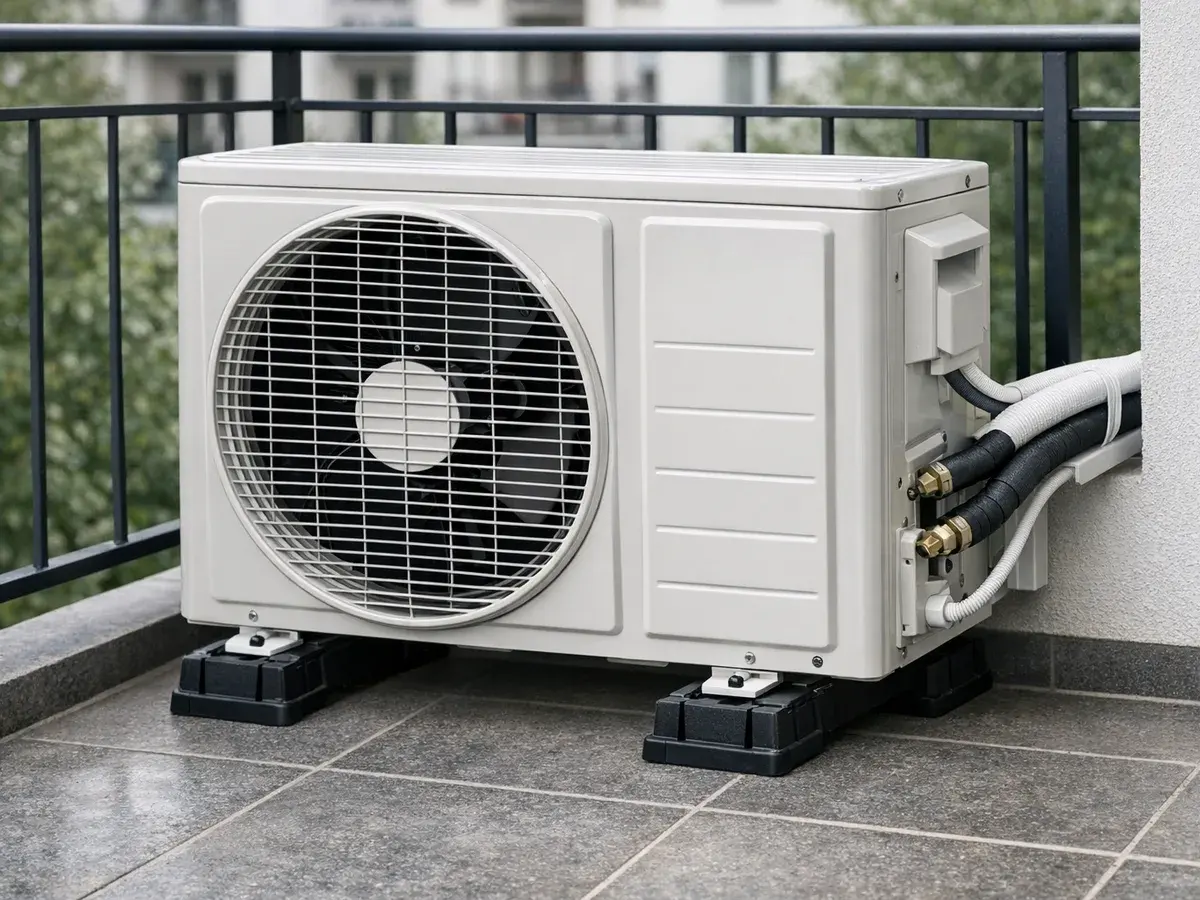
We size quiet air conditioning for the bedroom and living room, help you secure the consent of the housing community or cooperative, and install it in a single day — in a block, a tenement or a brand-new apartment building. We work clean, on sheeting and with a vacuum cleaner, and the units carry a manufacturer's warranty of up to 5 years.
Heatwaves in Warsaw are lasting longer and longer, and ever more often climb above 30 °C. Concrete, asphalt and dense development soak up heat all day and release it at night — which is why housing estates do not cool down even after dark. In a top-floor flat, or one with south-facing windows, the thermometer reads 28–29 °C in the evening, and an open window lets in only street noise and another wave of hot air. A fan does not lower the temperature by a single degree — it just stirs around the same warm air you already have far too much of in summer. After a few nights like that, sleep and recovery are hard to come by.
A decade ago “air conditioning in a flat” sounded like an extravagance — today it is as obvious a fixture as a dishwasher. A modern split is an air-to-air heat pump: in summer it cools, in spring and autumn it heats more cheaply than an electric radiator, and all year round it filters dust and pollen and dries the air after laundry hung up in the bathroom. In night mode, good units drop to 19–21 dB, quieter than the fridge in your kitchen. The bedroom cools down in a quarter of an hour — you close the windows, shut out the street noise and sleep, instead of letting the heat in along with the dust.
LeoKlima installs air conditioning in Warsaw and its immediate surroundings only — and it shows in the details. We know the regulations of the housing communities and cooperatives here, we know what the property managers require, and we have installations under our belt in every type of the capital's building stock: from pre-war tenements (kamienica) in Praga, through the prefab concrete blocks (wielka płyta) of Ursynów, to new apartment buildings in Wola. On this page we have gathered everything you need before deciding: the specifics of four types of building, the formalities with the community together with a ready-to-use application template, real 2026 prices, and a calculator that will work out an indicative cost for your floor area. And if you would rather talk — call 502 010 010.
1 day
typical installation in a flat
Why us
Why do Warsaw residents choose LeoKlima for their flats?
Because installation in an occupied flat is not the same as work on a building site — what counts is cleanliness, quiet, and formalities handled without using up your day off.
01
We take the formalities off your hands
Consent from the housing community (wspólnota) or cooperative (spółdzielnia) puts people off more than the price does — which is why we prepare the full set of documents for the property manager for you: a completed application, the unit's data sheet with the noise level in dB, a diagram of the route and condensate drainage, and the installer's liability insurance. You only sign and submit it. We know what Warsaw property managers require, because we put together sets like this every week.
02
Clean installation in an occupied flat
You do not have to move out while the work is under way, or pack away half the living room. We cover the floors and furniture with sheeting, and when drilling we hold an industrial vacuum cleaner right up to the bit, so the dust does not settle on the shelves. We install a standard split in 3–5 hours, the furniture goes back in place the same day, and we carry every cardboard box out after ourselves.
03
A quote in 24 h from photos
Send three photos from your phone or via WhatsApp — the wall where the unit is to hang, the window or balcony, and the meter board — and give us the floor area. Within 24 hours we call back with a concrete price range, not a brush-off “it depends”. Before installation we confirm everything with a free on-site survey, so the final price holds no surprises.
04
F-gas certified installers
Every LeoKlima installer holds the F-gas certificate required to work with refrigerant, plus the training of the manufacturers whose units we install. This is not a formality but a condition: the full, even five-year factory warranty is kept only by an installation carried out by a qualified installer and confirmed in the warranty card. An installation “by a handyman” can void it on day one.
05
Service after installation
Air conditioning does not end with the installation: the heat exchanger and filters have to be cleaned and disinfected once a year, otherwise the bills rise and the supply air starts to smell of cellar. We remind you of the inspection date ourselves and turn up with our own equipment, and because we know each of our installations, the service takes less time. If anything seems off, you call the team that did the installation.
06
Quiet air conditioning for the bedroom
For the bedroom we choose units that drop to 19 dB(A) in night mode — less than a whisper. Before you buy anything, we show you the noise level of the specific model on a comparison scale, not in the small print of a table. The result: you sleep at 24 °C instead of 29 °C and hear nothing but your own alarm clock.
Warsaw building stock
What kind of building do you live in?
A tenement, a prefab concrete block, a 1990s block and a new apartment building place completely different demands on the team. Pick your type of building and see what we check before we turn up with the tools.
Air conditioning in a pre-war tenement
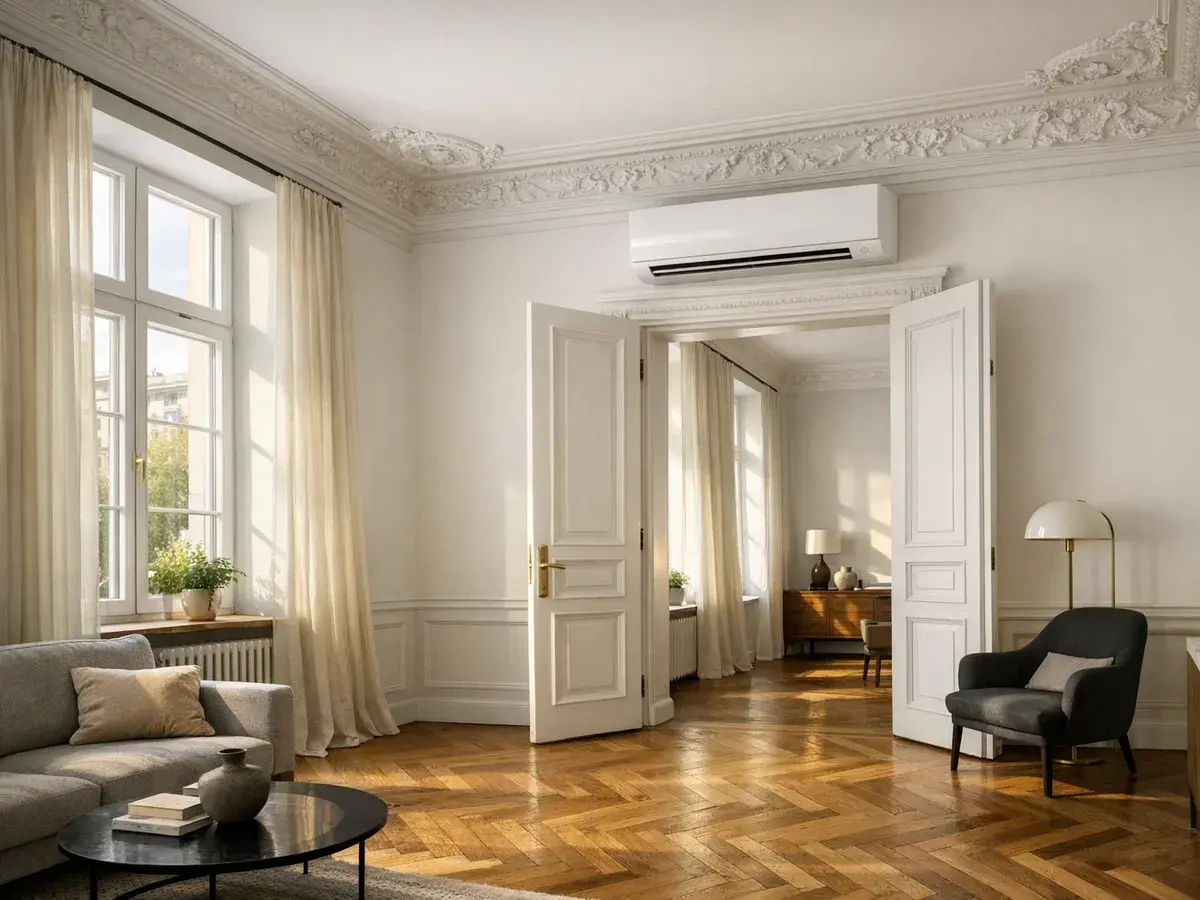
Pre-war walls of solid brick are sometimes 60–80 cm thick — the drilling alone takes longer here than in a block and calls for long core drill bits, which we allow for in the quote rather than adding on the spot. High ceilings raise the question of the route: we run it in a chase under the plaster or in discreet trunking above the line of the mouldings, so as not to cut into the ornamentation. The front of a tenement is often under conservation protection, so we plan the outdoor unit from the courtyard side or on the balcony. Condensate from a unit deep inside the flat is usually pumped by a quiet pump — a gravity fall rarely works out here.
What we look out for
Core drilling through a solid brick wall 60–80 cm thick
Route in a chase or in trunking above the mouldings
A condensate pump where there is no gravity fall
Outdoor unit from the courtyard or on the balcony — not from the front
Consents
Property manager + heritage conservator's opinion for listed buildings
Price
usually +10–15% versus a block
Typical districts
Śródmieście, Stary Mokotów, Praga-Północ, Żoliborz
Formalities
How do you get the consent of the housing community or cooperative for air conditioning?
Four steps, a ready-to-use application template and a plan B in case of refusal — we break the formalities down into their component parts.
Where does the consent requirement even come from? From the act on the ownership of premises: the façade, the external wall and the balcony balustrade are common parts of the building — they do not belong to your flat, even if they adjoin it. An outdoor unit screwed to the façade is interference with a common part and requires consent. It is different with the interior of a balcony or loggia: a unit placed within the footprint, on feet, without drilling into the balustrade, in practice usually requires only the property manager's consent or a notification. The procedure depends on the form of management. In a housing community (wspólnota) the decision is taken by the board, and for more substantial interference — by the owners by way of a resolution. In a cooperative (spółdzielnia) the regulations apply: you submit the application to the administration, which replies in writing. In both cases the documents are almost identical — and we prepare them for you.
1
Check the regulations and resolutions
Before you choose a unit, ask the property manager or administration for the regulations and resolutions on air conditioners. In Warsaw buildings the restrictions recur in four points: a ban on installation on the front of the façade, an imposed trunking colour, hours for noisy work, and the method of draining the condensate. It is better to know these rules before buying than to rework the installation after a letter from the administration. If there are no regulations, ask by email about the practice in the building — the answer alone is often half the battle.
2
Prepare the application with attachments
A good application answers the board's questions before it has time to ask them: the specific unit model with its data sheet and noise level in dB, a photo of the planned installation location, the condensate drainage route, the method of fixing with anti-vibration feet, and the installer's liability insurance. Such a set is hard to reject, because it leaves no room for guesswork. With every installation we prepare it for you — you only sign and send it. You will find the application template below, ready to copy.
3
Submit it and keep an eye on the deadline
Submit the application in writing — by email to the administration or through the e-records system — and ask for confirmation of receipt. The consent of a housing community board usually arrives in 1–3 weeks. If the matter requires an owners' resolution, you wait for a meeting or for a vote by circulation, which realistically means 2–6 weeks. Hence the advice we repeat to everyone: submit the application in spring, not in July in the middle of a heatwave, when installation lead times are at their longest too. No reply after two weeks? Follow up — it really works.
4
After consent — installation and notification
We carry out the installation exactly as the application described it: the same model, the same location, the same condensate route. Once the work is finished we take as-built photos and pass them to the administration — a short email closes the matter and stays in the flat's file in case of a change of manager. This care pays off: property managers who have once seen our documentation process the next applications bearing our signature noticeably faster.
The community said no? You have three ways out
A refusal is rare and almost never final. Most often it is not the air conditioning itself that is blocked, but the specific location of the outdoor unit — it is enough to change the spot or point to a quieter model with a dB sheet attached and submit the application again. On top of that you have three tried-and-tested alternatives:
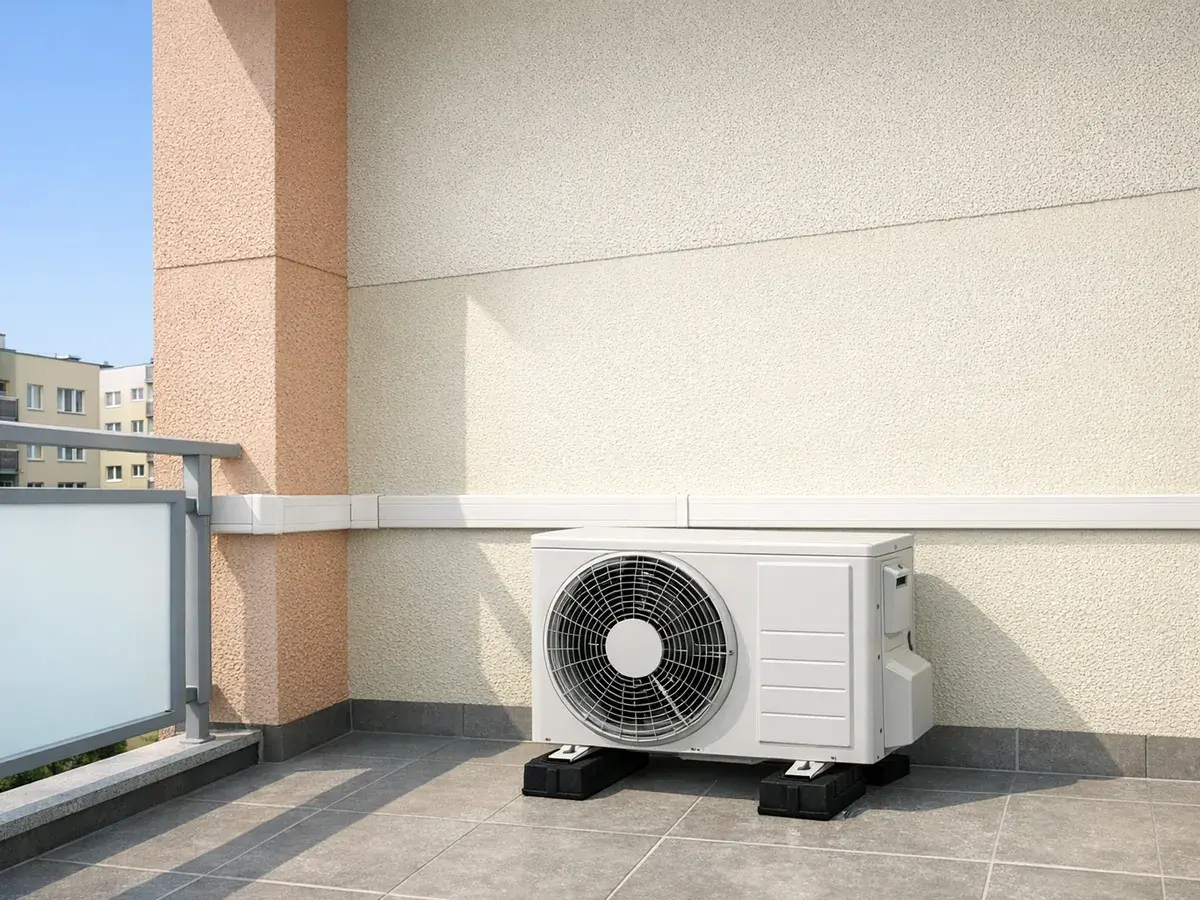
The outdoor unit within the balcony or loggia footprint rather than on the façade — with no interference with the common part, the property manager's consent usually suffices, not a resolution.
A wall-mounted monobloc with no outdoor unit — instead of an outdoor unit, two Ø160 penetrations with discreet grilles in the façade; louder than a split, but accepted almost everywhere.
A portable air conditioner for the hottest weeks — no consents and no drilling; loud and not very efficient, so treat it as a temporary solution, not a permanent one.
Consent application template (in Polish)▼
Wniosek o wyrażenie zgody na montaż klimatyzacji
Zarząd Wspólnoty Mieszkaniowej / Spółdzielni Mieszkaniowej [nazwa]
[adres administracji]
Ja, niżej podpisany/a [imię i nazwisko], właściciel/ka lokalu nr [nr] przy ul. [adres], zwracam się z prośbą o wyrażenie zgody na montaż klimatyzacji typu split w moim lokalu.
Planowany zakres prac:
– jednostka wewnętrzna: [model], poziom hałasu od 19 dB(A),
– jednostka zewnętrzna: [model], poziom hałasu [xx] dB(A), wymiary [szer. × wys. × gł.],
– miejsce montażu jednostki zewnętrznej: [balkon / loggia / elewacja — zgodnie z załączonym zdjęciem],
– odprowadzenie skroplin: [do pionu kanalizacyjnego / pompką skroplin],
– montaż na stopach/uchwytach antywibracyjnych ograniczających przenoszenie drgań.
Prace wykona firma LeoKlima, posiadająca certyfikat F-gazowy oraz ubezpieczenie OC. Zobowiązuję się do utrzymania urządzenia w należytym stanie technicznym oraz przywrócenia elewacji do stanu pierwotnego w przypadku demontażu.
Załączniki: karta katalogowa urządzenia, zdjęcie planowanego miejsca montażu.
Z poważaniem,
[imię i nazwisko, nr lokalu, telefon, data]
We help you compile the application and attachments free of charge with every installation in Warsaw.
Choosing the unit
Split, multi-split or an air conditioner with no outdoor unit?
Four ways to cool a flat compared honestly: noise, prices and the real chance of the community's consent.
We start choosing air conditioning for a flat with the number of rooms to be cooled, not with the catalogue. In a typical one- or two-bedroom flat with a living room open to the kitchen, a single 3.5 kW split usually suffices: with the doors open, the cool air spreads to the rest of the flat and at night the bedroom becomes bearable too. Full temperature control in a closed bedroom comes only with a multi-split or a second split — a separate unit in each room and still one outdoor unit on the balcony, which makes the community's consent easier. A monobloc is a design for special situations: all the mechanics sit in the indoor unit, and only two Ø160 openings in the wall connect it to the building.
We speak honestly about the portable air conditioner, even though we do not sell it: it is the loudest solution in the comparison — 45–55 dB in the room where you are trying to fall asleep, the loudness of a conversation. The exhaust hose has to hang in a tilted window, through which the heat immediately returns inside, so the efficiency is the lowest possible. You can buy one off the shelf in a DIY store, but it makes sense in one scenario: you rent a flat, the owner does not agree to drilling, and you want to survive August. As a permanent air conditioner for your own flat — a waste of electricity and nerves.
Variant
Cooling
Noise in the room
Price with installation (8% VAT)
Community consent?
Best for
Wall-mounted splitMost common choice
2.5–3.5 kW
19–24 dB
3 400–6 500 zł
usually yes (outdoor unit)
1–2 rooms next to each other
Multi-split (2–3 units)
2× 2.0–2.6 kW and more
19–26 dB
7 500–18 000 zł
yes — one outdoor unit
3–4-room flats, bedrooms separately
Wall-mounted monobloc (no outdoor unit)
2.3–2.6 kW
35–40 dB
6 000–9 000 zł
often no — 2× Ø160 openings
no consent for an outdoor unit, listed buildings
Portable air conditioner
2.0–2.6 kW
45–55 dB
1 500–3 500 zł (without installation)
no
rental, temporary solution
Indicative prices for 2026 for Warsaw — final quote after a free survey.
Quiet at night
How loud is air conditioning in a flat?
We show the decibels on a comparison scale — from night mode to a busy street outside the window.
Decibels from a catalogue say little, so let us translate them into real life. The dB(A) scale is logarithmic: every extra 10 dB is perceived by the ear as roughly a doubling of loudness. The indoor unit in night mode runs at 19–21 dB(A) — less than a whisper (26 dB) and a level you barely register in the bedroom, especially against the city outside the window. In ordinary cooling mode a split reaches 22–24 dB, still below a quiet library. No one in the household will wake up — more often it is switching the air conditioning off, and the returning heat, that wakes you.
A 3.5 kW outdoor unit generates 45–52 dB right by the casing — distinctly less than a busy street outside the window. The key, however, is not “how much” but “where and how”: we place the outdoor unit on anti-vibration feet, which cut the vibration off from the wall and balustrade, and choose the location so that the air outlet does not point at the neighbours' bedroom windows. The Regulation of the Minister of the Environment sets limits for installations near multi-family buildings of 55 dB by day and 45 dB at night — which is why we propose quiet outdoor-unit models and set the quiet operating mode for the night. After installation you can simply measure it with an app on your phone.
indoor unit — night mode19 dB
a whisper26 dB
a quiet library35 dB
3.5 kW outdoor unit45–52 dB
a busy street outside the window55 dB
The permissible noise from an installation near multi-family buildings is 55 dB by day and 45 dB at night (Regulation of the Minister of the Environment). We meet these limits by choosing a quiet outdoor unit, anti-vibration feet and a night operating mode.
Do you live on a busy street? Closed windows and air conditioning mean less noise at night and a lower temperature than an open window.
2026 prices
How much does air conditioning for a flat cost in Warsaw?
Real price ranges with installation and 8% VAT instead of a marketing “from 999 zł” that grows once we are on site.
Flat
Scope
Gross price with installation
Studio / 1 room
split 2.5–3.5 kW
3 400–6 500 zł
2 rooms
2× split or multi-split
7 500–13 000 zł
3 rooms
multi-split, 3 units
11 000–18 000 zł
Installation only (your own unit)
split, standard route
from 1 600 zł
Flat 90 m²+ / penthouse
multi-split / ducted
individual quote
8% VAT instead of 23% — how does it work?
Flats up to 150 m² qualify as housing covered by the social housing programme — which lets us bill an air conditioner bought together with installation as a single service at 8% VAT instead of 23%. There is one condition: the same company supplies the unit and the installation; equipment bought separately in a shop always carries 23%. In concrete terms: a set worth 5 500 zł net costs 5 940 zł at 8% VAT and 6 765 zł at 23% — a difference of about 825 zł, which covers a sizeable part of the labour. That is why a “bargain” from a DIY store plus a fitter from a classified ad rarely works out cheaper than the complete package from an installer. In our quotes you see the 8% VAT straight away, with no asterisks.
Costs others keep quiet about
A condensate pump where there is no gravity fall — a surcharge of 400–700 zł with installation.
An installation route over 4 running metres — every additional metre is 150–250 zł.
Concealing trunking on the façade and finishing the wall penetration.
Work at height — a hoist or a rope-access technician when the outdoor unit hangs beyond the balcony's reach.
Some administrations charge a fee for occupying a common part — we check this before the quote.
Price ranges for Warsaw for 2026 — we confirm the exact price after a free survey. Get an indicative figure below.
How much will air conditioning cost in your flat?
Air conditioning for a flat with no guessing from a price list: set the floor area, the number of rooms, the type of building and the floor, and you will see the capacity, the price and the electricity cost straight away. Indicative and with no obligation.
An indicative calculation based on average 2026 prices for Warsaw — it does not constitute a commercial offer. We will prepare an exact quote free of charge in 24 h.
Step by step
What does installing air conditioning in a flat look like step by step?
Six steps from the first phone call to a cool flat — we take most of the work on ourselves.
1
Photos and a conversation (15 minutes)
You call or message on WhatsApp and send three photos: the wall for the indoor unit, the window or balcony from the outside, and the meter board. Plus the floor area and the floor you are on. That is enough for us to call back within 24 hours with a price range and a proposal of specific units — with no walking around the flat with a tape measure and no obligation on your part.
2
Free survey in the flat
Before installation a technician comes round and checks what the photos do not show: the sun exposure and the floor (a top floor beneath the roof means about +350 W of capacity in reserve), the wall material, the installation route, the spot for the outdoor unit and the condensate drainage. After the survey you get the final price — one that does not grow during the work.
3
Formalities with the property manager
If the building requires consent, we compile the documents: an application following the template on this page, the data sheet with noise levels, a photo of the installation location, a description of the condensate route and our liability insurance. You sign it and pass it on to the property manager or the administration. Board consent is usually 1–3 weeks, a community resolution 2–6 — we use that time to reserve the date and the equipment.
4
Installation in 1 day
On installation day we protect the floors and furniture with sheeting, make the Ø65–80 penetration with the vacuum cleaner at the bit, hang the units and connect the refrigerant, electrical and condensate installation. Before letting the refrigerant in we evacuate the system with a vacuum pump and check it for tightness — that stage we never cut short. A split takes 3–5 hours; we leave a tidied-up flat behind us.
5
Start-up and the app
We start the unit up and test all the modes: cooling, heating, drying and night mode. We measure the supply air temperature, configure the Wi-Fi and the app on your phone — you can switch the air conditioning on as you leave work and walk into a cooled flat. Finally a short briefing: which settings save electricity and how to look after the filters between inspections.
6
Warranty and inspections
You get a warranty card filled in by an authorised installer — the condition of the full manufacturer's warranty, which depending on the brand reaches 5 years. Once a year the air conditioning needs an inspection with cleaning and disinfection; we remind you of the date ourselves, so you do not have to watch the calendar. We service what we have installed — and we know each of our installations.
Running costs
How much electricity does air conditioning in a flat use?
Less than intuition suggests. An A+++ inverter split (SEER ≥ 6.1) does not run at full power the whole time — once the room is cooled it only maintains the temperature, drawing a fraction of its rated power. A 3.5 kW unit cooling for 6 hours a day uses about 100–130 kWh in a hot month, which at a price of 1.15 zł/kWh comes to 115–150 zł on the bill. A single evening of cooling — four hours with 30 °C outside — costs 1.5–2 zł, less than a bottle of water in town. Outside the peak of summer the consumption is distinctly lower, because the compressor slows down instead of switching off and revving up again.
Three habits genuinely lower the bill. Set 24–25 °C instead of 20 °C — every degree lower is a few percent more electricity, and you barely feel the difference in comfort. Use a schedule or the app instead of round-the-clock operation: the air conditioning switches on an hour before you get home and does not cool an empty flat. Switch on eco mode and the presence sensor if your model has them — they detect an empty room and reduce the power by themselves. We show you all these settings at start-up.
Outside summer, air conditioning earns its keep by heating. A split is an air-to-air heat pump: at SCOP 4 and above it gives back about 4 kWh of heat from 1 kWh of electricity, so in March, April or October it heats the flat several times more cheaply than an electric radiator — handy before the community switches the heating on, or once it has switched it off. The anti-pollen filters and ionisation work all year too: they trap dust, pollen and part of the smog that can hang over Warsaw from November to March. Allergy sufferers feel the difference after the first week.
~1.5 złcost of an evening's cooling (4 h, 3.5 kW split)
Portfolio
What do our installations in Warsaw flats look like?
Four installations from recent months — one for each type of Warsaw building stock.
Mokotów
A premium split in a tenement living room
A living room with a high ceiling in a pre-war tenement in Stary Mokotów. We ran the route in a chase just above the line of the mouldings — after painting it is invisible. A quiet pump pushes the condensate, because there was no gravity fall, and the outdoor unit went up on the courtyard side, in line with the property manager's guidelines. All you can see in the room is the unit — no trunking running across the middle of the wall.
Ursynów
A multi-split for two rooms in a prefab block
A flat in a prefab concrete block in Ursynów: two indoor units — living room and bedroom — connected to a single outdoor unit on the loggia. Chemical anchors, anti-vibration feet and zero interference with the façade, so the cooperative administration issued its consent in two weeks. The routes came out short, 3–4 running metres each, and we wrapped the whole job up in one working day.
Wola
Installation without chasing in an apartment building
An apartment building in Wola with the infrastructure ready: the developer's condensate riser in the wall and a technical spot for the outdoor unit. We managed without any chasing — the whole installation, from the sheeting on the floor to the cooling test, took four hours. The owners chose a designer unit in matt white that blends into the minimalist interior rather than competing with it.
Praga-Południe
A quiet bedroom in a block on the street
A bedroom facing a busy street in a 1990s block in Praga-Południe. The owner wanted to finally sleep with the windows closed — we chose a unit that drops to 19 dB in night mode, quieter than a whisper. The housing community's regulations imposed a trunking colour, so we ordered the covers in the shade of the façade. The board accepted the documentation without a single comment.
Coverage
Where do we install air conditioning in Warsaw?
We install air conditioning for flats in all eighteen districts of Warsaw and in towns up to around 20 km from the city limits — including Piaseczno, Marki and Legionowo. The call-out for the survey is free regardless of the address, and we usually arrange a date within a few days.
Which air conditioning brands do we install in flats?
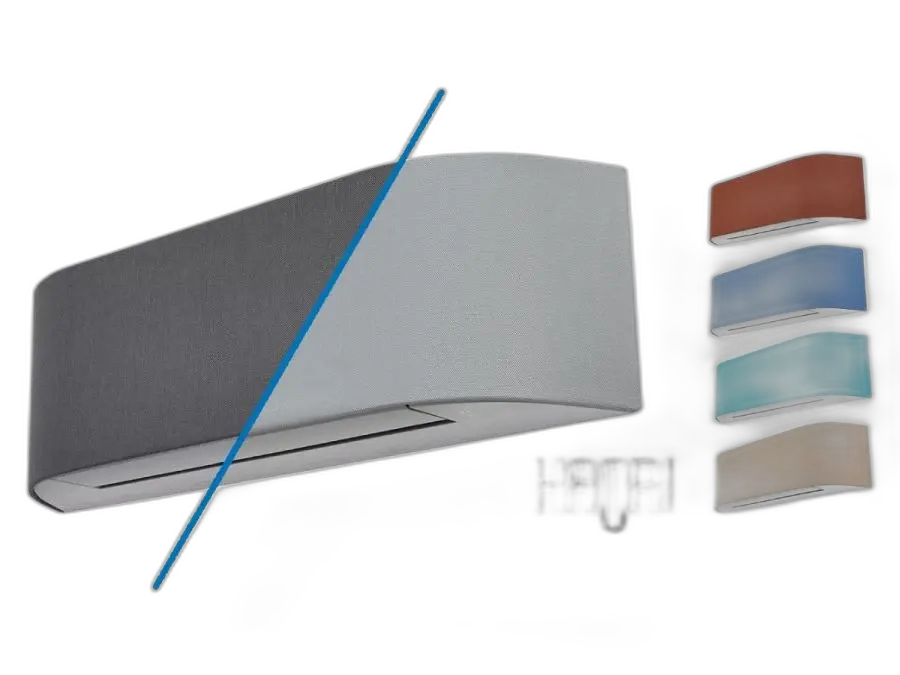
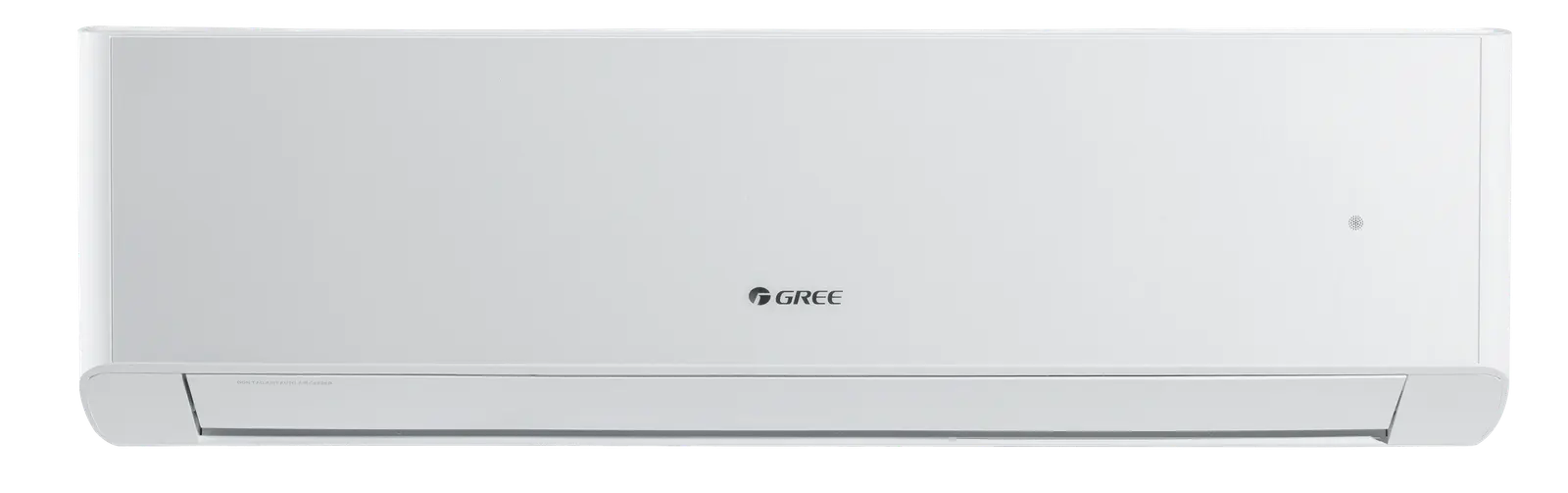
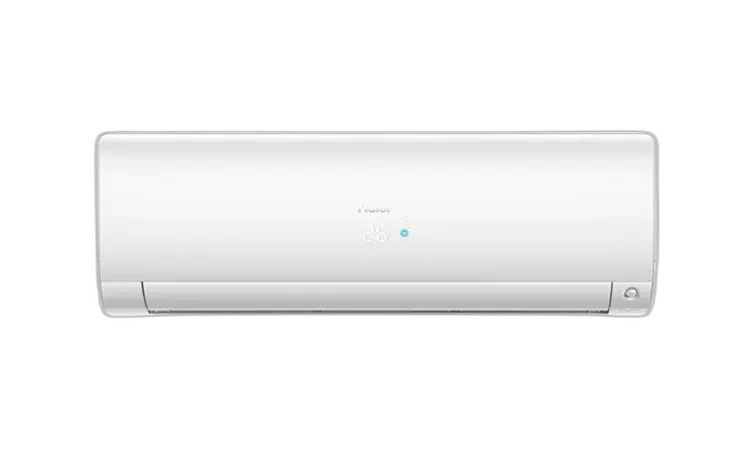
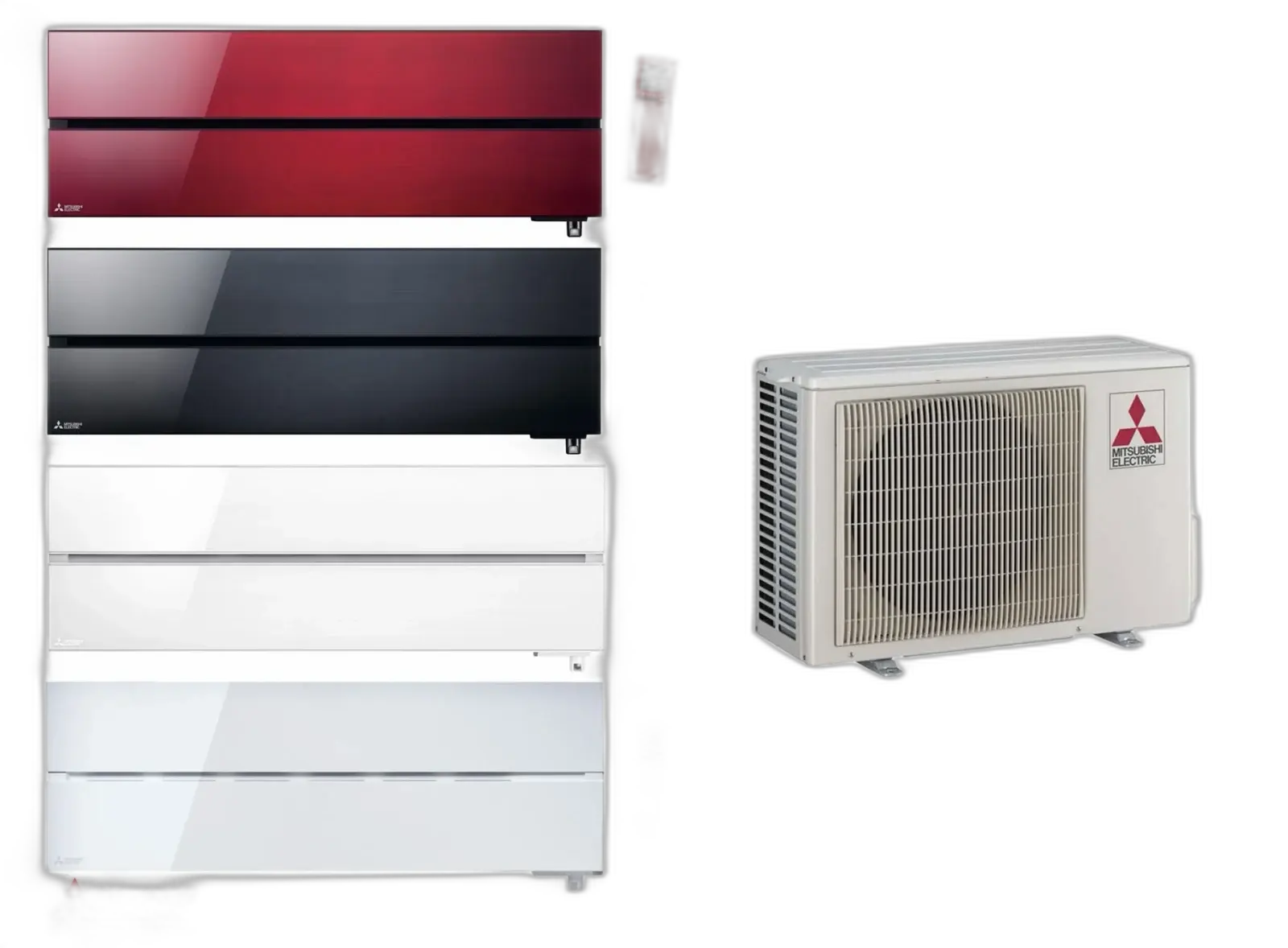
For flats we recommend the units we know from our own installations and servicing, not from brochures. Quiet and good-looking: the Toshiba Haori in its textile casing and the Mitsubishi Diamond — favourites for bedrooms. Energy efficiency: the Gree Amber Prestige in the A+++ class. Budget safe bets: Haier, Hyundai and Gree Pular — simple to operate and cheap to service. We hold these manufacturers' authorisations, so every installation keeps the full factory warranty.
Brands We Work With
Authorized service and installation
Products
Tried-and-tested models from authorised distributors. Price always includes installation.
Air conditioning for a flat — frequently asked questions
Short, concrete answers to the questions we hear most often from owners of Warsaw flats.
How much does air conditioning for a flat cost in Warsaw?
Air conditioning with installation runs 3 400–6 500 zł gross for a studio or one room, 7 500–13 000 zł for two rooms, and 11 000–18 000 zł for three. Installing a unit you supply yourself starts from 1 600 zł. The price depends on the unit's class, the route length, the condensate pump and the building — a tenement can be 10–15% more than a block. All figures include the 8% VAT due on flats up to 150 m².
Do I need the consent of the housing community or cooperative to install air conditioning in a block?
In most cases yes — the façade and external wall are common parts of the building, so an outdoor unit on the wall requires the consent of the community or cooperative administration. A balcony or loggia is easier: a unit within the footprint, with no drilling into the façade or balustrade, usually needs only the property manager's consent or a notification. Each building has its own regulations, so we check them before the quote. The documents — application, noise sheet, route diagram, insurance — we prepare for you free.
What if the community does not agree to an outdoor unit?
You have several ways out. The simplest: move the outdoor unit into the balcony or loggia footprint — that usually needs no resolution. The second: a monobloc with no outdoor unit, requiring only two Ø160 penetrations with discreet grilles; it costs 6 000–9 000 zł and is louder than a split, but solves the consent problem. The third, temporary: a portable air conditioner. It is also worth resubmitting with a quieter model and a dB sheet attached — many refusals stem from fears about noise, not principle.
Can an air conditioner be installed on a balcony or loggia?
Yes — it is the most common location for the outdoor unit in Warsaw flats. We place the unit on anti-vibration feet, which damp the vibration transmitted to the structure, and position it for free airflow: an outdoor unit “choked” in a tight corner loses efficiency and runs louder. We keep the service clearances from the walls and balustrade too. Installation within the footprint does not touch the façade, so the formalities are simpler and the balcony stays usable — a typical unit is smaller than a washing machine.
What air conditioning for a 40–50 m² flat?
Reckon on about 100 W of cooling capacity per square metre — for 40–50 m² that is 4–5 kW, but a whole flat is rarely cooled with one unit. The most common choice is a 3.5 kW split in a living room with a kitchenette, which with the doors open lowers the temperature in the other rooms too. To cool a closed bedroom independently, a multi-split or two separate splits is better. On the top floor we add about 350 W in reserve. We confirm the final choice with a free survey — an oversized unit costs more and dehumidifies worse.
How much electricity does air conditioning in a flat use?
An A+++ 3.5 kW inverter split (SEER ≥ 6.1) cooling 6 hours a day uses about 100–130 kWh a month — at 1.15 zł/kWh that is 115–150 zł in a really hot month. A single evening of cooling costs 1.5–2 zł. Outside the peak of summer the consumption is distinctly lower, because after cooling the room the inverter only maintains the temperature. You lower the bill further by setting 24–25 °C instead of 20 °C and using schedules rather than round-the-clock operation.
Can air conditioning heat a flat?
Yes — every split we install is an air-to-air heat pump. At a SCOP of 4 and above, the unit gives back about 4 kWh of heat from 1 kWh of electricity, several times cheaper than an electric radiator. It works best in the transitional months — March, April, October and November — before the district heating starts or once it has gone off. In Warsaw flats this is often the deciding argument: one unit settles both the heatwaves and the chilly mornings.
How loud is the air conditioning, and does the outdoor unit disturb the neighbours?
The indoor unit runs at 19–24 dB — in night mode quieter than a whisper, so you can sleep beside it. The outdoor unit generates 45–52 dB right by the casing, less than a busy street. The rules set limits near multi-family buildings of 55 dB by day and 45 dB at night; we meet them with quiet models, anti-vibration feet and a night mode. We choose the location so the air outlet does not point at the neighbours' bedroom windows.
How long does it take to install air conditioning in a flat?
We install a standard split in 3–5 hours, and a multi-split with two or three indoor units in one working day. We work in occupied flats every day: we cover the floors and furniture with sheeting, collect the drilling dust with an industrial vacuum cleaner straight at the bit, then clean up and put the furniture back. You do not have to take a whole day off. By the evening of the same day the air conditioning is already cooling.
Do you install air conditioning in tenements and in prefab concrete blocks?
Yes, it is our everyday work. In a tenement we reckon with solid brick walls 60–80 cm thick, run the route in a chase or above the mouldings, and plan the outdoor unit from the courtyard — for a listed building we also help with the heritage conservator's opinion. In a prefab concrete block we use chemical anchors and place the outdoor unit on the loggia on anti-vibration feet, with no interference with the façade, which speeds up the cooperative's consent. The two building types need different equipment and documents.
Can air conditioning be installed in a rented flat?
Yes, provided the owner's written consent — installation requires drilling into the walls, so a verbal promise is not enough. The formalities with the community are identical to those for an owner-occupied flat; the application is submitted by the owner, or by the tenant with their power of attorney. Increasingly, owners finance the split themselves, because a flat with air conditioning rents out faster and for more. If the owner refuses, a portable air conditioner remains — needing no consents or interference with the flat.
Where is the condensate from an air conditioner in a block drained to?
Best of all by gravity: we run a line with a fall to the outside or into the wastewater riser — as the building's regulations allow. When a fall cannot be achieved, for instance with a unit deep inside the flat, we fit a quiet condensate pump (a surcharge of 400–700 zł) that pushes the water to a drainage point. What we never do: let condensate out “onto the façade”, dripping onto a neighbour's balcony or windowsill — the shortest road to a dispute and a removal order.
Install air conditioning in your flat before the heat arrives
The closer the heat, the longer the queue for installation — in spring the slots are shortest, and the communities can still meet before the holidays. Send three photos and the floor area: you will get the quote in 24 hours, and we will prepare the survey and the application to the community for free.