Professional service for split, multisplit, cassette and ducted air conditioning systems across the whole of Warsaw. F-Gas certificate, 12-month warranty, same-day call-out.
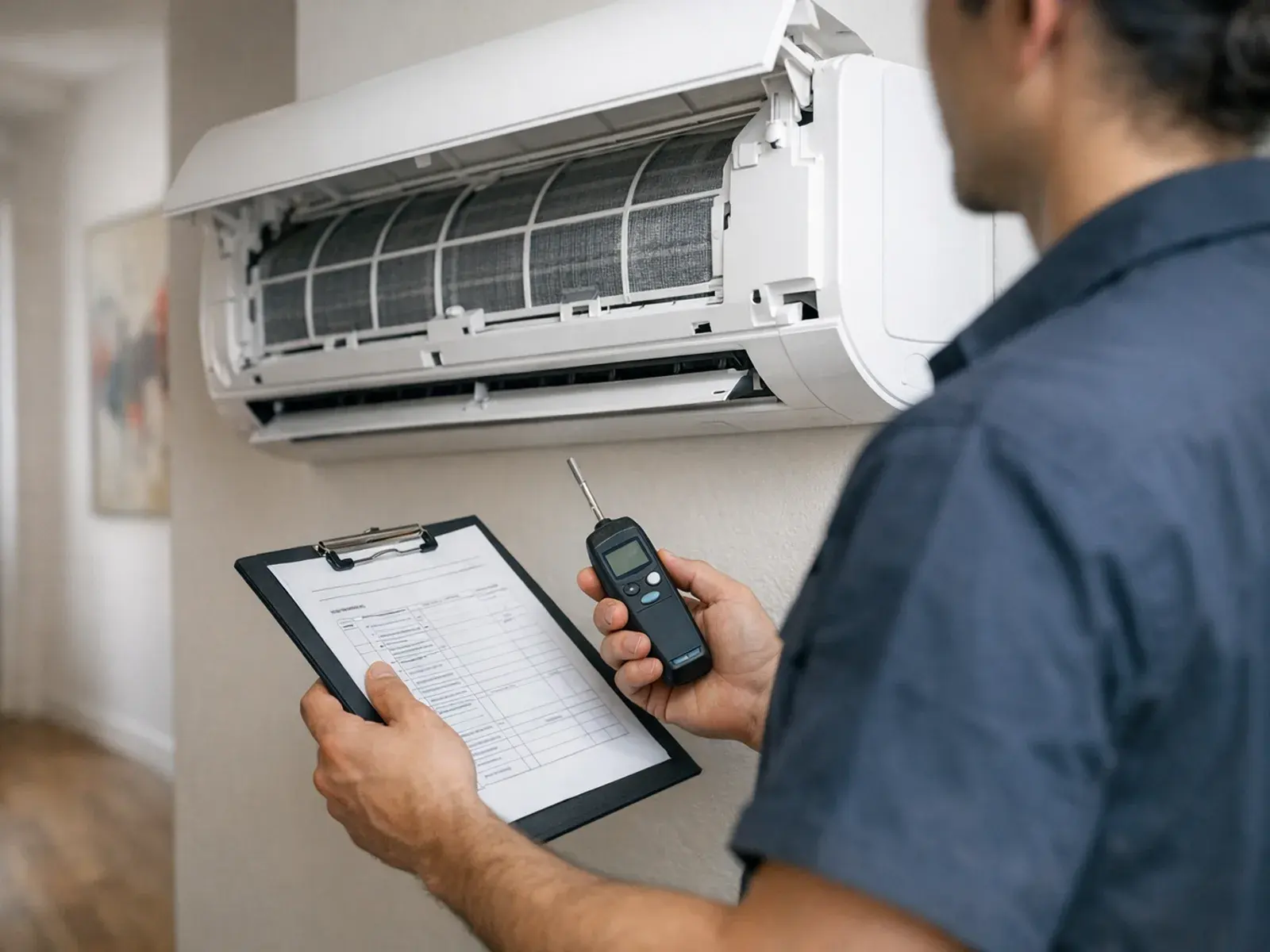
We do not limit ourselves to spraying a mould treatment — every visit ends with a measurement report and a unit record card.
01
Certified technicians with F-Gas authorisation
Every LeoKlima technician holds an individual F-GAZ-P certificate and the company holds the F-GAZ-S company certificate. Every inspection or leak test ends with an entry in the Central Operators Register (CRO) in compliance with EU Regulation 517/2014. Beyond the F-Gas authorisations, our technicians have completed manufacturer training with Daikin, Mitsubishi Electric and Toshiba — they know the specifics of particular control systems, not just general HVAC principles. The certificate number appears on every service report.
02
Full diagnostics, not just cleaning
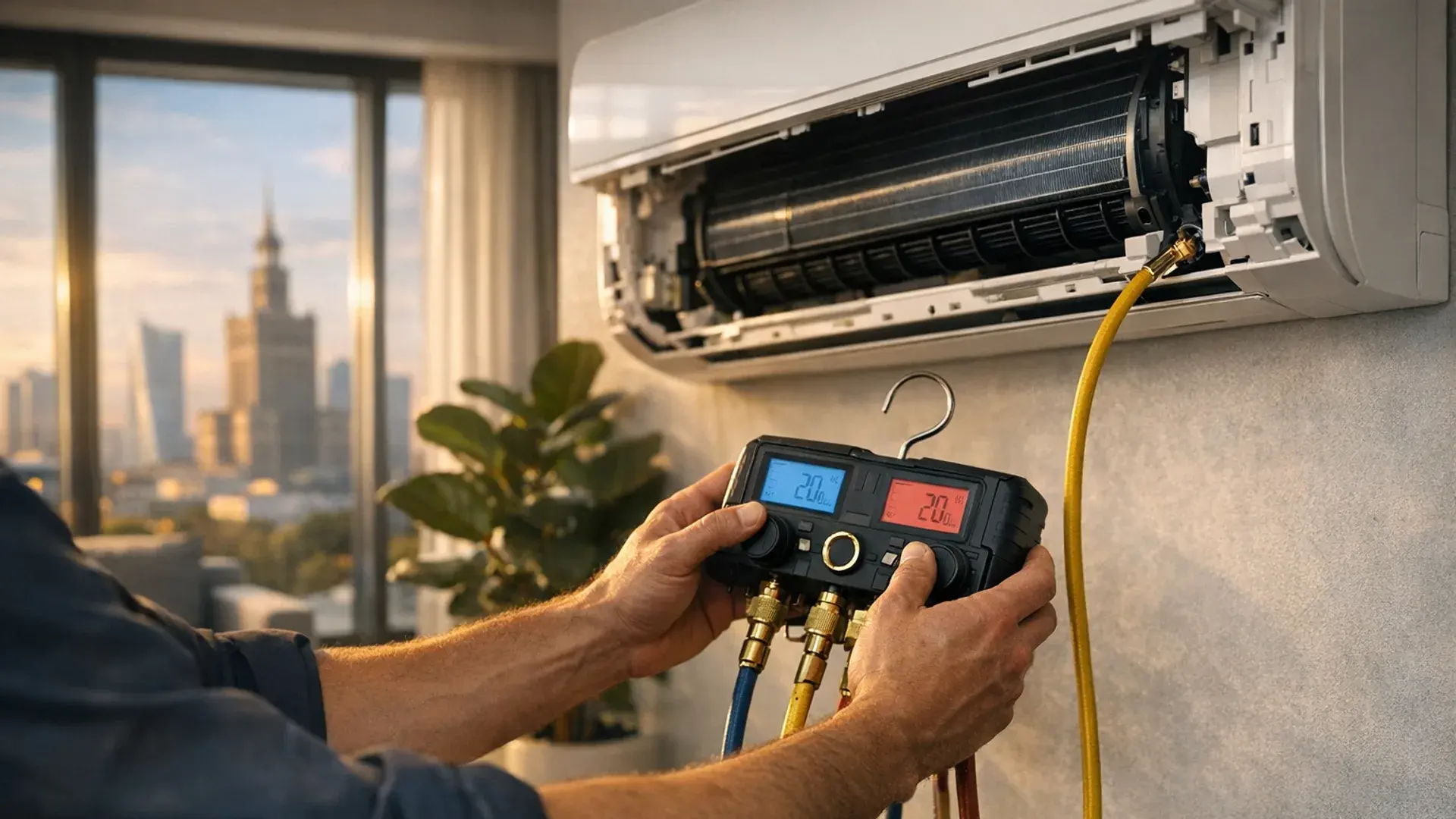
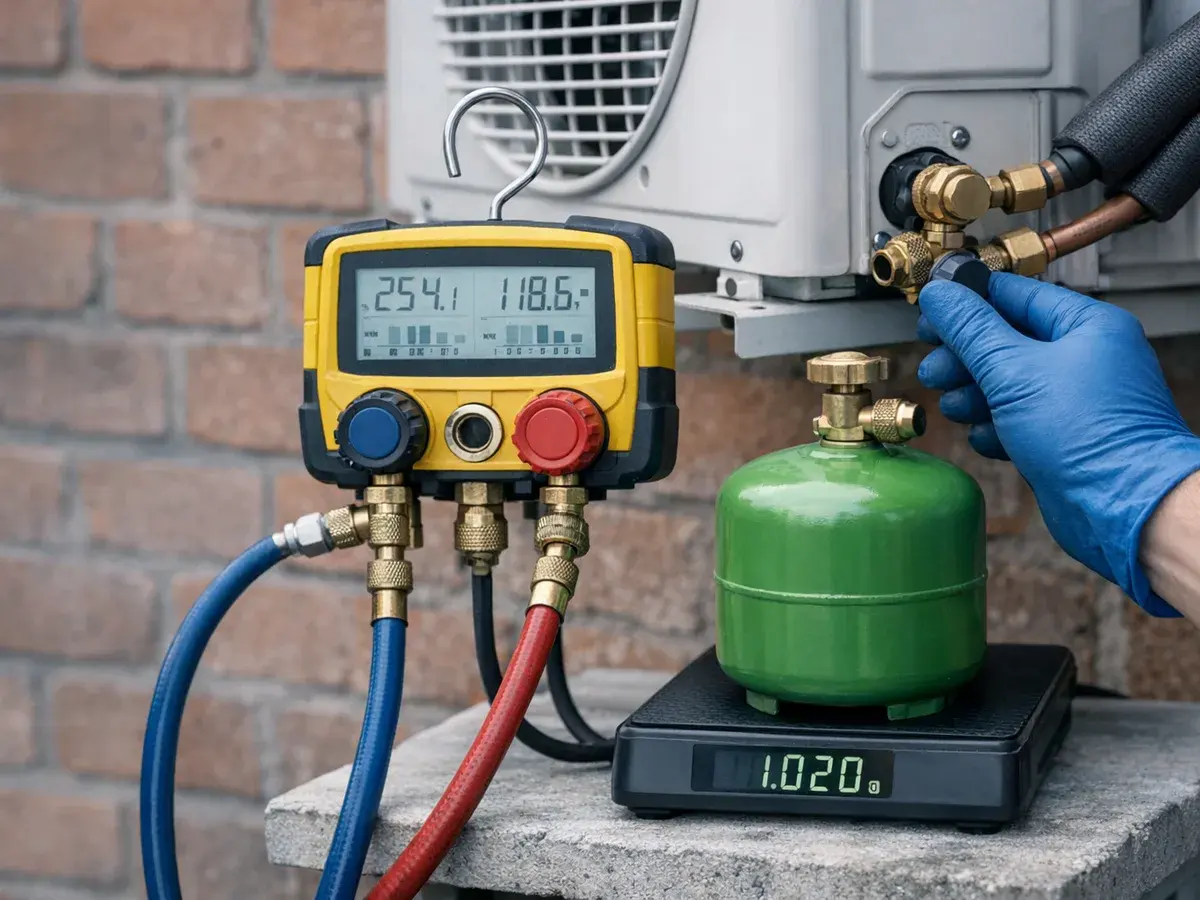
We follow a 12-point protocol: manifold pressure readings, nitrogen leak test, compressor and fan motor current measurement, supply voltage check, evaporator and condenser inspection, filter and condensate tray cleaning, drain line clearance, evaporator delta T, sensor calibration and error code read-out. You receive a report with actual measured values — not a vague assurance that everything is fine.
03
Same-day call-out across all of Warsaw
In the summer season (May–September) the average response time from booking to technician arrival is 4–6 hours. We cover all 18 Warsaw districts with no travel surcharge within the ring road. Outside Warsaw — Pruszków, Marki, Ząbki, Piaseczno, Legionowo, Łomianki, Konstancin-Jeziorna — travel is agreed individually. We understand that no cooling in hot weather is not merely a comfort issue but one of health and productivity.
04
Transparent pricing with no hidden charges
A written quote before any tools are touched. If diagnostics reveal something beyond the basic scope, we stop and ask for authorisation — we do not present a surprise on the invoice. Travel within the ring road is free regardless of the visit outcome. Every line item on the estimate is named.
05
12-month warranty on every repair
Written 12-month warranty on labour and fitted parts — with a job number, no searching through papers. On compressors the warranty also covers a free return call-out. Warranty claims: response within 48 hours.
06
Unit record card and report compliant with EU Reg. 517/2014
For every unit we create or update the record in the CRO database: leak test results, service history, refrigerant data. Documentation in line with the Polish F-Gas Act (Journal of Laws 2015, item 881) and EU Regulation 517/2014. Absence of the record carries a fine of up to 30,000 zł. For commercial installations we issue a report ready for UDT audit.
Introduction
AC service in Warsaw — what it is and why it matters
Air conditioning manufacturers recommend a minimum of two inspections a year: a spring service before the cooling season (March–April) and an autumn service after it (October–November). This is not marketing — it is a condition for maintaining the warranty. In practice, Warsaw residents often conflate four distinct operations: a periodic inspection covers pressure, leak and electrical checks; maintenance means cleaning the heat exchangers and the condensate drainage system; repair involves replacing damaged components; and evaporator cleaning and mould treatment is a separate chemical procedure using enzymatic foam and ozonisation. Simply pulling out the filter and rinsing it under the tap accounts for less than 10% of what a proper AC service entails.
Neglected AC servicing raises electricity consumption by 20–30% — a dirty evaporator forces the compressor to run longer for less cooling effect. The compressor is the most expensive component: replacement costs 1,200–3,500 zł, often more than a new unit. An uncleaned evaporator harbours Cladosporium and Aspergillus moulds and Legionella pneumophila bacteria — all of which cause respiratory illness and are particularly dangerous for children, elderly people and allergy sufferers. Loss of the manufacturer's warranty after a missed scheduled service is another consequence that dealers rarely mention at the point of sale.
LeoKlima has been operating in the Warsaw market for over 12 years. In that time we have serviced more than 8,000 indoor and outdoor units within the ring road. We hold the company F-GAZ-S certificate and individual F-GAZ-P certificates for every technician — which means we carry out leak testing and enter results into the CRO register ourselves, rather than subcontracting it. The LeoKlima approach is a full 12-point protocol with actual measured values, an updated unit record card and a written warranty — not a one-off mould spray and out of the door in 20 minutes.
F-GAZ-S
UDT certificate
Scope of service
What does AC service in Warsaw cover?
From periodic inspection to F-Gas leak testing — a complete range of service operations in one place.
Periodic AC inspection
12-point protocol: manifold pressure readings, nitrogen leak test, compressor and fan motor current measurement, supply voltage check, evaporator and condenser inspection, filter and condensate tray cleaning, drain clearance, evaporator delta T, sensor calibration, error code read-out, CRO card update. The client receives a report with numerical values.
Every 6 months, flats and offices
Evaporator cleaning and mould treatment
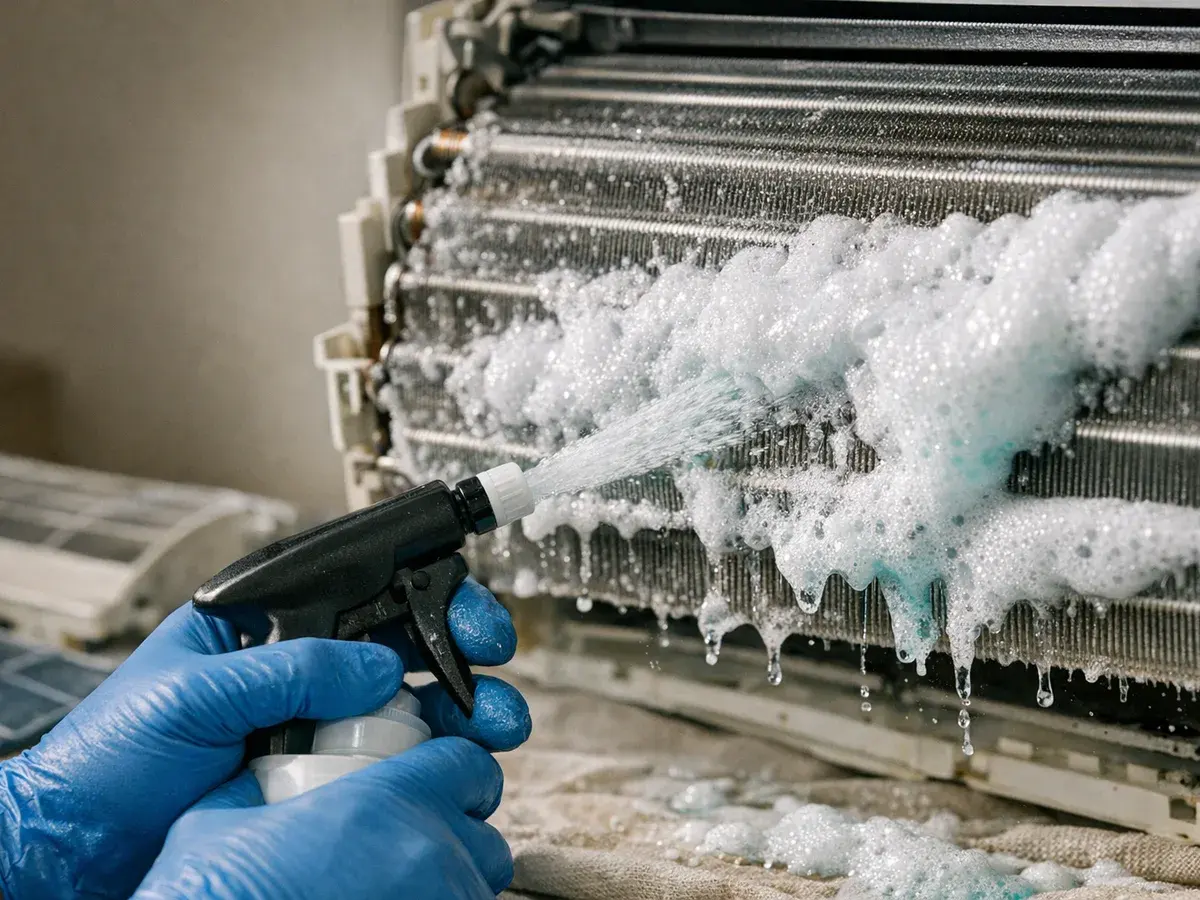
A chemical procedure removing moulds (Cladosporium, Aspergillus) and bacterial biofilm from the heat exchanger and the condensate drainage system. We use a biodegradable enzymatic foam that penetrates the evaporator fins and breaks down organic contaminants. We then flush the evaporator with distilled water, clean the condensate tray and disinfect the drain pipe. The cycle concludes with 30 minutes of ozone treatment inside the unit. Result: elimination of the source of unpleasant odours and disinfection of the air blown into the room.
Unpleasant odour, allergy sufferers, households with children
AC fault repair
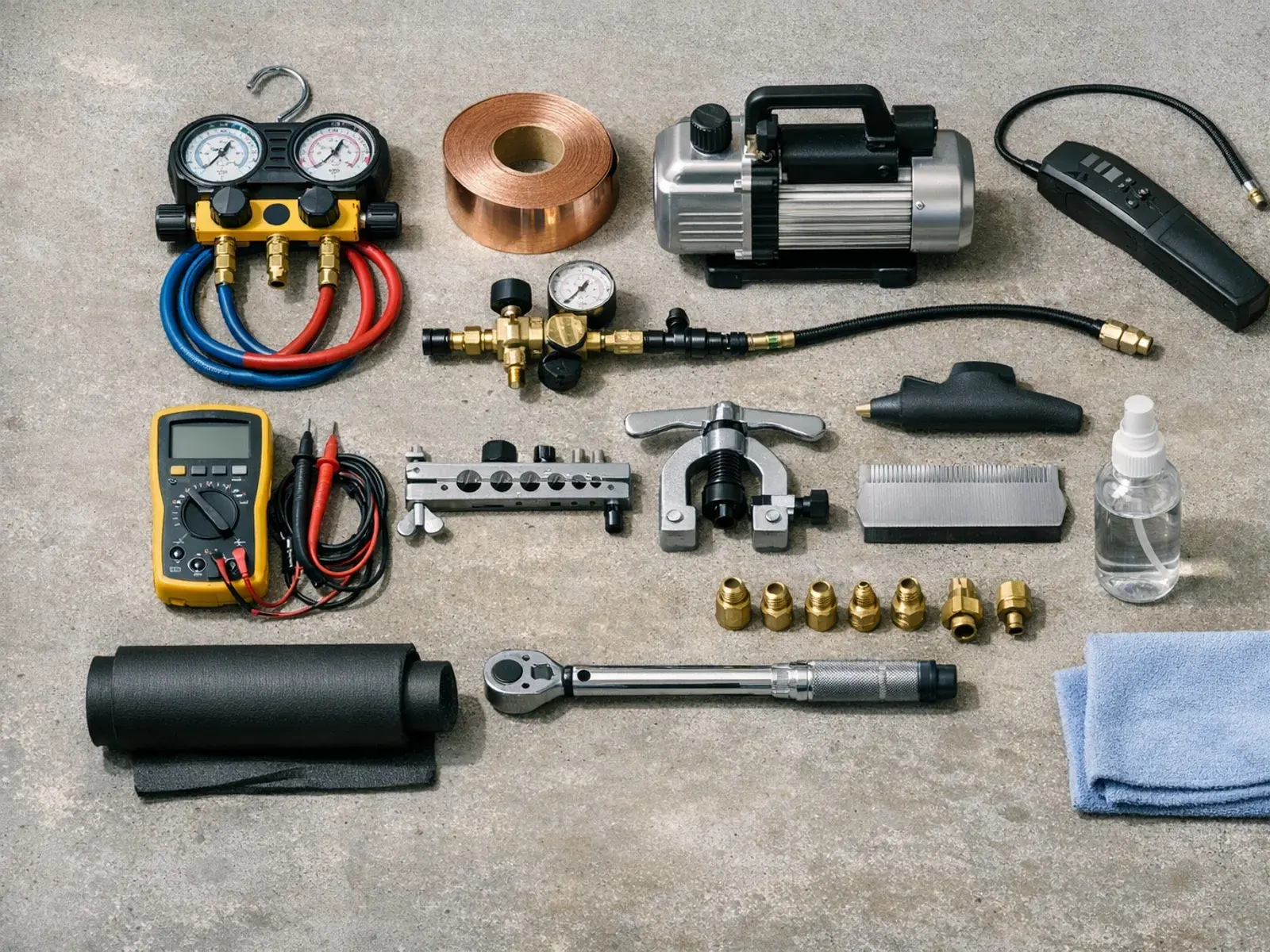
Fault diagnosis starts with reading error codes and taking electrical measurements. For leak detection we work sequentially: an electronic fluorescent detector, UV dye injected into the system, and a nitrogen pressure test. Once the fault is located: we replace damaged flares or short pipe sections, replace compressors and starting capacitors, repair or replace PCB control modules, and replace fan motor units (both indoor and outdoor). Every replaced part carries a 12-month warranty covering the part and labour.
No cooling, water dripping, noisy operation
Refrigerant top-up R32/R290
A correct refrigerant top-up is a multi-stage procedure: we first recover any remaining refrigerant using an F-Gas-certified recovery unit, evacuate the system with a rotary pump to a minimum of 500 µm Hg and hold that vacuum for at least 30 minutes (to verify absence of moisture), and only then charge the new refrigerant by weight in accordance with the unit's technical data sheet. Every gram of refrigerant is logged in the CRO unit record. We work with R32, R410A and R290 — we use the refrigerant specified in the technical data sheet, not a substitute.
Reduced cooling capacity
F-Gas leak test
Mandatory leak testing applies to units containing 5 t CO₂ eq or more — for example a multisplit unit with 7.4 kg of R32 or 2.4 kg of R410A. The test may only be carried out by a technician holding an F-GAZ-P certificate. Procedure: electronic detector on fittings and valves, optional nitrogen test, documentation in a CRO protocol. The CRO entry is accessible to the Office of Technical Inspection (UDT) and the Environmental Protection Inspectorate. Absence of the test or its absence from the CRO register carries a fine of up to 30,000 zł.
Multisplit, VRF, commercial installations
Creating and updating the CRO unit record
The unit record in the Central Operators Register (CRO) is mandatory for every installation containing F-Gas refrigerant with a CO₂ equivalent mass of ≥5 t. We create the record for new installations after commissioning and update it after every leak test and every refrigerant charge or recovery. The entry contains: refrigerant type and mass, leak test results with date, operator and technician details. The record is accessible online from anywhere — useful when selling a property and for environmental audits.
From a small wall-mounted split to a commercial VRF system — each type has its own service requirements.
Wall-mounted split
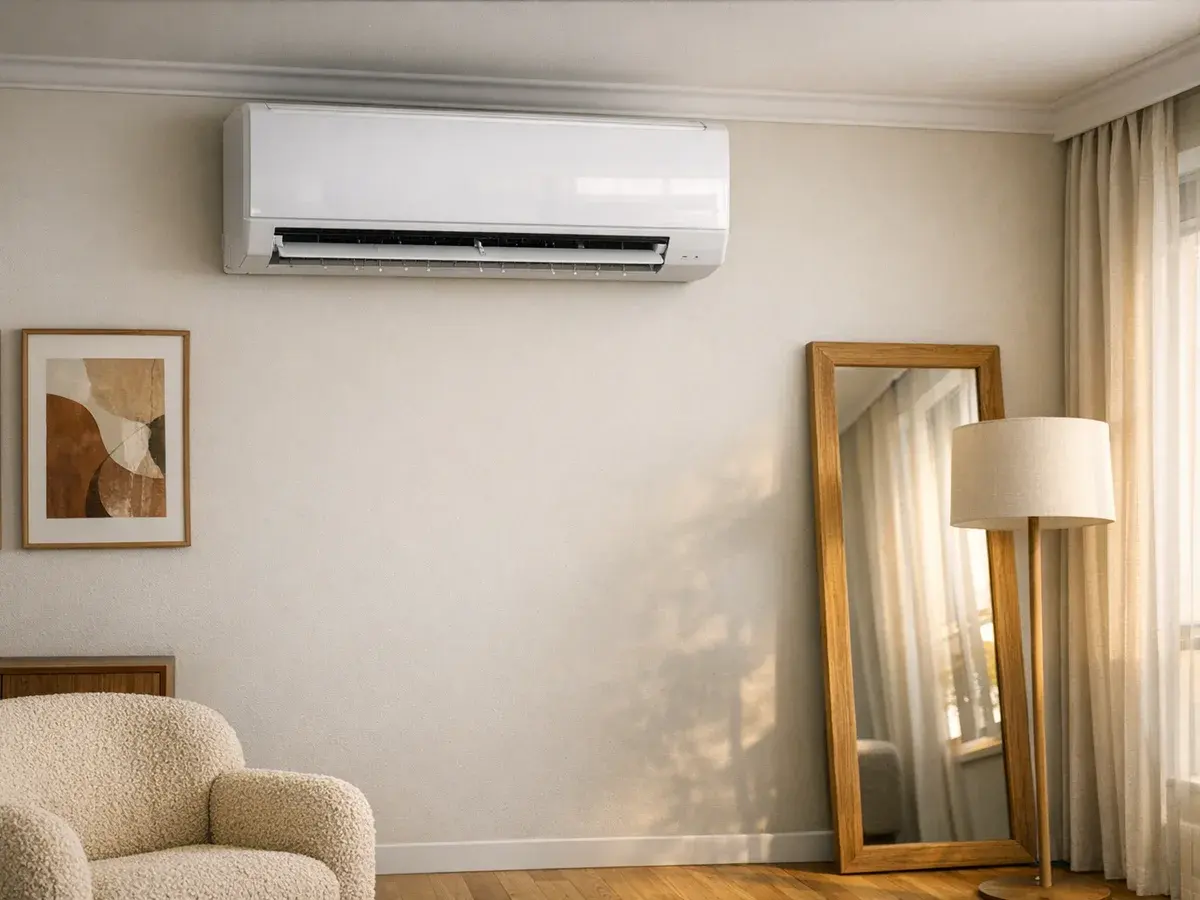
The most popular type in Polish flats and small offices. The indoor unit is mounted high on the wall, the outdoor unit on the building facade or balcony. Service covers filter, evaporator and condensate tray cleaning, refrigerant pressure check for R32 or R410A, and compressor and fan current measurement. Access to the indoor unit is usually straightforward, which keeps the service visit to 30–50 minutes.
Flats, offices up to 35 m²
Multisplit (2–5 indoor units)
One outdoor unit serves between two and five indoor units — wall splits, cassettes or ducted units in different rooms. Servicing a multisplit requires checking the refrigerant balance across the entire system and the correct operation of each indoor unit individually. We pay particular attention to the branching valves, the master controller and the communication between units. The CRO protocol covers the entire system as a single installation.
Houses, larger flats
Cassette (4-way cassette)
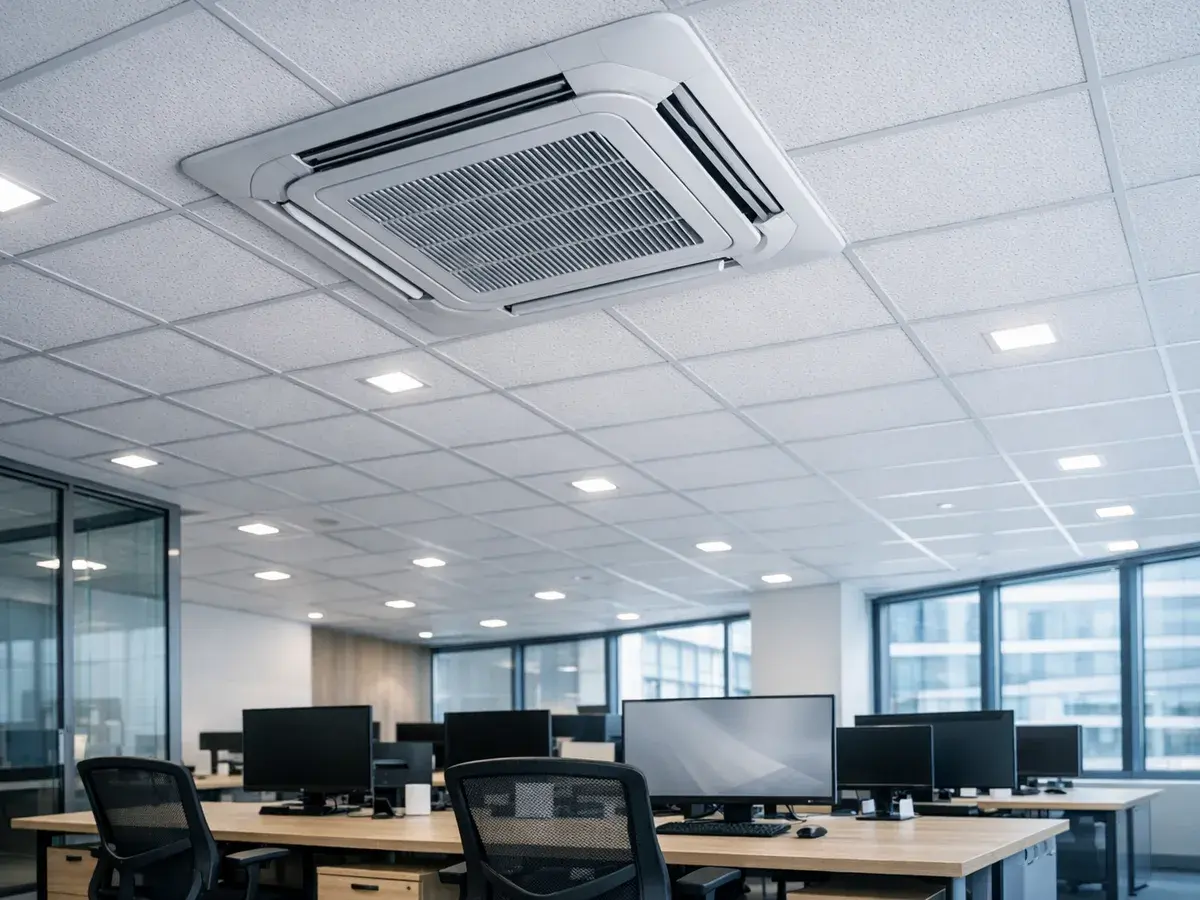
The indoor unit is mounted in a suspended ceiling — four-directional airflow through grilles in the panel. Service requires access to the ceiling void or a lift platform. We clean the cassette filter, evaporator, condensate tray and condensate pump — the last of these is a frequent cause of suspended-ceiling flooding and needs regular attention. Mounting inside a suspended ceiling restricts natural ventilation of the outdoor unit — we check condensing temperature.
Offices, shops, conference rooms
Ducted (concealed)
The indoor unit is hidden in the ceiling; supply and return air pass through a network of sheet-metal or flexible ducts. Servicing a ducted unit requires access through ceiling inspection panels and an inspection of the ducts for leaks and contamination. We clean the heat exchanger, filters and condensate pump, and check the duct sealing. Airflow measurement is critical — blocked supply grilles or a dirty filter cause evaporator icing.
Houses with suspended ceilings, boutiques
Floor/ceiling unit (UFCC)
A versatile indoor unit type mounted at floor or ceiling level — without any work to the walls. Popular in commercial premises and showrooms with glass walls. Service is similar to a wall split, but access to the evaporator and filters is easier thanks to the front service panel. We check the mounting and seating in the bracket and the condition of the acoustic seals.
Commercial premises, showrooms
VRF / VRV (Variable Refrigerant Flow)
Commercial systems with variable refrigerant flow: one or more outdoor units serve multiple indoor units. VRF service requires the manufacturer's diagnostic software (Daikin VRV, Mitsubishi City Multi, Toshiba SMMS). We check error codes, refrigerant balance, EEV valves and communication between units.
Office buildings, hotels, large floor areas
Fault symptoms
Identify the symptom — we find the cause
Every symptom has several possible causes. On-site diagnostics let us pinpoint the right one on the first visit.
Likely causes
R32/R410A refrigerant leak — system pressure below normal
Dirty evaporator or condenser — restricted airflow and heat exchange
Failed compressor or starting capacitor — compressor not reaching full capacity
What we do
Manifold pressure reading + leak location with electronic detector and UV dye
Heat exchanger cleaning and indoor/outdoor fan check
Refrigerant charge after vacuum, or compressor replacement with 12-month warranty
We know these faults inside out — most are resolved during a single visit.
Refrigerant leak
The most common cause of reduced cooling capacity. Leaks typically occur at flared pipe joints or at service valve fittings. Diagnosis proceeds in three stages: an electronic detector identifies the area of the leak, a nitrogen pressure test (without refrigerant, for safety) pinpoints the location, and UV dye under a lamp confirms the exact spot. After locating the fault we replace the affected pipe section or re-flare the joint, then evacuate and charge the refrigerant by weight.
Repair time
1–3h
Warranty
12 months
Compressor failure
The most expensive refrigeration component — diagnosis must be certain before a replacement decision is taken. We measure start-up and running current, test the starting capacitor and check the motor winding resistance. Sometimes the compressor is electrically sound but mechanically seized — an attempt to free it is the first step. If replacement is economical relative to a new unit, we fit the compressor and charge refrigerant with a CRO protocol.
Repair time
3–5h
Warranty
12 months on the compressor
PCB control module failure
PCB damage is a typical result of mains surges during storms or a faulty UPS. We replace both indoor unit modules (airflow, motor, louvre control) and outdoor unit modules (inverter compressor control). After replacement we calibrate the controller parameters to the technical data sheet and run a test in both cooling and heating mode. Modules are sourced within 24–48 hours for popular Daikin, Mitsubishi, Toshiba and Panasonic models.
Repair time
1–2h
Warranty
12 months
Condenser fan motor failure
A failed outdoor unit fan motor means noisy operation, rising condensing temperature and compressor overheating. We replace the fan motor together with the starting capacitor — these two components wear together. After replacement we measure the new motor's current draw and the condensing temperature under load to confirm a return to normal operating parameters.
Repair time
1–2h
Warranty
12 months
Urgent service
AC breakdown? We respond the same day
In the summer season, no cooling is not a luxury issue — it is a matter of comfort and health. Response time during working hours is 4–6 hours from the booking. Out of hours: send an SMS or WhatsApp message to 502 010 010 and the technician will confirm a visit for the following day.
Mon–Sat 7:00–22:00, Sundays and bank holidays — SMS/WhatsApp
5 steps from booking to report — no mess, no surprises.
1
Booking online or by phone
Submit the form on the website, call 502 010 010, message on WhatsApp or send an e-mail. Describe the symptoms — what the AC is doing or not doing — and give the brand and model. The more detail you provide, the more accurate a preliminary quote we can give over the phone. In-season slots (May–August) book up 2–3 days ahead; out of season we usually have availability the same or next day.
2
On-site diagnosis
The technician carries out the full 12-point diagnostic protocol: low and high side pressure readings, leak test, electrical checks, compressor and fan motor current, visual inspection of the evaporator, condenser and condensate tray, and error code read-out from the controller. Diagnostics take 30–60 minutes and give a complete picture of the unit's condition — whether you are booking an inspection or a repair for a specific fault.
3
Quote and authorisation
Based on the diagnosis we prepare a written quote split into labour and parts. The quote is presented to you before any tools are touched. Without your authorisation we do not carry out any work beyond the basic diagnostics. If the scope changes during the work (for example an additional leak at another fitting), we stop and ask again.
4
Repair, inspection or cleaning
We carry out the agreed work using genuine replacement parts and F-Gas-certified refrigerant. For repairs: we replace faulty components, charge refrigerant by weight after vacuum, and test the unit in both cooling and heating mode. For inspections: we clean all system components, measure parameters and complete the report. Standard working time: 1–3 hours.
5
Report and unit record card
On completion we issue a written service report with the date, scope of work and measured parameter values. We update the unit record card in the CRO database (refrigerant entry, leak test results, service date). We issue a VAT invoice and a written warranty for the work carried out, with the job number. Documents can be e-mailed. The entire process takes about 10 minutes after the technical work is finished.
Coverage
AC service across all Warsaw districts
We cover all 18 Warsaw districts with no travel surcharge. In the summer season the average response time from booking to technician arrival is 4–6 hours. Out of season, usually the same or next working day. We also cover areas around Warsaw.
F-Gas and air conditioning — your obligations as the owner
The Polish F-Gas Act (Journal of Laws 2015, item 881) and EU Regulation 517/2014 place specific obligations on the operator of an air conditioning installation: creating the unit record in the CRO, carrying out regular leak tests, and documenting every operation involving F-Gas refrigerant. Fines for non-compliance reach 30,000 zł and are enforced by the Environmental Protection Inspectorate. The obligations apply even to flat owners with a multisplit installation.
Unit record in the CRO database
The unit record in the Central Operators Register is mandatory for every installation containing ≥5 t CO₂ eq of F-Gas refrigerant. For R32 (GWP 675) this is approximately 7.4 kg; for R410A (GWP 2088) only 2.4 kg. Many multisplit installations exceed this threshold. The record may only be created by a technician holding an F-GAZ-P certificate. Absence of the record or a missing entry after service carries a fine of up to 30,000 zł. LeoKlima creates and updates unit records for all installations we service.
Leak test frequency
Leak test frequency depends on the refrigerant charge: installations of 5–50 t CO₂ eq — annually; 50–500 t CO₂ eq — every 6 months; ≥500 t CO₂ eq — every 3 months. The test may only be performed by a technician with an F-GAZ-P certificate. The result must be entered in the CRO unit record within 30 days of the test. Installations fitted with a fixed leak detection system (typical in large office buildings) qualify for less frequent testing.
R410A phase-out and the move to R32/R290
The European Union is implementing a gradual phase-down of high-GWP F-Gases from 2025. R410A (GWP 2088) faces the strictest restrictions — production and import quotas are being tightened progressively, and prices are rising. R32 (GWP 675) and R290 (propane, GWP 3) are the refrigerants of the future. If your air conditioner is over 8–10 years old and needs an R410A top-up after a leak, it is worth comparing the cost of the repair against the cost of upgrading to an R32 or R290 unit. LeoKlima will advise which option makes financial sense.
Case studies
Example service jobs in Warsaw
A few specific recent jobs — as they happened.
Mokotów
Multisplit Daikin inspection in a 78 m² flat
Outdoor unit 5MXM100A + 3 indoor units FTXM25/35. Full 12-point service protocol for each unit, evaporator cleaning with enzymatic foam, filter replacement, CRO unit record update. Approximately 2.5 hours of work. The client received a report with pressure and current values for each unit separately.
Śródmieście
Refrigerant leak repair in a 220 m² office
Mitsubishi Electric cassette unit — complaints of reduced cooling capacity. Leak detected at a flared joint on the outdoor unit using an electronic detector and UV dye. Flare repair, 45-minute vacuum, 1.2 kg of R410A charged by weight. CRO protocol and warranty invoice issued.
Wilanów
Mould treatment and filter replacement in a detached house
4 Mitsubishi Heavy Industries wall units after 5 years without service — strong mould smell. Evaporator mould treatment with enzymatic foam, condensate tray cleaning, 30-minute ozone treatment inside each unit, filter replacement. The client described the result as: the AC smells like new.
Praga-Południe
PCB failure and Mitsubishi Electric module replacement
E5 error on the indoor unit display — MSZ-AP35. Multimeter measurement confirmed damage to the PCB communication module after a mains surge. Replacement module sourced in 24h, controller calibrated, test in both heating and cooling mode. 12-month warranty on the module and labour.
Qualifications
LeoKlima certificates and qualifications
Formal authorisations are an essential requirement for reliable AC service — particularly for F-Gas work. Every job we undertake is carried out by a technician with valid certificates.
F-GAZ-S company certificate — authorisation to service refrigeration systems using F-Gas refrigerants
F-GAZ-P personal certificate — every technician holds an individual authorisation
UDT authorisation for hard and soft soldering (PN-EN 13585)
Health and safety + working-at-height authorisation up to 3 m (renewed every 12 months)
Brands
We service all leading AC brands
Daikin, Mitsubishi Electric, Mitsubishi Heavy Industries, Toshiba, Panasonic, Hitachi, LG, Samsung, Gree, Haier, Fujitsu, Rotenso, Sevra, AUX, Innova, Hyundai, Vivax and others. Your brand not on the list? Get in touch — we service virtually every brand available on the Polish market.
Brands We Work With
Authorized service and installation
FAQ
Frequently asked questions about AC service
Answers to the questions we hear most often before a first service visit.
How often should I service my air conditioning?
Manufacturers recommend a minimum of two inspections a year: a spring service (March–April) before the season and an autumn service (October–November) after it. In practice, for home users one inspection a year plus a mould treatment every 12–18 months is sufficient, provided the user cleans the filters every 4–6 weeks.
How much does AC service cost in Warsaw?
A periodic inspection from 283 zł gross per unit, cleaning with mould treatment from 344 zł, fault diagnostics 308 zł for the first hour. Travel within the Warsaw ring road is free. You will find the full price list with all line items in the pricing section above.
Do you service air conditioning installed by other companies?
Yes, regardless of who carried out the installation. We service every installation — from sole-trader installers to large companies. Before the inspection we survey the installation, create or update the CRO unit record, and issue a service report with full measurements.
What if the air conditioning has not been serviced for 3 years?
It needs a thorough service: chemical evaporator cleaning (enzymatic foam), a leak test, possible refrigerant top-up and filter replacement. Cost is typically 400–700 zł depending on the number of units. After full service the AC recovers its full cooling capacity.
Do you top up R410A refrigerant?
Yes, we top up R410A, although it is subject to the European phase-down from 2025. R410A prices are rising steadily. If there is a significant refrigerant loss, we recommend weighing the options: leak repair plus top-up versus upgrading to an R32 or R290 unit. We will provide specific figures after the diagnosis.
Does creating a CRO unit record require a certificate?
Yes. Only a technician holding an F-GAZ-P certificate may register an installation in the CRO database and enter the results of a leak test. All LeoKlima technicians hold individual F-GAZ-P certificates. The company holds the F-GAZ-S certificate, which is required to carry out F-Gas operations commercially.
How long does a periodic inspection take for a split AC?
30–50 minutes for a single wall split unit. A multisplit with 2–3 indoor units: 60–90 minutes. Add 15 minutes to the visit time for completing the report, updating the CRO card and discussing the results with the client.
Do you carry out service on Saturdays and Sundays?
Saturdays: standard working hours (7:00–22:00), no surcharge. Sundays and bank holidays: emergency call-outs only — contact by SMS or WhatsApp, and we agree a slot for the next working day. If a Sunday visit is required at the client's specific request, a 30% surcharge applies.
I live in a block of flats — do I need the building management's consent for a service?
No. Service and inspection are standard maintenance operations that require no administrative consent. The building management company's or housing association's consent was required only for the original mounting of the outdoor unit on the facade or roof.
Do you provide a warranty on repairs?
Yes, 12 months on parts and labour for every repair. The warranty is issued in writing with the job number. For replaced compressors the warranty covers 12 months plus a free return call-out for warranty claims. In the event of a warranty fault, response time does not exceed 48 hours.
What is mould treatment and is it really necessary?
Mould treatment is the chemical removal of Cladosporium and Aspergillus mould colonies and potential Legionella from the evaporator and drainage system. It is necessary when the AC produces an unpleasant smell, in households with children and allergy sufferers, and as a preventive measure every 12–18 months. Enzymatic foam penetrates the evaporator fins without dismantling the unit.
Which AC brands do you service?
Daikin, Mitsubishi Electric, Mitsubishi Heavy Industries, Toshiba, Panasonic, Hitachi, LG, Samsung, Gree, Haier, Fujitsu, Rotenso, Sevra, AUX, Innova, Hyundai, Vivax and others. If your brand is not on the list, please get in touch — we service virtually every air conditioner available on the Polish market.
Do you carry out commercial service (offices, shops, hospitality)?
Yes. We service both small offices with 1–3 units and large multisplit and VRF installations in office buildings, hotels, shopping centres and hospitality venues. For corporate clients we offer annual service contracts with a scheduled inspection programme and a 10–15% discount.
Is there a charge for travel outside Warsaw?
Within the Warsaw ring road, travel is included in the service price — 0 zł. Outside the ring road: 3.08 zł gross per km measured from Rondo Daszyńskiego. Pruszków, Marki and Ząbki are typically 25–40 km each way, meaning a travel supplement of 75–120 zł.