Air-to-Water Heat Pump — Complete 2026 Guide
A February morning on the outskirts of Warsaw, minus twelve degrees outside, and in the cellar a 2009 gas boiler hums on as it always has — steady, unfussed. Only the gas bills have stopped being calm: a 145 m² house after two partial thermomodernisation rounds, an invoice of PLN 1,380 for January, against PLN 720 three winters ago. The question comes back every winter — is a heat pump now a real alternative, or just another fashion that will leave behind breakdowns and an embarrassing forum thread five years later? Few household topics show such a sharp gap between manufacturer marketing and what the neighbour says after his first winter with one.
This guide walks through what actually decides whether an air-to-water heat pump succeeds or fails in a Polish house — how to calculate the required output, how underfloor heating differs from radiators, how to integrate a heat pump with an existing boiler in hybrid mode, what it costs in 2026, which subsidies apply and which installer mistakes to avoid. At LeoKlima we specialise in air conditioning and air-to-air heat pumps, but here we take the wider view — heat and cooling in the same house should be designed together, otherwise you end up buying two systems that fight each other.
What exactly is an air-to-water heat pump?
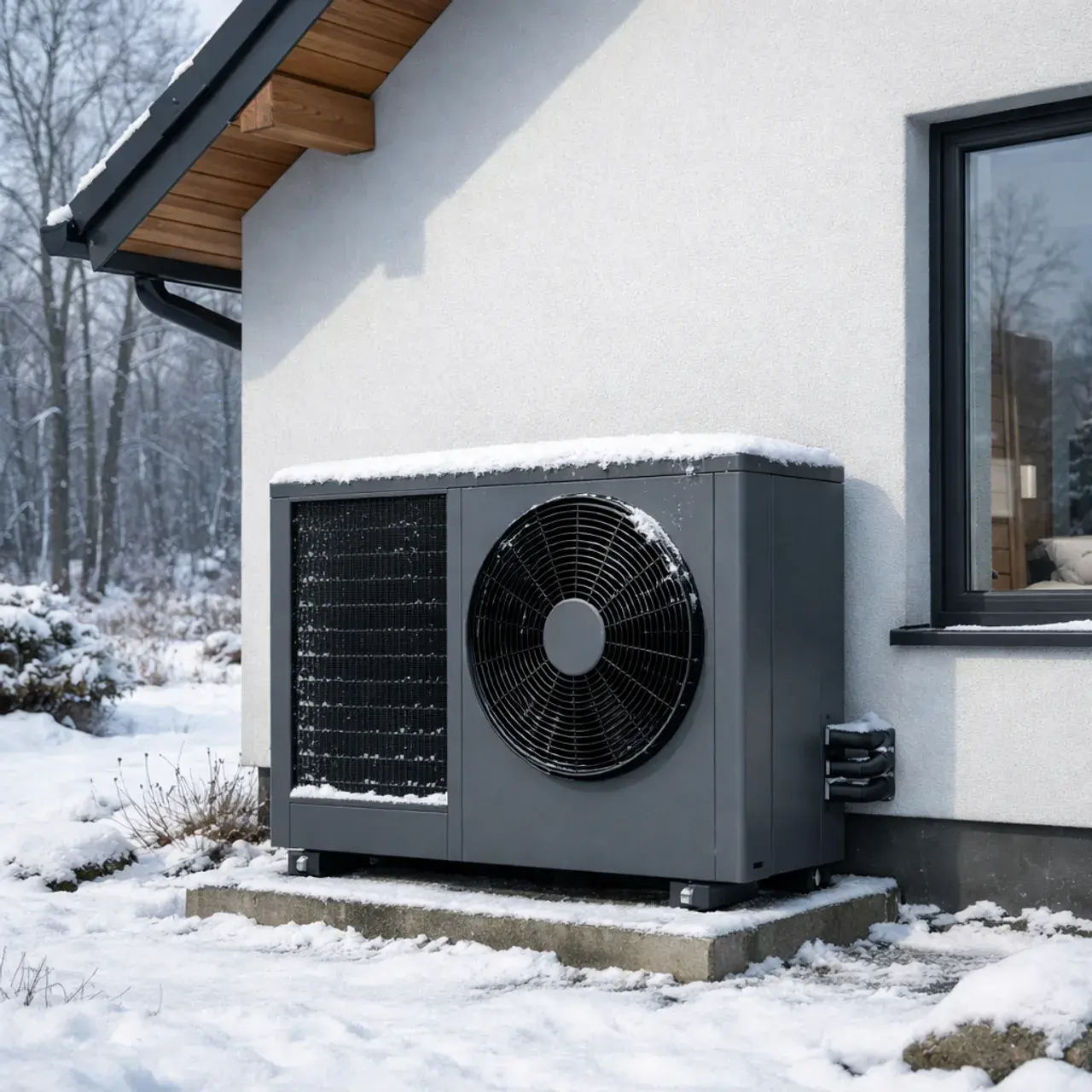
An air-to-water heat pump (often abbreviated AWHP) extracts heat from the outside air — even at sharply sub-zero temperatures — and transfers it to the water circulating in the home's central heating system and in the domestic hot water (DHW) cylinder. That is the fundamental difference compared with an air-to-air pump, i.e. the popular air conditioner with a heating function. An air-to-water pump heats the whole house through a wet heating circuit (underfloor heating, radiators, fan coils), whereas a split air conditioner heats the air in the single room where the indoor unit is mounted. The first is the heat source for the entire building; the second is a supplement or a point heater for one room.
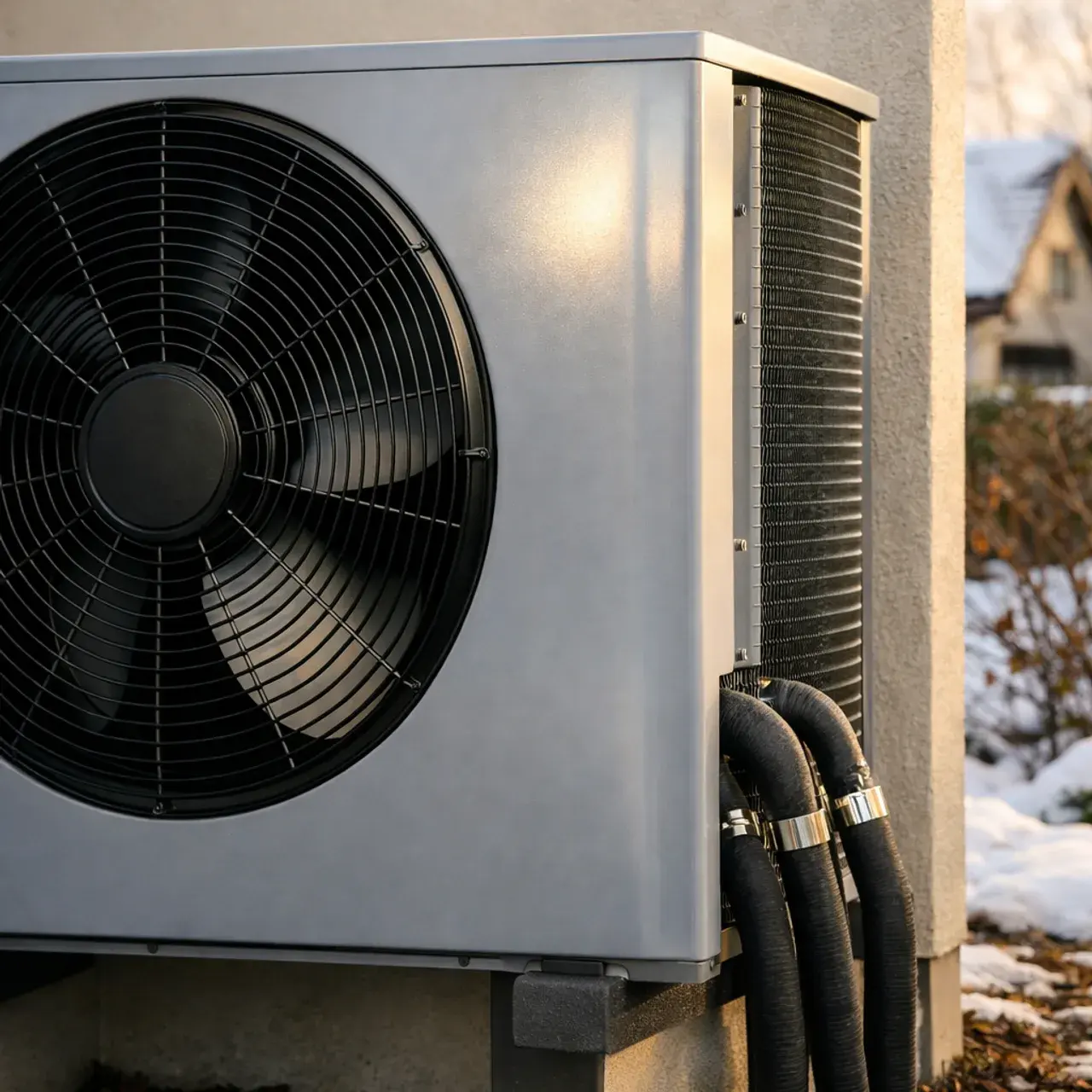
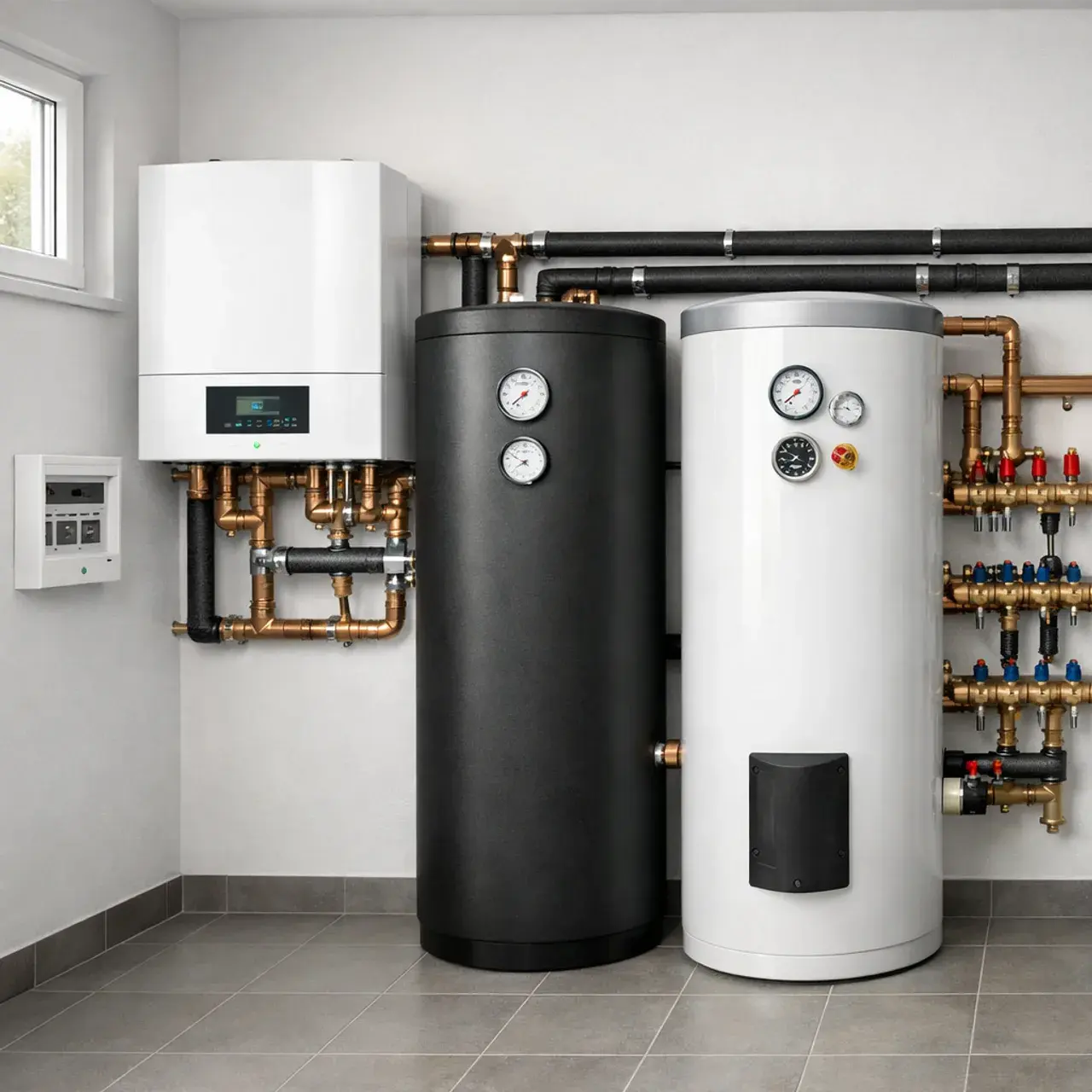
The components are always the same, even if they are arranged differently depending on the design. The outdoor unit houses the compressor, evaporator and fan — it is the one that pulls heat from the air. The indoor unit, or hydraulic module, contains the circulation pump, valves, expansion vessel, sensors and controller. Add a DHW cylinder (200–300 L), an optional heating buffer tank (50–200 L) and an electric heating element as a peak or backup source. In a monobloc design almost the entire refrigerant circuit is sealed inside the outdoor unit; only two insulated pipes carrying heating water enter the house. In a split design the compressor sits outside but the hydraulic module is installed in a utility room, and an F-gas certified technician is required to connect the refrigerant lines.
The easiest way to picture a reverse-cycle compressor is as a fridge turned upside down. A normal fridge takes heat from the inside of the cabinet and dumps it into the kitchen — you can feel the warm radiator at the back. A heat pump does the same thing on a larger scale: it takes heat from the outside air, the compressor raises its temperature, and the heat exchanger passes it to the heating water at 35–55 °C. The net result is that for every 1 kWh of electricity used by the compressor and fan, 3 to 4.5 kWh of heat reaches the water — the difference is contributed by the air itself. A seasonal coefficient of performance (SCOP) of 3.5–4.5 translates, in practice, to about 75% less primary energy than an electric boiler uses. This is physics, not magic — and not marketing.
- Monobloc — all hydraulics and refrigerant are sealed inside the outdoor unit; only the water circuit and controller cross into the house. Simpler installation, no F-gas certification needed, but a risk of the circuit freezing during a power cut.
- Split — compressor outside, hydraulic module inside a utility room; an F-gas certified installer is mandatory. A quieter indoor environment and a smaller outdoor unit footprint.
- Bivalent / hybrid — a heat pump working in parallel with an existing gas boiler or electric heater; safety in the deepest frosts without oversizing the pump.
- DHW cylinder — typically 200–300 L, heated by an internal coil in cycles every several hours, with a weekly thermal disinfection to 60–65 °C.
- Heating buffer — a small heating-water tank (50–200 L) that smooths compressor cycles, essential in radiator systems with low water content.
Sizing the pump — seasonal demand ≠ peak load
The most common mistake among new buyers and some installers is sizing the pump "by square metres": a 150 m² house gets a 12 kW unit, 200 m² gets 16 kW. That is not how it works. Two separate numbers are needed. First: the seasonal demand (EUco, kWh per year) — how much thermal energy the building will consume over a whole season. Second: the peak load — the instantaneous demand at the worst moment, i.e. at the design outdoor temperature (Warsaw sits in Climate Zone III per PN-EN 12831: −20 °C). The pump must either cover that peak on its own or be deliberately designed with a bivalent point and a top-up electric heater; EUco is used to estimate annual running cost and payback.
Typical indicators depend on the thermal standard. A pre-2002 house with no thermomodernisation has an EUco of around 180 kWh/m²·year; the same house after window replacement and wall insulation drops to 120 kWh/m²·year; a new house built to WT 2021 standards is below 50 kWh/m²·year. Between the worst and best insulation that is a seven-fold ratio in annual consumption. Without knowing EUco, pump sizing carries a hefty "just in case" margin, which translates into a more expensive unit and compressor short-cycling in the shoulder seasons.
| Building standard | EUco indicator | House 120 m² | House 150 m² | House 200 m² |
|---|---|---|---|---|
| Old, pre-2002 (no thermomodernisation) | ~180 kWh/m²·year | ~21,600 kWh | ~27,000 kWh | ~36,000 kWh |
| After partial thermomodernisation | ~120 kWh/m²·year | ~14,400 kWh | ~18,000 kWh | ~24,000 kWh |
| WT 2014 (mid-range standard) | ~80 kWh/m²·year | ~9,600 kWh | ~12,000 kWh | ~16,000 kWh |
| WT 2021 (new construction) | ~50 kWh/m²·year | ~6,000 kWh | ~7,500 kWh | ~10,000 kWh |
| Passive / NZEB | ~25 kWh/m²·year | ~3,000 kWh | ~3,750 kWh | ~5,000 kWh |
Peak load is a different story. A WT 2014 house of 150 m² needs roughly 8–10 kW at −20 °C. The same floor area in a 1990s house after partial thermomodernisation — 14–16 kW. A 150 m² passive house — 3–4 kW, and a 5 kW pump is already on the generous side. Multiplying the calculated load by 1.2, or piling on a "safe" 25% reserve, makes no sense — an oversized pump runs in short cycles (short-cycling) because the house cannot absorb the output the compressor produces straight after start-up. Short cycles wear out the compressor, drop SCOP by 15–20% and add to the running cost for the entire life of the unit.
The bivalent point is a deliberate design decision that many owners only discover after the fact. You can size a pump so that it covers 100% of demand even at −20 °C — and then the unit is large, expensive and runs at low load for 95% of the season. Or you can deliberately pick a smaller pump with a bivalent point at −7 °C and let an electric heating element step in on the three to seven coldest days of the year. The latter is cheaper to buy and often cheaper to run — the element works 30–60 hours a year, rather than a badly sized pump struggling all winter.
Low flow temperature is the key to a high SCOP
SCOP, the seasonal coefficient of performance (per PN-EN 14825, average climate), rises sharply as the design flow temperature falls. This is the single most important number to understand when designing a heat pump system. A pump designed for a 35 °C flow temperature reaches a SCOP of around 4.5; at 45 °C — 3.8; at 55 °C — 3.2; at 65 °C — 2.5. Every 10 °C lower in the flow water means roughly 15–20% less energy consumed across the season. Over a year that is the difference between a bill of about PLN 2,800 and PLN 5,000 for the same heat in the same house. Low flow temperature is not cosmetic optimisation — it is the axis the entire economics of the technology rests on.
That is why underfloor heating (normally 35–40 °C) is the natural partner for a heat pump. The larger surface — a whole floor instead of a few square metres of radiator — delivers the same output at a far lower carrier temperature. Classic panel radiators sized at 75/65 °C in older systems need 55–65 °C water, and 70 °C in deep frosts — and they pull SCOP down to 2.5–3.0. That still beats an electric boiler comfortably but loses ground to gas. There are middle-ground options, though: enlarging the existing radiators, swapping them for low-temperature models, or adding wall-mounted fan coils — in many older homes a heat pump remains viable if the design is done with care.
You can't, however, heat just anything with a heat pump. Very old cast-iron radiators designed for 90/70 °C, plumbed into a 1970s system, can demand 70–75 °C in deep frost — at which point the seasonal SCOP drops below 2.5 and the investment becomes questionable. A typical 1995–2010 house with panel radiators runs at 50–55 °C and is sensibly upgradable, especially if 1–2 of the worst radiators (usually the bedroom with two external walls and the north-facing living room) are enlarged at the same time.
The heating curve is the second, underrated parameter. Heat pump controls smoothly adjust the flow temperature to the outdoor temperature — in a house with radiators that might be 50 °C at −10 °C, around 40 °C at 0 °C, and around 32 °C at +10 °C; in pure underfloor heating 38/32/26 °C respectively. The heating curve is the graph describing that relationship, and it is specific to every house, its insulation and its emitters. A well-tuned curve is the difference between a SCOP of 4.0 and 3.2 for the same building, at no cost. Installers often leave the factory curve from the manufacturer's documentation in place and walk away — and the pump runs with a flow temperature 5 °C too high all winter, losing 15–20% efficiency without the owner knowing.
Retrofitting a house with radiators — does it make sense?
Yes, in most cases. A heat pump isn't reserved for new houses with underfloor heating. In a 1995–2015 building with panel radiators a typical SCOP is 3.0–3.6 — worse than underfloor (4.2), but still three times better than electric heating and 20–30% cheaper to run than mains gas. The trick is to work out, before you commit, whether the existing radiators will deliver the required output at 50–55 °C, or whether the temperature will need to be pushed up to 65 °C in deep frosts. That single difference decides whether the project is worth doing.
A practical checklist for each room: radiator model and rated output from the nameplate (usually quoted at 75/65/20 °C), area of external walls, orientation, current room temperature on the coldest days. If the radiator is too small at −15 °C now (the room reads 18 °C instead of 22 °C), then after switching to a heat pump it will need to be enlarged, supplemented with a second unit, or swapped for a water-fed fan coil — because the lower flow temperature will cut the existing radiator's output by 30–40%.
Replacing a wall radiator with a water-fed fan coil is a clever option for one or two rooms. A fan coil is a small heat exchanger with a fan, plumbed into the same heating water as the rest of the system; it forces air across the coil and delivers full output already at 40–45 °C flow temperature, where a classic radiator would need 60 °C. Many models can also cool in summer, when the pump runs in reverse — easier and cheaper than tearing up a floor to retrofit underfloor heating.
Hot water — on demand or in tanks?
Heat pumps do not heat domestic hot water on demand the way a condensing boiler does in priority mode. That is a fundamental difference in operating logic, and one that sometimes catches users coming from gas off guard. The standard is a 200–300 L cylinder with an internal coil. The pump runs for 30–60 minutes, brings the cylinder up to 50–55 °C, then returns to heating the house and idles until the next cycle. The DHW cycle starts when the temperature in the top of the cylinder drops below its set point (typically 45 °C) or on a schedule.
The legionella question is non-negotiable, whatever model you pick. Legionella pneumophila multiplies in water between 25 and 50 °C; to clear it reliably the cylinder must be raised to 60 °C for at least 30 minutes (or 65 °C for about 10 minutes) at least once a week. That is a more expensive cycle from a COP point of view (the pump runs at a very high compression ratio, COP during the cycle drops to 1.8–2.3, and the final degrees are often topped up by the electric element), but it is mandatory — skipping thermal disinfection puts the household at risk of infection through the showerhead. Most heat pumps handle it automatically overnight if the owner enables the feature in the app.
Peak household DHW demand falls in the morning (showers before work) and in the evening (the bath, the washing-up). A 250 L cylinder is enough for a family of four, provided the pump puts out at least 8 kW and reheats the tank in about 50 minutes. A smaller pump (5–7 kW) paired with a 300 L cylinder can be a better strategy than a bigger unit — the pump works in its sweet spot (long cycles, low temperature), and the user doesn't notice any "slow reheat". Choosing 200 vs 300 L is a difference of about PLN 1,200 and one of the best returns on investment in the whole project.
Hybrid with an existing gas boiler — a transitional strategy
Not everyone has to abandon gas immediately and replace everything in one renovation. A hybrid setup — a heat pump working alongside an existing gas boiler — is an increasingly popular strategy for homes with a healthy condensing boiler 5–10 years into its life. The logic is simple: the heat pump covers 80–90% of annual heat demand, and the gas boiler fires only on the three to seven coldest days of the year, when the pump's COP drops below 2.5 and gas becomes the cheaper source for those specific hours. Economically that works out better than oversizing the pump to cover 100% of peak load — the pump does 80% of the work more cheaply than gas, and gas does the top 20% of peak hours more cheaply than an oversized pump.
Hybrid makes sense in a handful of situations. First: a healthy condensing boiler with a 5–10 year replacement horizon — in that case the hybrid bridges two generations of the system. Second: older radiators that need 60–65 °C water in deep frost — gas covers the worst days, the pump does the rest. Third: a house without full thermomodernisation but with a renovation planned in the next 3–5 years — a smaller pump is specified (6–8 kW instead of 14–16 kW), at roughly half the cost, and once the thermomodernisation is done it stands on its own without the gas.
Where hybrid stops making sense — a new WT 2021 building with underfloor heating and no existing boiler. A pump sized to EUco covers 100% of demand on its own, and a boiler kept "just in case" is PLN 12,000–18,000 thrown away, plus space taken in the plant room, plus the cost of an annual gas inspection (PLN 250–400) and a tightness test every five years. In passive houses a hybrid is plainly absurd — a peak load of 3–4 kW means a 5 kW pump covers everything with margin even in the deepest cold.
Costs — what an air-to-water heat pump actually costs in 2026
The price range for air-to-water pumps in 2026 is wide and doesn't always track quality. At the cheap end a no-name 12 kW monobloc can be had for PLN 18,000 gross for the unit alone. Branded options with documented service support in Poland — Daikin Altherma 3, Mitsubishi Ecodan, Viessmann Vitocal, Bosch Compress, Vaillant aroTHERM plus, NIBE S2125, Panasonic Aquarea — run PLN 25,000–45,000 for an 8–12 kW unit. Add installation at PLN 8,000–20,000 (depending on complexity), a DHW cylinder at PLN 2,500–5,000 and a heating buffer at PLN 1,200–2,500.
A turnkey total in 2026 for a typical 150 m² house comes to PLN 45,000–75,000 — with a buffer, DHW cylinder, basic hydraulic alterations and commissioning. Subsidies (Czyste Powietrze, Moje Ciepło) can knock 35–60% off that figure depending on the income threshold and the state of the programme in any given year. That is why Polish heat pump prices have swung so much over the last five years — the moment you file the subsidy application often matters more than haggling 5% off the distributor's price. In practice most reputable installers help prepare the application, and that's worth writing into the contract as a condition.
| Heat source | SCOP/efficiency | Annual energy use | Annual cost | Impact of 8 kWp PV |
|---|---|---|---|---|
| Condensing gas boiler | 92% | ~13,040 kWh gas | ~PLN 4,400 | none |
| Pellet boiler | 85% | ~14,100 kWh pellets (≈2.94 t) | ~PLN 5,000 | none |
| Air-to-water heat pump (underfloor) | SCOP 4.2 | ~2,860 kWh electricity | ~PLN 3,000 | −PLN 1,500 |
| Air-to-water heat pump (radiators) | SCOP 3.3 | ~3,640 kWh electricity | ~PLN 3,800 | −PLN 1,700 |
| Air conditioner with heating (split) | SCOP 4.2 | ~2,860 kWh electricity | ~PLN 3,000 | −PLN 1,500 |
| Electric radiators | 1.0 | ~12,000 kWh electricity | ~PLN 12,600 | −PLN 3,000 |
A heat pump with photovoltaics is the classic combination, but with a sharp timing caveat. The pump consumes the most energy from November to March, when PV produces only 5–15% of its annual yield. A 10–15 kWh battery doesn't change that radically — in the depth of winter it empties in 4–6 hours of pump operation. Economically, the pump "uses" PV mainly in the shoulder months (October, April), when there is still plenty of sun and heating is either just starting or just ending. In winter the pump pulls from the grid, drawing on the net-billing prosumer balance built up in summer — it still works, but the arithmetic is different from air conditioning, where PV output and AC demand line up in time.
Subsidies in 2026 — Czyste Powietrze, Moje Ciepło, thermomodernisation tax relief
Legal status and amounts as of May 2026 — these programmes change mid-year and are sometimes suspended when the rules are revised. Before signing any contract, always check the current terms on czystepowietrze.gov.pl, mojecieplo.gov.pl, mojprad.gov.pl and on the websites of NFOŚiGW and your regional WFOŚiGW.
In practice most owners draw on a combination of three sources: Czyste Powietrze (or Moje Ciepło for new construction), Mój Prąd for an energy or thermal storage component, and the thermomodernisation income-tax relief. The programmes are independent and can be combined, but each has its own conditions, limits and lists of approved equipment.
- Czyste Powietrze — the headline programme for owners of existing homes. Replacement of an inefficient heat source (coal, oil or similar) with an air-to-water heat pump; since 31 March 2025 gas boilers have been excluded from the main call. The maximum grant scales with income: basic level up to roughly PLN 66,000, raised level up to about PLN 99,000, the highest level up to PLN 136,200 (figures close to PLN 170,000 are quoted in the comprehensive package that includes thermomodernisation). Conditions: a pump from the ZUM list — Lista Zielonych Urządzeń i Materiałów (the Polish 'Green Devices' approved-equipment list, ZUM), an F-gas certified installer for split designs, and documentation showing the old heat source was scrapped.
- Moje Ciepło — for new construction with an occupancy permit issued after 1 January 2021 (the programme is accepting applications until 31 December 2026, or until funds are exhausted). The grant is PLN 7,000–21,000 for air-to-water pumps, depending on energy class and Large Family Card status. The core condition: EUco ≤ 63 kWh/m²·year (WT 2021 or better). It does not combine with Czyste Powietrze on the same unit.
- Mój Prąd 6.0 — indirectly relevant to heat pumps: it co-finances thermal storage (a DHW cylinder or buffer of at least 20 dm³ using water as the medium) installed together with a PV system; up to 50% of eligible costs, max PLN 5,000 for the thermal store plus PV and battery grants (up to about PLN 28,000 in total). Prosumer status is required.
- Thermomodernisation income-tax relief — a deduction of heat pump expenditure up to PLN 53,000 per person (PLN 106,000 for a married couple when both are co-owners). Costs are deducted over the six years from the end of the year of the first invoice, on condition the work is completed within three years. Independent of the other grants. Requires VAT invoices and inclusion of the works in the annual tax return.
The most common installer mistakes
- Oversizing — the classic "safety" 12 kW instead of the 8 kW that was actually calculated, "just in case". The consequence: compressor short-cycling (run times under 10 minutes), a 15–20% drop in SCOP versus correct sizing, and a compressor life cut by 3–5 years. This is the most common error in Poland — estimated to affect 40% of installations completed before 2023.
- No buffer in a radiator-based system — the heat pump runs in cycles, while a classic radiator system holds very little water (40–80 L in the whole installation). The pump ends up starting every 8–12 minutes, the compressor wears, and the owner hears the fan kicking in constantly. A 100–200 L buffer is a PLN 1,200–2,200 investment that smooths the cycles and adds years to the unit's life.
- Factory heating curve left "for later" — the pump's controller has dozens of parameters; most installers set only 3–4 of the basics and walk away from commissioning. Tuning the heating curve in the first season, ideally after 3–4 months of operation, can cut bills by 15%. It's an hour of remote work, but the knowledge required is beyond a standard installer course.
- No magnetic filter on the return — heat pumps are unusually sensitive to debris in the water circuit. Old steel, scale and sludge particles from radiators can destroy a plate heat exchanger or circulation pump within 2–3 years. A magnetic filter and dirt separator is a PLN 600–1,000 investment that saves an PLN 8,000 heat exchanger.
- Bad outdoor unit placement — under the owner's or a neighbour's bedroom window, in the shaded side of the house, on waterlogged ground without a concrete pad. Defrost condensate (several litres of water every few hours during frosts) with no drainage into a soakaway or a gravel drainage pit turns into ice on the pavement; the fan produces 45–55 dB(A) at 1 m. The minimum standard should be 3 m from a bedroom window and a south or east-facing position.
- Wrong refrigerant in the specification — R32 (GWP 675) and R290 (propane, GWP 3) are the current 2026 standard; R290 dominates in monoblocs, R32 in split units. Under the F-gas Regulation (EU) 2024/573, from 1 January 2027 the sale of monoblocs ≤12 kW and splits ≤12 kW containing refrigerants with GWP ≥150 will be banned — which in practice covers R32 in new units of that size. R410A (GWP 2088) is being phased out faster still, and new equipment using it is now rare. A pump charged with R410A may be cheaper today, but in 5–7 years service and top-ups will be expensive because of the requirement to use reclaimed or regenerated refrigerant.
Installation — what it looks like and what to organise beforehand
A typical air-to-water installation in a single-family home is 2–4 days' work for a two-person crew, plus handover and tuning the following week. Day 1: placing the outdoor unit on a concrete pad or vibration-isolating brackets, drilling through the load-bearing wall, running the insulated hydraulic pipework. Day 2: fitting the indoor module, DHW cylinder and heating buffer, and connecting them to the existing CH system. Day 3: electrical work (usually three-phase for outputs ≥7 kW), commissioning, first tests, controller programming. Day 4 (if needed): adjustments, owner walk-through, paperwork.
Owner-side preparation before the crew arrives: a base for the outdoor unit (concrete pad about 80×120 cm, poured at least a month earlier and anchored into the ground), condensate drainage to a soakaway or gravel drainage pit (critical in winter, so the condensate does not freeze on the pavement), a cable-and-pipe route to the plant room (two insulated pipes 28–35 mm in conduit), and around 2 m² of reserve space for the buffer and DHW cylinder — ideally in a boiler room with a drain to the sewer.
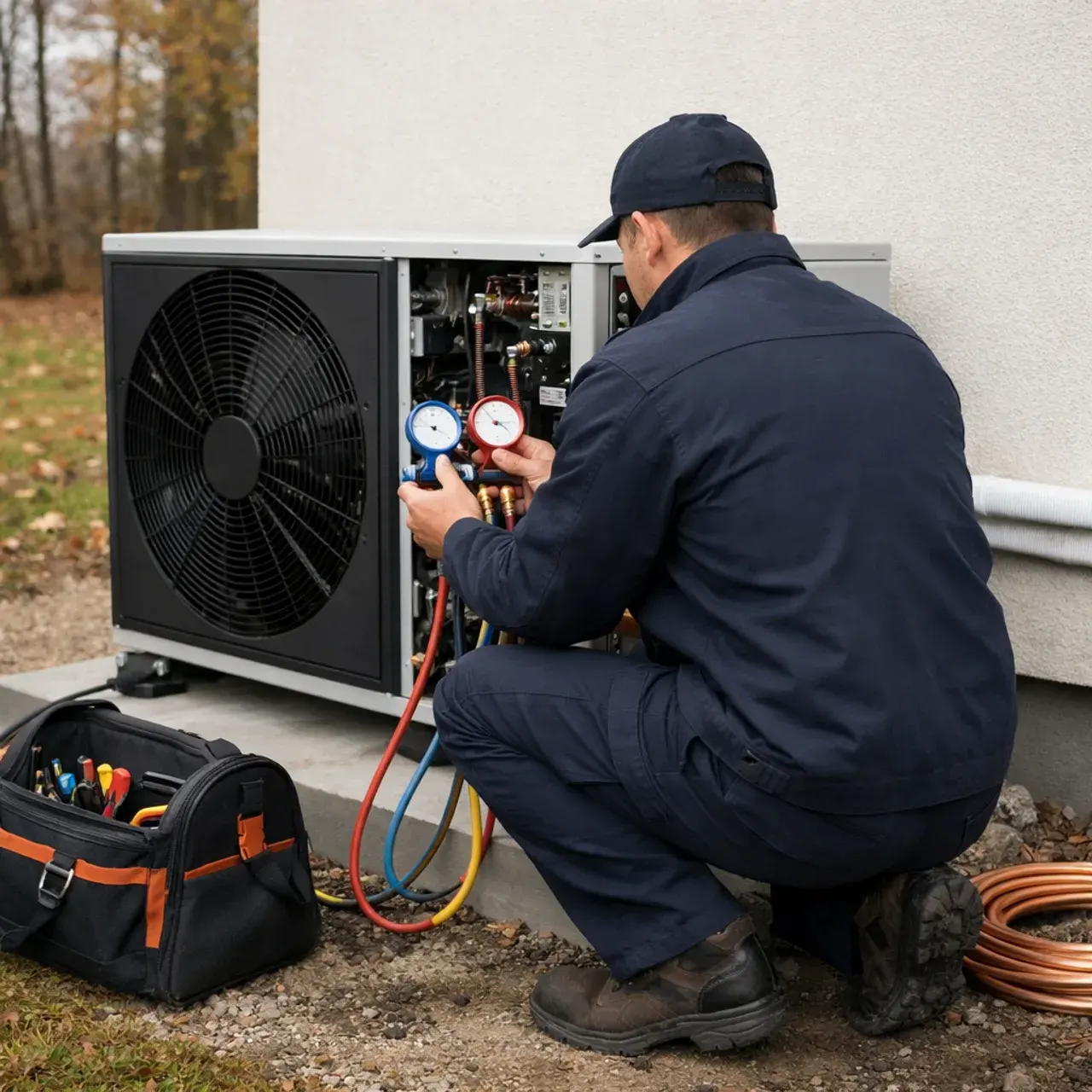
Handover and documentation is the moment when too many owners sign too easily and let it go. A reputable installer should leave behind: a hydraulic schematic with valves labelled, the tuned heating-curve parameters, a flow measurement protocol for the water loop, a leak-tightness warranty on the refrigerant circuit (at least five years), and a Polish-language manual for the controller. This isn't bureaucracy — without the hydraulic schematic, in a year's time no one remembers how the buffer and DHW cylinder are linked, and a mid-season fault paralyses the house for a week because another firm's service team starts by drawing the installation from scratch.
- Has a heat-loss calculation (OZC) been done for the house, broken down by room and with peak load shown?
- What SCOP has the manufacturer declared at the 35 °C / 55 °C operating points for Warsaw-area climate conditions?
- Are the heating buffer, the magnetic filter and the dirt separator on the return all included in the price?
- What is the warranty on the compressor (typically 5–7 years) and on the refrigerant circuit (5 years on leak-tightness)?
- Who will tune the heating curve after the first heating season — and at what price, if it isn't already in the quote?
Smart control and monitoring
Modern heat pumps come with built-in Wi-Fi and a mobile app as standard. Every serious manufacturer now has its own platform: Daikin ONECTA, Mitsubishi MELCloud, Vaillant myVAILLANT, Bosch HomeCom, Viessmann ViCare, NIBE Uplink, Panasonic Aquarea Smart Cloud. From anywhere you can check the current COP, flow temperature, DHW cylinder status and the history of energy consumption. This isn't a gadget — without the app you can't sensibly tune the system in the first few months, because data from the local controller would have to be hand-recorded once a week, and no one does that.
Integrations with Home Assistant, openHAB or Loxone let you correlate the pump's operation with the PV system better than the native apps manage on their own. The pump "knows" when panel output is high and brings the DHW cylinder or heating buffer up to temperature in those hours, rather than waiting for the more expensive grid electricity at night. That's 5–10% annual savings with no extra hardware — a Raspberry Pi and an hour of configuration are enough. It's worth checking that a specific model has an open API before you buy it. We covered the pump-with-PV integration logic in detail in our guide on air conditioning with photovoltaics, and the practical multi-split layouts for apartments in our multi-split system guide — in a home with a heat pump, adding 2–3 indoor units in the bedrooms is today the standard comfort move.
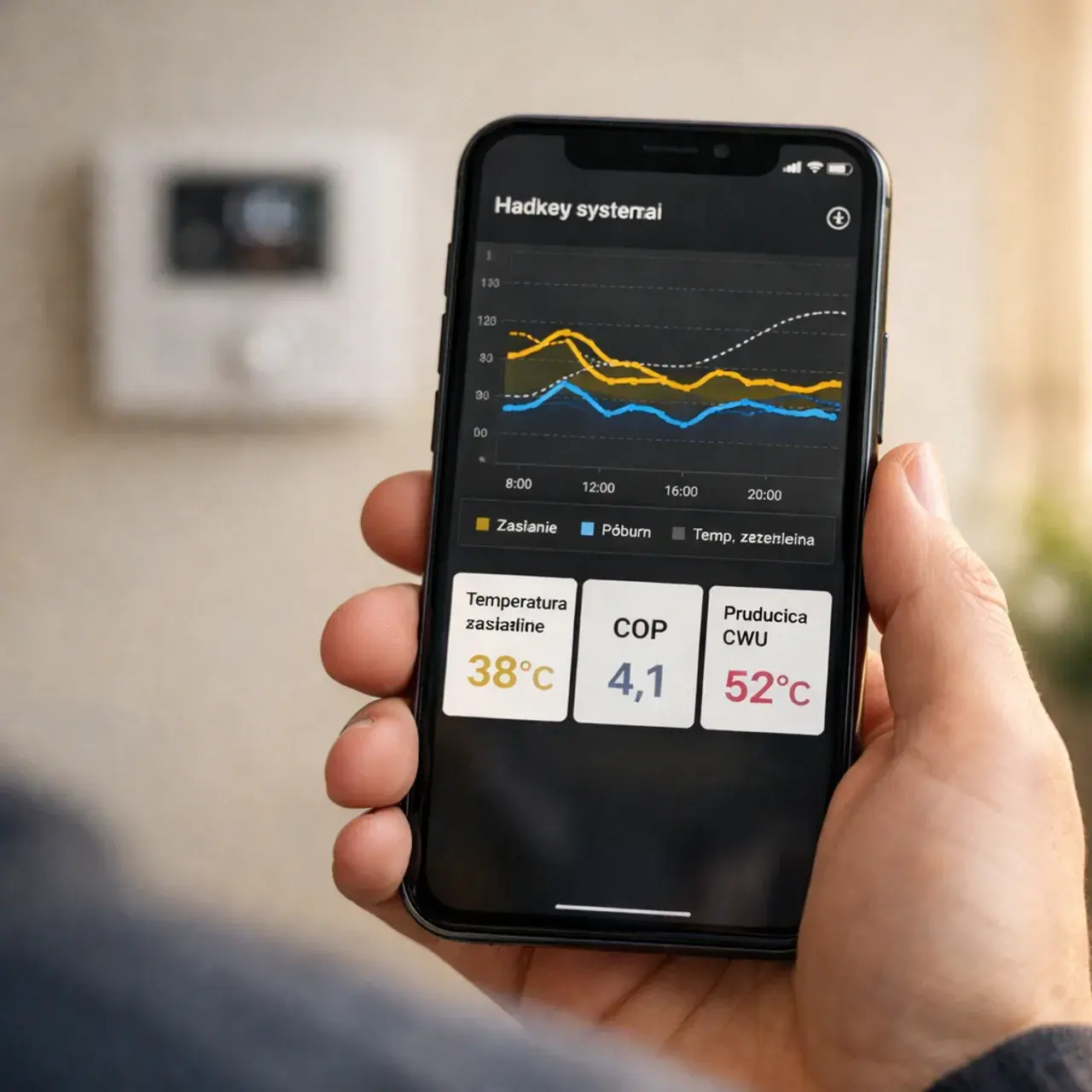
- Real-time SCOP monitoring — an automatic phone alert when the coefficient drops more than 0.3 points below the design value.
- DHW schedule aligned with PV production — heating the cylinder between 12:00 and 15:00 in summer, between 10:00 and 14:00 in winter, when sunshine is at its peak.
- Voice control and scenes (Google Home, Alexa, Apple HomeKit) — simple commands like "drop the bedroom 3 °C overnight" without opening the app.
- Service reminders — an automatic 12-monthly alert with a checklist for the installer and the thermal-disinfection calendar.
- Data export — a monthly consumption report in CSV format, ready for further analysis in a spreadsheet or comparison with neighbours.
FAQ — the questions clients ask most often
Does an air-to-water heat pump work in a Polish winter at −20 °C?
Yes — most modern premium-class heat pumps run stably down to −25 or −28 °C, including Mitsubishi Ecodan Zubadan, Daikin Altherma 3 H HT, Vaillant aroTHERM plus and NIBE F2120. COP falls as the frost deepens: at 0 °C it sits at 3.5–4.0; at −10 °C around 2.5–3.0; at −20 °C only 1.8–2.2. In practice Warsaw sees 5–10 days a year below −15 °C, and only 1–3 days below −20 °C. On those extreme days the house can be topped up with the built-in electric element — which is precisely the bivalent point you've designed for.
Do I need a backup heat source?
In most new houses (WT 2021 or better) — no; a heat pump with the electric element built into the hydraulic module covers 100% of situations. In older houses after a partial thermomodernisation it can be sensible to keep the existing gas boiler as a backup, or as a fully independent fallback in case the pump fails mid-winter. The cost is an annual gas inspection (PLN 250–350), space in the plant room, and a tightness test every five years. That's a reasonable compromise for owners who don't want to risk a week without heat over a service issue.
Can you hear the heat pump from outside?
Modern heat pumps generate 45–55 dB(A) at 1 m when running at full output. That's the loudness of a normal conversation or soft rain. At 3–5 m from a bedroom window, with an average sound-insulated wall, it is practically unnoticeable at night. Under the bedroom window — always a bad call, regardless of brand. "Silent" or "eco" modes drop the noise by 5–7 dB(A) at the cost of 10–15% peak output, and they activate automatically at night. It's worth asking before purchase whether a specific model has a night mode and how much output it still delivers in it.
How many hours a year does a heat pump run?
Seasonally, 2,500–4,500 hours in a single-family home covering both heating and DHW, depending on the building's thermal standard and the comfort level the owner sets. Two things drive this: the pump has a lower rated output than a classic gas boiler (8–12 kW vs 24 kW), so its running time is longer; and the pump doesn't cycle on/off the way a boiler does — it runs modulated, holding flow temperature at a steady level. Longer, gentler cycles are more efficient and less harmful to the compressor than frequent full starts.
Can a heat pump cool in summer?
Yes — most heat pumps in reverse (cooling) mode can chill water to 7–18 °C and send it through the home's distribution system — but only if that distribution will handle it. Water-fed fan coils with a condensate tray, and underfloor heating with active dew-point control (a humidity and temperature sensor regulating flow temperature), will; classic panel radiators will not (they sweat and create dripping cold spots). Without dew-point control, the flow temperature in underfloor heating can't drop below about 18 °C, which limits cooling output to roughly 1 kW per 15–20 m² — that's a comfort top-up, not full-blown air conditioning. If you actually want to cool the house during a heatwave, a split air conditioner alongside the heat pump is a more sensible direction than trying to squeeze cooling out of the underfloor circuit.
How long does a heat pump last?
The compressor — the heart of the unit — runs for 15–20 years with correct sizing, timely servicing and no short-cycling. The plate heat exchanger and the indoor module's hydraulics — 20–25 years, provided the water in the system is clean and a magnetic filter sits on the return. The electronics (the main controller board, sensors, fan inverter) are the weakest link in the whole system: 10–15 years, depending on how stable the grid supply is. Realistically the full unit lifetime is around 15 years — comparable with a good condensing gas boiler, but with more complex and more expensive service.
Summary and next step
Three main takeaways. First: an air-to-water pump is now the default choice for a new single-family home and a sensible option for upgrading buildings from after 1995 — provided the radiators will deliver the required output at 50–55 °C flow. Second: the key to profitability is correct sizing and low flow temperature, not the brand badge — a Daikin oversized by 30% performs worse than a properly sized mid-range monobloc. Third: subsidies (Czyste Powietrze, Moje Ciepło) radically change the economics — without them the payback against mains gas is 8–12 years; with them, 4–7.
At LeoKlima we design year-round thermal comfort for Polish homes — split, multi-split and ducted air conditioning — and on projects combined with an air-to-water heat pump we refer the client to two trusted hydronic-specialist partners in Warsaw and run the joint "heat + cool" project together. In practice most of our customers, after replacing a gas boiler with a heat pump, add a multi-split air conditioner in the bedrooms — summer cooling is the second season in which the investment pays back through photovoltaics and the thermo-modernisation tax relief. If you're planning to replace your heat source and at the same time want a quiet, air-conditioned home in August — book a free site visit. We'll walk through the heat balance, the sizing and a sensible "heat + cool" split across two technologies together. Call: 502 010 010 or write through the form on /kontakt.