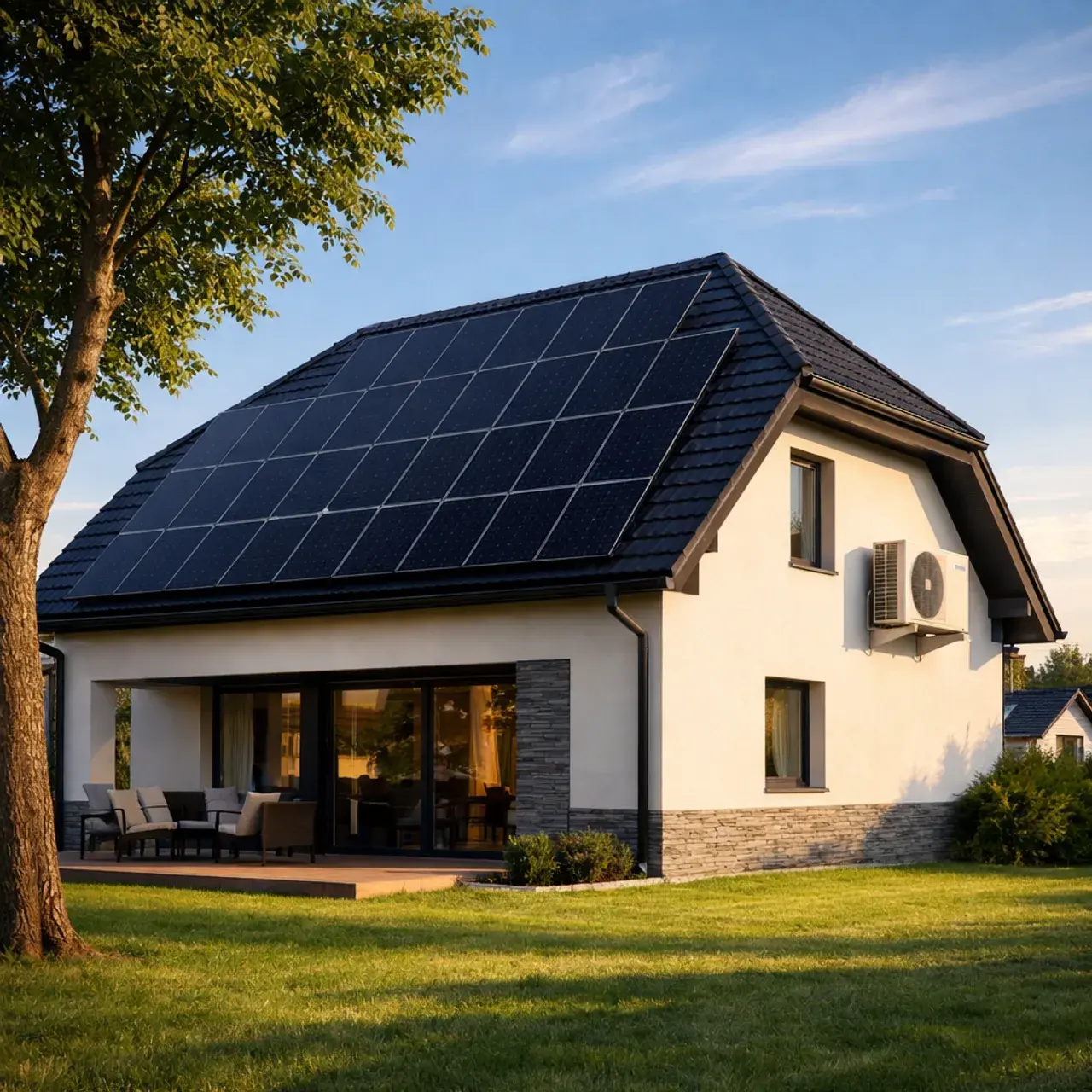
AC with Photovoltaics — 2026 Guide
A July afternoon in Mokotów. In a fourth-floor flat the thermometer reads 31 degrees, the sun has been hammering the south wall since eleven, and a computer with two monitors is adding its share to the stifling open-plan kitchen. But from the pavement you can see something that was not here a decade ago: photovoltaic panels glinting on the neighbouring tenement's roof, and a few metres away, on the gable wall, the quiet hum of an air conditioner's outdoor unit. This is now the most common question we hear from clients: will photovoltaics cover air conditioning, and if so, how should it all be planned so that in the 2026 season, instead of worrying about bills, you can enjoy cool air without subsidising it.
In this guide you will get concrete answers to the questions that come up most often during our on-site visits: how to size a PV system for an air conditioner or an air-to-air heat pump, why autoconsumption matters more than annual balances, how heating with a split unit really performs in Polish conditions, which subsidies apply in 2026, and which mistakes to avoid. All of it backed by numbers and examples from flats and houses in Warsaw that we have serviced over the past few seasons.
Will photovoltaics cover air conditioning?
The short answer: in the cooling season, yes, and with plenty of headroom. In July and August panel output peaks between eleven and four — exactly when the sun heats homes hardest and the air conditioner is working flat out. This is a rare case of such good time alignment between an energy source and its load; in a typical home most consumption happens in the morning and evening, and PV output is already falling at those hours. Air conditioning inverts that logic — it shifts consumption into the middle of the day, when the rooftop power plant is running at maximum. From a PV economics standpoint there is hardly a better load than a split inverter in cooling mode.
You do, however, need to separate two ideas that often get muddled in PV conversations — the annual balance and the hourly balance. A photovoltaic installation produces energy when the sun shines, not when you need it. Under the net-billing system in force since 1 April 2022, you produce energy at midday and, if you do not consume it on the spot, you sell the surplus at market price (monthly RCEm or hourly RCE, which in 2025 ran between PLN 0.15 and PLN 0.40 per kWh depending on month and hour). In the evening you buy that same energy back from the grid at retail rates with distribution, which usually means PLN 0.90–1.00 per kWh for households. Even when the annual kWh balance hits zero, the financial balance does not. What matters is what you actually consume in the same hour that the PV system produces — in other words, autoconsumption.
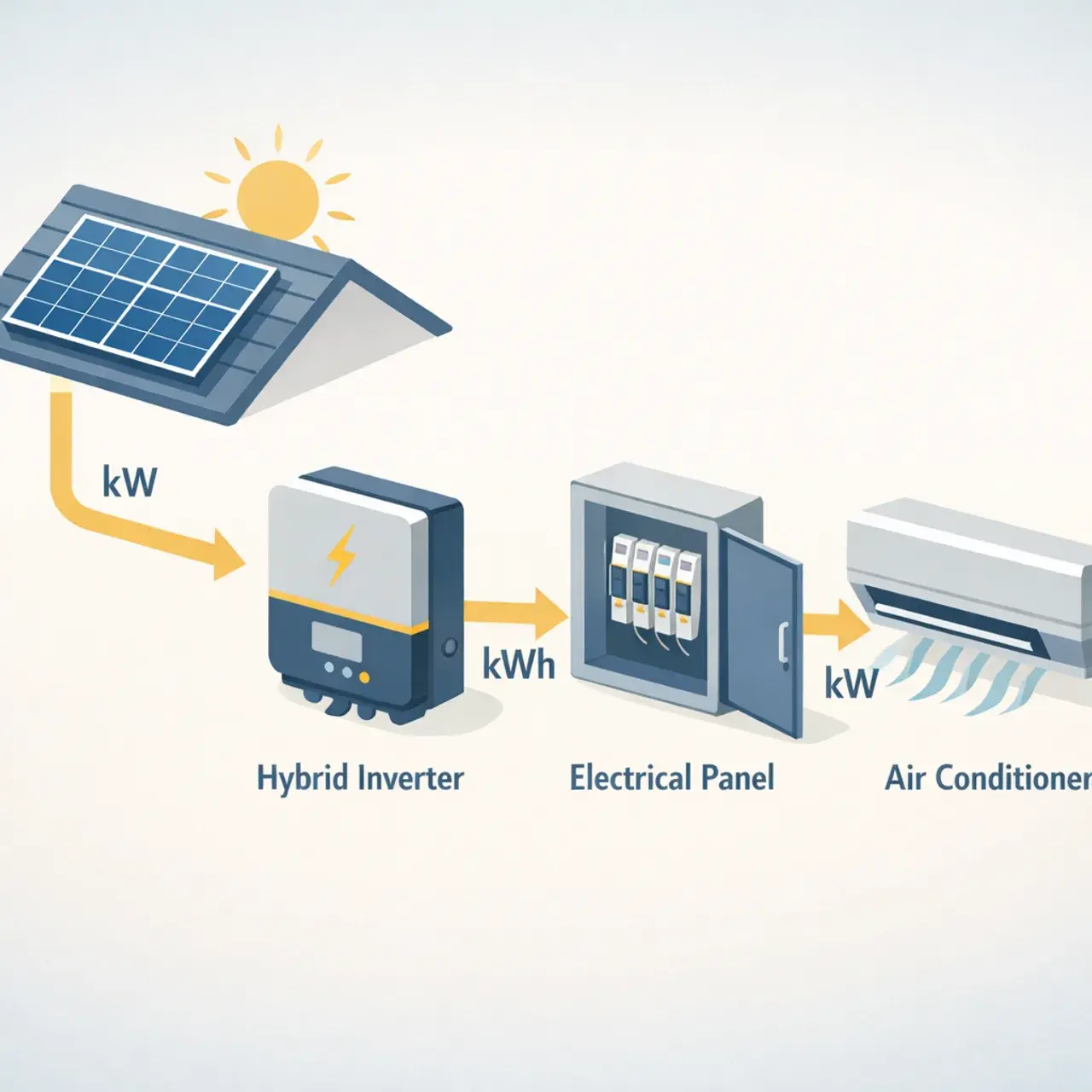
The mechanics are simpler than manufacturer marketing suggests. Panels do not power the air conditioner "directly"; they produce DC, the inverter converts it to AC and feeds it into the home's electrical installation in parallel with the lines from the utility. The air conditioner, the fridge and the kettle all draw current from the same bus — they have no idea where it comes from. The bidirectional meter only measures what crosses the house boundary in either direction. The more energy you consume during the hours it is produced, the less flows through the meter and the better the economics of the whole system.
- Peak PV output in the Polish climate falls between 11:00 and 16:00 — exactly when air conditioning demand for cooling is highest.
- A 2.5 kW air conditioner in cooling mode draws 0.4–1.0 kWh/h in practice, while a 5 kWp installation produces 3–4 kWh/h at sunny midday — with plenty of headroom for other loads.
- In winter, AC in heating mode needs more energy and PV produces little; the gap is filled by the net-billing credit accumulated over summer and by purchases from the grid at retail prices.
- An energy storage battery improves autoconsumption, but it rarely pays for itself on air conditioning alone — it makes more sense alongside an EV, induction hob and a heat pump in winter.
- Oversizing PV under net-billing is poor economics — you sell surpluses cheaply and buy back missing kWh at a high price.
How much electricity does air conditioning use in a flat and a house?
To size photovoltaics for air conditioning properly, you first need to know the unit's real, not marketing, consumption. Cooling capacity in kilowatts (sometimes also given in BTU/h, where 12,000 BTU/h is about 3.5 kW) describes thermal output — not electrical draw. Consumption is determined by the seasonal efficiency coefficient: SEER for cooling and SCOP for heating, both computed over a full season at varying outdoor temperatures. EER and COP are their point-value counterparts, measured under laboratory conditions. A modern A+++ split inverter today reaches SEER 8–9 and SCOP 4–5, meaning it consumes only around 0.12 kWh for every kilowatt of cooling delivered. In Warsaw conditions the cooling season works out to a realistic 300–500 hours of compressor runtime, not two months non-stop, as clients sometimes imagine.
Let's run a concrete example: a 60 m² flat in Mokotów, south-west exposure, one split air conditioner with 3.5 kW cooling capacity and SEER 8.0. Over the season from June to September the unit runs for about 400 hours on average (not 400 days — that's 16–17 full days of pure runtime). Real annual consumption comes out at around 175 kWh. Across the year, that's less than two washing-machine cycles per week. Many clients expect thousands of złoty on the bill; reality lands at PLN 170–250 — for the whole season, not per month.
| Area | Cooling capacity | SEER | Runtime hours/year | Annual consumption kWh |
|---|---|---|---|---|
| 35 m² (studio) | 2.5 kW | 8.5 | 350 | ~100 kWh |
| 50 m² (1-bed) | 3.5 kW | 8.0 | 400 | ~175 kWh |
| 80 m² (2 split units) | 2× 2.5 kW | 8.0 | 400 | ~250 kWh |
| 120 m² (multi-split) | 5.0 + 2.5 kW | 7.5 | 450 | ~450 kWh |
| House 150 m² (ducted) | 8.0 kW | 7.0 | 500 | ~570 kWh |
The table is indicative — real air-conditioning consumption depends on wall insulation, window quality, solar exposure, setpoint, the number of occupants, and whether you switch the unit on only when you get home or keep the comfort constant. The most important caveat concerns heating mode: in winter the same air conditioner usually uses 2–4 times more energy than over the cooling season, because the heating mode runs for 1,500–2,000 hours a year, not 400. It is the heating mode, not cooling, that drives PV sizing in a household looking to squeeze maximum value out of the system.
How much energy does a PV installation produce in Polish conditions?
Annual yield from a photovoltaic installation in Poland lands in the 950–1,100 kWh range per kWp of installed capacity, depending on region and installation quality. The optimal module orientation is south; east and west cost you 10–15%, and north is effectively a non-starter. A roof pitch of 25–40 degrees gives the best year-round results; a flat roof with an east-west substructure system is a popular alternative on new builds. Central Poland, including the Warsaw metropolitan area, sits close to the national average at around 1,000 kWh/kWp. That's above the German benchmark and below southern Italy, but more than enough to balance the typical annual consumption of a single-family home.
The seasonal distribution of PV output is the key to understanding why photovoltaics and air conditioning fit so well together. Roughly 70% of a PV installation's annual output falls between April and September — exactly the period when the air conditioner runs in cooling mode. On the other hand, December and January together deliver only 5–10% of the annual yield, so heating with a split in the middle of winter relies largely on the grid. That is not a flaw of the PV system, it's a natural property — one you need to factor into capacity sizing and into the economics of any battery storage.
| System capacity | Northern Poland (~950 kWh/kWp) | Central Poland (~1,000 kWh/kWp) | Southern Poland (~1,080 kWh/kWp) |
|---|---|---|---|
| 3 kWp | 2,850 kWh | 3,000 kWh | 3,240 kWh |
| 5 kWp | 4,750 kWh | 5,000 kWh | 5,400 kWh |
| 7 kWp | 6,650 kWh | 7,000 kWh | 7,560 kWh |
| 10 kWp | 9,500 kWh | 10,000 kWh | 10,800 kWh |
Real PV yield gets corrected by a handful of factors that are easy to miss during a quote. A single tree casting shade between 10:00 and 14:00 can cut output by 15–25%. Dirty panels lose another 5%, more in dusty areas. With partial shading, power optimisers fitted on each module (DC-DC with per-panel MPP tracking) or microinverters with true per-panel MPPT help — they isolate the problem to a single panel rather than dragging down the whole string. Quality modules carry a performance warranty of 25–30 years with degradation capped at 0.5% per year.
Sizing PV for air conditioning — step by step
- Start with annual consumption from the last 12 bills or your distributor's app — that's the hard starting point. Two-year totals are even better, because they smooth out one-off weather anomalies.
- Add projected air-conditioning consumption based on the table in the second section, or the manufacturer data for an air-to-air heat pump if you plan to heat with a split unit in winter.
- Add a 10–15% reserve for new loads you don't have yet but might in a 3–5 year horizon — a home-charged EV or an induction hob can easily add 2,000–3,500 kWh a year.
- Divide the total by the regional yield from the previous table — usually around 1,000 kWh/kWp for the Warsaw area — and you get the nominal PV capacity you need in kilowatt-peak.
- Cross-check against available roof area — a monocrystalline module rated 400–450 W takes up about 2 m², so 1 kWp needs around 5 m² of roof surface.
- Under net-billing, do not oversize — target 90–100% of the annual balance, not 130–150%. Every overproduced kWh is lost margin rather than savings.
Why is oversizing PV under net-billing a bad idea? Selling surplus output from a photovoltaic installation happens at the RCEm or RCE price — at PLN 0.15–0.40/kWh in 2025 (with dramatic dips during sunny midday hours and even negative pricing at peak PV output), while buying back from the grid in the evening costs PLN 0.90–1.00/kWh including distribution. The spread — the difference — works out in practice to PLN 0.50–0.80/kWh, and that's the playing field. Every kWh that PV produces but you do not consume loses several dozen groszy of value. On 1,000 kWh of annual overproduction the gap is PLN 500–800 — several percent of a typical annual saving from the installation.
What should you bring to a PV quote so that the installer can give you a serious offer rather than a template? First, the electricity tariff (G11 single-zone, G12 two-zone, G12w weekend) — because the zones decide when purchases are cheaper and when sales are less profitable. Second, month-by-month consumption, ideally as a chart from your distributor's portal. Third, roof orientation and pitch plus a photo of any obstacles (chimney, antenna, neighbouring tree). Fourth, your plans for an air conditioner and a heat pump over the next five years — because it is better to design the distribution board and cable cross-sections with headroom from the start than to rework them in two years.
Example 1: a 60 m² flat in Warsaw
A couple without children, G11 tariff, annual consumption 2,200 kWh. They are planning to install a single 3.5 kW split air conditioner in the living room with open-plan kitchen. The table in the second section puts the extra load at around 175 kWh/year — 2,375 kWh in total, rounded to 2,400 kWh. In a typical multi-unit tenement, however, your own rooftop PV is practically unattainable, because the roof belongs to the community and a balcony installation barely yields 0.5–1 kWp. The exception: a building with a flat roof where the community agrees to collective or individual solutions — then 2.5–3 kWp on an east-west rack will cover the entire load from the open-plan kitchen and the air conditioner.
The alternative for flat dwellers is an energy cooperative or collective prosumer model — a framework introduced by the 2024 amendment to the renewables act, allowing a group of consumers to share a single installation. In practice, for most flat owners the pragmatic advice is: install the air conditioner and don't fight for PV. The air conditioning itself pays back in comfort and property value, and a solid A+++ inverter unit running 175–250 kWh seasonally costs PLN 200–300 a year on the bill.
Example 2: a 150 m² house outside Warsaw with an air-to-air heat pump
A family of four, a 2015-built house with standard insulation, G12w tariff. Base annual consumption 4,500 kWh. Ducted 8 kW air conditioning in cooling mode: about 570 kWh a year. Heating mode on the split unit as a back-up to the gas boiler over 1,800 hours of the season: roughly 5,500 kWh a year. Total: 10,570 kWh, plus a 10% reserve takes it to around 12,000 kWh. Dividing by 1,000 kWh/kWp for the Warsaw region gives 12 kWp. In practice it pays to stop at 10–11 kWp, because the winter deficit (December, January, part of February) will not be covered from the roof regardless of system size, and it is cheaper to plug that gap with grid energy than to add more panels.
With a system like that it's worth bringing in smart control: pre-cooling rooms to 21–22 degrees between 12:00 and 15:00 (so-called precooling) means the air conditioner works less in the evening, and the earlier energy came from PV rather than the grid. The same logic applies in winter during the shoulder season (October, March) — preheating at midday, when PV is still producing and temperatures are moderate, saves you from buying evening energy at retail prices.
Autoconsumption vs net-billing — why it pays off in summer
Net-billing is the settlement system that has applied to new prosumers since 1 April 2022. Instead of swapping energy at a 1:0.8 or 1:0.7 ratio, as under the previous net-metering scheme, today you settle in cash. Surplus energy your PV system produces but does not consume on the spot is sold at market price. Until mid-2024 the monthly RCEm rate applied — the average from the day-ahead market for the given month. From 1 July 2024 new prosumers settle on an hourly basis by default, at the RCE rate (the market clearing price for the imbalance settlement period) — significantly more volatile; prosumers connected before that date can choose between the hourly and monthly models. In practice, monthly RCEm in 2025 ranged from around PLN 0.14/kWh in June to PLN 0.48/kWh in January, and during the midday hours of a sunny day the RCE price can drop to zero or go negative, when the grid is oversupplied with electricity from other PV systems.
Retail energy bought from the grid, by contrast, costs around PLN 0.90–1.00/kWh including distribution fees, excise duty and VAT (the G11 tariff approved by URE for 2026 has an active-energy price of PLN 0.495/kWh net, on top of which fixed and variable distribution charges apply). The difference between selling and buying is the spread, in practice PLN 0.50–0.80/kWh in 2026, and even more during the midday hours of a sunny day. Every kWh missed as autoconsumption therefore turns into money lost on both sides — first you sell cheap energy from photovoltaics, then you buy it back expensively. The air conditioner on a hot day is the simplest tool for closing that gap without buying an energy storage battery. Why? Because air conditioning runs precisely when the panels produce most; because you can schedule it to operate at midday; and because it doesn't need any extra hardware between the inverter and the load.
A concrete example from a June day in 2025 — a house outside Warsaw, 5 kWp system. Sunny midday, six hours of production at 5 kWh/h, 30 kWh in total per day. The family works from home; the 3.5 kW air conditioner runs for six hours at 0.9 kWh/h, consuming 5.4 kWh. If those 5.4 kWh had been sold to the grid at PLN 0.20 (the realistic average for sunny midday hours in June 2025), the revenue would have been PLN 1.08. Consumed instead as autoconsumption on the air conditioner, those same 5.4 × 0.95 = PLN 5.13 are saved on what would otherwise be a purchase. Daily difference: about PLN 4. Multiply by the 60 hottest days of the year and you get PLN 200–280 per season from a single air conditioner. For two units in a multi-split, the figure climbs to PLN 600–900 a year.
“The more energy you consume during the hours when you produce it yourself, the faster the installation pays back. For many homes, air conditioning is the best autoconsumption tool in the summer season — and one of the few investments that also pays back in comfort.”
— LeoKlima team
Air conditioning with heating + photovoltaics = year-round savings
A split air conditioner in heating mode is essentially an air-to-air heat pump. The seasonal coefficient SCOP for modern A+++ models is 4.0–5.0 in a temperate climate, meaning that for every kilowatt of electrical energy drawn from PV or the grid, the unit delivers about four kilowatts of heat to the room. Economically, this beats electric resistance heating by roughly fivefold, and matches or even outpaces gas boilers when gas prices rise. In Warsaw conditions, the heating bill for a good 3.5 kW split serving a 25–30 m² living room comes to PLN 800–1,200 over a full season — less than a gas-heated home pays for December alone.
Polish winters do have their limits, though. At outdoor temperatures of −10 degrees Celsius the COP of a modern split drops to 2.0–2.5, meaning it draws twice as much electricity per unit of heat as it would at +5 degrees. At the same time PV delivers a mere 5–10% of its annual yield — December and January are months when panels produce 200–400 kWh per 5 kWp of installed capacity. A heating-capable air conditioner therefore performs best in the shoulder seasons: from October to mid-December and from February to April. At the peak of winter the main heat source should be taken over by a gas boiler, an air-to-water heat pump or a more efficient system supported by thermal storage.
The hybrid layout of gas plus heating-capable air conditioning gained formal recognition in the 2024 tariffs — gas and electricity operators started rewarding this model in capacity charges. Subsidy programmes (Czyste Powietrze (Clean Air, a national heating-replacement subsidy), Mój Prąd 6.0 (a Polish solar subsidy program)) prefer replacing the main heat source, but a heating-capable air conditioner as a back-up fits the long-term strategy of phasing out coal and reducing gas use. In application documents it pays to describe the air conditioner as an "additional auxiliary heat source operating in air-to-air heat-pump mode" — that is the formal technical name for a split unit that also acts as a heater. Assumption for the table below: a 100 m² home with standard post-WT 2014 insulation and seasonal demand of around 150 kWh/m², electricity G11 ≈ PLN 0.95/kWh, gas W-3.6 with a standing charge, 2025/2026 season.
| Source | Efficiency / COP | Annual gross cost | Impact of 10 kWp PV |
|---|---|---|---|
| Condensing gas boiler | 92% | ~PLN 6,200 | none (gas) |
| Heating-capable air conditioner (split inverter) | SCOP 4.2 | ~PLN 3,600 | −PLN 1,200 to −1,800 |
| Air-to-water heat pump | SCOP 4.0 | ~PLN 3,800 | −PLN 1,400 to −2,000 |
| Electric resistance heater | 1.0 | ~PLN 14,000 | −PLN 2,500 |
The number and placement of indoor units determines real comfort — a single split in the living room won't heat a bedroom behind a closed door, while a multi-split with three indoor units often outperforms an air-to-water heat pump in homes up to 120 m². For the full strategy on heating with air conditioning in Polish conditions, see our article "Air conditioning with a heating function — saving energy in winter".
Subsidies and programmes in 2026: Mój Prąd, Czyste Powietrze, Stop Smog
Legal status and amounts as of May 2026. Subsidy programmes change during the year — calls are extended, suspended and reopened, and amounts get adjusted. Before signing a contract with a contractor, confirm the current conditions on the NFOŚiGW pages (mojprad.gov.pl) and gov.pl/czystepowietrze.
The subsidy landscape for photovoltaics and heat pumps in Poland shifts every dozen or so months, so every investment decision requires checking the current state of the programme. As of mid-2026 there are four instruments that matter most: the Mój Prąd programme (the most recent edition, 6.0, closed for applications in autumn 2025, with subsequent rounds handled by NFOŚiGW) covering PV installations as well as electrical and thermal storage; Czyste Powietrze, financing replacement of the main heat source; Stop Smog, dedicated to the lowest-income households in selected municipalities; and the thermomodernisation income-tax relief in PIT, allowing up to PLN 53,000 per taxpayer (up to PLN 106,000 in total for spouses co-owning a single-family home) to be deducted from the tax base, settled in the year the cost was incurred and over the following five tax years. These programmes often combine, but require care with the paperwork.
Who qualifies for what? A split air conditioner installed in a flat generally does not qualify for any subsidy — it's a cooling device, not a heating one, so it falls outside thermomodernisation programmes. The exception is an air-to-air heat pump (i.e. an air conditioner with a heating function) provided it becomes the main, not the supplementary, heat source in the building. That is a formal distinction that matters: in a home without a gas boiler and with the flue disconnected (or sealed by a chimney sweep), the AC can be recognised as the primary heat source and then qualifies for Czyste Powietrze.
- Mój Prąd (edition 6.0 / subsequent rounds) — co-financing for PV (indicatively up to around PLN 7,000 when purchased with an additional device), an energy storage battery (up to around PLN 16,000, minimum 2 kWh capacity) and thermal storage (up to around PLN 5,000); condition: prosumer status under net-billing; confirm current amounts at mojprad.gov.pl.
- Czyste Powietrze — co-financing for replacing the main heat source; in the variant with the highest support level a heat pump can be covered for up to around 80% of eligible costs; a split air conditioner treated as an air-to-air heat pump only qualifies as the sole (main) heat source in the building.
- Stop Smog — support for households with the lowest incomes (175% of the minimum pension for a single-person household, 125% for a multi-person one), limited to municipalities that have signed an agreement with NFOŚiGW.
- Thermomodernisation income-tax relief — deduction of PV, energy-storage, thermal-storage and heat-pump expenditure up to PLN 53,000 per taxpayer (up to PLN 106,000 for spouses combined). From 1 January 2025 new gas and oil boilers were removed from the eligible-expenditure catalogue.
Smart control and monitoring — getting the most out of PV+AC
Scheduling the air conditioner inside the PV production window is the cheapest way to raise autoconsumption by ten-plus percent. The mechanism is simple: between noon and three, when PV produces the most, the air conditioner gets the instruction to cool the flat down to 21–22 degrees. After three, the thermostat lifts the setpoint to 23–24 degrees and the unit only runs in short cycles, riding the building's thermal inertia. In the evening, when the sun sets and the tariff turns expensive, the air conditioner barely runs. The same mechanism works in winter as preheating during the shoulder season — you heat the house at midday with energy from PV, and in the evening the house releases that heat without fresh grid purchases.
Tech integrations from recent years have made precooling accessible without a developer. Most air conditioners produced after 2022 ship with Wi-Fi as standard or as a cheap add-on (PLN 50–150). Manufacturer apps — Daikin Onecta, Mitsubishi Electric MELCloud, LG ThinQ, Haier hOn, Samsung SmartThings — let you build schedules and AC control scenes. Universal systems such as Home Assistant, Loxone and openHAB connect the air conditioner to the PV inverter and can react in real time to panel output — adjusting setpoints automatically.
- Precooling — cooling rooms to 22 °C between 12:00 and 15:00, when PV is at full output.
- Schedules that react to production forecasts (solar forecast in Home Assistant, OpenWeatherMap PV).
- Conditional scenarios: "if output > 3 kW, set AC to 21 °C; if < 1 kW, set 25 °C".
- Alerts for inverter faults or loss of communication with the AC unit.
- Daily autoconsumption reports — a quick check on whether the tariff still fits the consumption profile.
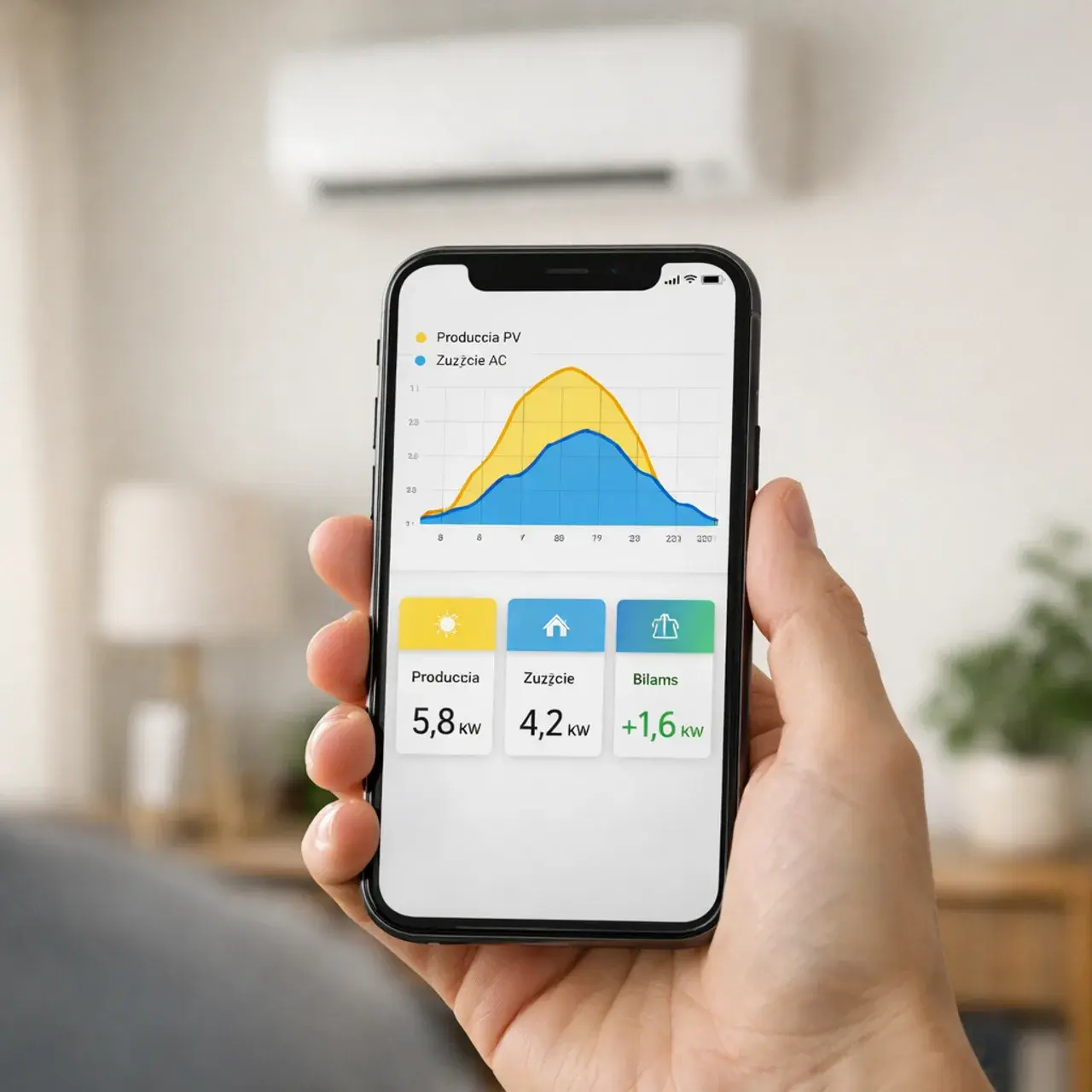
A practical tip at the equipment-choice stage: ask about an open API or native Home Assistant integration. Models locked into the manufacturer's app are fully functional, but harder to correlate with the PV inverter and smart meters. Daikin, Mitsubishi Heavy Industries and some LG models work well with open systems; cheaper brands tend to be poorer here and need adapters (such as ESP-Home modules) that complicate servicing.
The most common mistakes when combining PV and air conditioning
- Sizing PV against the annual total without looking at the hourly profile — the system then sells midday surpluses for PLN 0.15–0.30 and buys back in the evening at around PLN 1.00. Fix: start from the hourly consumption profile, and only then pick the capacity.
- Oversizing energy storage in the hope of covering all AC in winter — in Polish conditions it rarely pays back; without a Mój Prąd subsidy almost never. Cooling AC in summer doesn't need a battery, because consumption and production are in phase.
- Setting setpoints too aggressively (16–18 °C) — these raise consumption 2–3× compared with 23–24 °C without any real comfort gain. SEER 8 falls to an effective 4–5 at such setpoints, and the unit runs at full power around the clock.
- No cleaning of filters and the evaporator — a dirty unit loses up to 20% of its efficiency; that means more kWh for the same effect and shorter PV cover. Cleaning every six months is an investment that pays back in a single season.
- Choosing the PV installer and the AC installer without coordination — cables, distribution board, miniature circuit breakers (B16 / C16), earthing — all of it needs a single, coherent plan. At LeoKlima we don't install PV ourselves, but we always coordinate with the inverter contractor to avoid clashes.
Installation — what to know before you call the installer
The order of works matters. In over 90% of the cases we handled over the past two seasons, the PV system goes in first and the air conditioning is added afterwards. Why? Because photovoltaics drives the size of the distribution board, the choice of residual-current devices, the cross-section of supply cables, and often forces an earthing upgrade. Adding air conditioning to a well-designed electrical installation is plain routine. The reverse — adding PV to AC that was installed without a forward-looking plan — ends in reworking protections and the cross-section of the cable feeding the main board, which costs both time and money.
What should you check in the home's electrical installation before the AC design? First: whether the distribution board has free space for 1–2 additional B16 or C16 miniature circuit breakers. Second: whether the residual-current device covering the outdoor unit's circuit is type A — for modern inverter air conditioners type AC is no longer recommended, because it does not detect pulsating DC components, and some configurations require even type B. Separately, bear in mind that the PV inverter circuit can be demanding: most transformerless bidirectional inverters need a type B RCD or a built-in RCMU module — check this in the manufacturer's documentation. Third: whether the installation has correct earthing in line with PN-HD 60364, because old TN-C installations without a PE conductor need adaptation before a PV inverter and a modern air conditioner can be fitted.
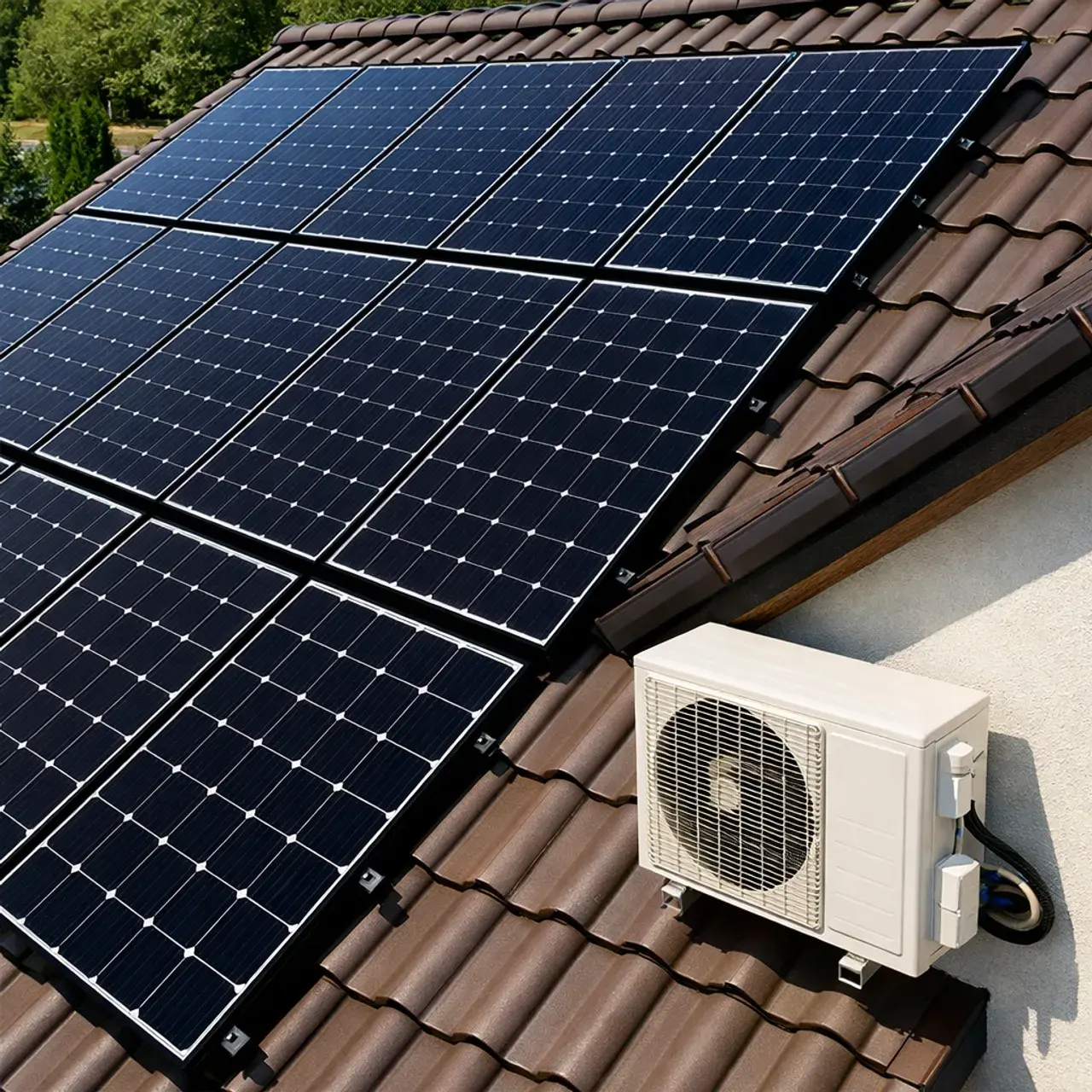
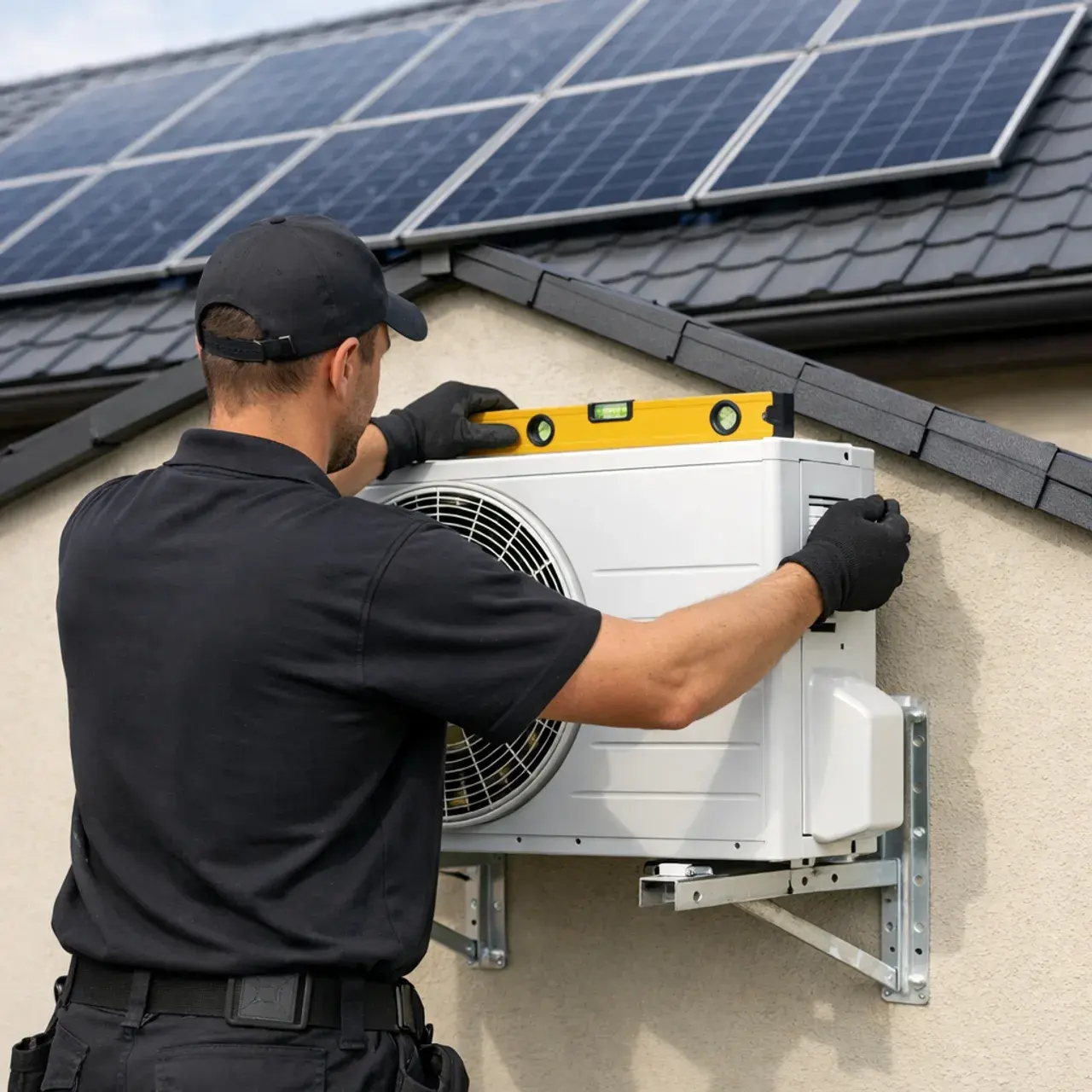
The air conditioner's outdoor unit works entirely independently of the PV inverter — these are two separate circuits connected only at the main distribution board. The proximity of photovoltaic panels and the outdoor unit poses no electromagnetic problem. From practice: the air conditioner is usually mounted 1.5–2 m from the roof edge to avoid shading the PV panels, and to keep the outdoor unit from sucking in the hot air that builds up under sun-soaked modules. That is a very real thermal failure mode — drawing 45-degree air from under the panels instead of 32-degree ambient air cuts the AC's COP by 10–15%.
- What overcurrent and residual-current protection is planned in the distribution board for the new AC unit?
- Does the PV inverter support monitoring of load circuits, or will an external smart meter with Modbus be needed?
- What is the exact SCOP and SEER of the proposed AC model in a temperate climate?
- Will the contractor provide a vacuum protocol (≤ 500 microns) and a parameter measurement after commissioning?
- What is the warranty on refrigerant-circuit tightness (R32 refrigerant in newer models; commonly called freon) — usually 24–60 months?
FAQ — the most common questions from LeoKlima clients
Is a small 3 kWp PV system enough to power an air conditioner?
Yes, if we are talking about a single 2.5 kW split air conditioner in a flat, on an annual-balance basis. A 3 kWp installation produces around 3,000 kWh in the Warsaw climate, and a typical split consumes 100–175 kWh over the cooling season. Numerically there's no issue. What matters more is the hourly profile: in summer, midday output far exceeds consumption, so savings on the bill follow automatically. In winter the picture flips — if you use the same split for heating, seasonal consumption climbs to 2,000–3,000 kWh, and December PV output is minimal. Heating then leans mostly on the grid and on the net-billing credit accumulated over summer.
Does the air conditioner run directly from the panels, or through the grid?
Technically, the energy from the panels passes through the inverter and feeds into the home's electrical installation on the same bus as the fridge and the kettle. The air conditioner draws current from that bus and has no idea whether the source is the sun or the utility. In a typical grid-tied installation without storage, when the grid supply drops (a neighbourhood outage, for example), the inverter shuts off automatically for safety reasons, and the air conditioner stops working — even if the sun is blazing on the roof. Only hybrid systems with island-mode and storage keep loads running through a blackout.
Do I need an energy storage battery?
For cooling — no. In summer, PV output and AC consumption line up in time, so autoconsumption reaches 60–80% without any battery at all. A domestic energy storage battery of around 10 kWh makes sense if you have heavy evening loads (EV charger, induction hob, large appliances) or if you use the air conditioner in heating mode through dark winter evenings in December and January. Without a Mój Prąd subsidy, the payback on a battery dedicated solely to air conditioning is typically 12+ years — longer than the battery's own warranty. With a subsidy on PV plus storage, the economics improve significantly.
Will photovoltaics cut my air-conditioning bill by 100%?
On an annual balance, with correctly sized PV — yes, the cooling-season bill drops effectively to zero. Air conditioning consumes 100–600 kWh a year, and 5 kWp produces 5,000 kWh, so the balance sits firmly on the producer's side. The harder case is heating: December and January are months where PV covers only 5–10% of heating demand, and the air conditioner runs at its worst COP. The claim of "100% AC savings" holds for cooling and is conditional for heating — and it pays to tell the client that plainly, because otherwise disappointment follows.
Can I have PV and AC installed in one job?
Yes, and coordinating saves both time and money. One site visit covers two investments, one electrical audit assesses the distribution board and cable cross-sections, one routing exercise through the cable trench or service shaft serves both circuits. At LeoKlima we install air conditioning in Warsaw and the surrounding area and work with trusted PV partners — a single project manager runs both crews, so there is no "we'll come next week, first the PV electrician needs to be here". The client gets a single schedule, a single invoice for coordination, and a single point of contact for any questions.
What about flats in apartment blocks?
A private PV installation on a multi-family building is rare in practice, because the roof belongs to the housing community and installation requires a resolution. More realistic alternatives: an energy cooperative or collective prosumer arrangement — models introduced by the 2024 amendments, allowing a group of consumers to share a single installation. The other pragmatic path: install the air conditioner without PV. The unit alone pays back in comfort and apartment value, and a seasonal bill of PLN 200–300 is not a barrier for most Warsaw households. Many of our clients in blocks in Mokotów and Wilanów take exactly this route — air conditioning now, photovoltaics later, at the community level.
Summary and next step
First: the cooling season in the Polish climate aligns perfectly with peak panel output, so an air conditioner in cooling mode is one of the best autoconsumption loads you could ask for — no battery, no juggling, no compromises. Second: sizing PV for AC requires the hourly consumption profile, not just the annual balance, because under net-billing the spread between sell and buy prices reaches PLN 0.50–0.80 per kilowatt-hour. Third: a split unit in heating mode plus a sensible net-billing credit accumulated over summer is the formula for year-round savings, and it works in homes up to around 150 m² and in well-insulated flats.
If you live in Warsaw or the surrounding area and you are planning air conditioning in a house with an existing or planned PV installation, book a free site visit on the LeoKlima contact page. We'll advise on indoor-unit selection, coordinate the electrical installation with your PV contractor, and help you pick a model with an open API for production and consumption monitoring. After the visit we provide a detailed quote broken down into materials, installation and any distribution-board adaptations — no vague "from… to" ranges that tell you nothing. Call 502 010 010 or write through the form on our website.