The Importance of Vacuum in AC Installation
Evacuating the refrigerant lines is one of the most important stages of air conditioning installation, directly affecting the lifespan and efficiency of the system. Unfortunately, it is also the step most commonly skipped or performed incorrectly by inexperienced installers. In this article, we explain why evacuation matters so much and what a proper procedure looks like.
The purpose of evacuation is to remove moisture and air from the piping before charging with refrigerant. Moisture in the refrigeration circuit is a serious threat — it reacts with the refrigerant and compressor oil, forming acids that damage system components from within. Air in the circuit reduces cooling efficiency and increases energy consumption because it acts as a non-condensable gas in the refrigeration cycle.
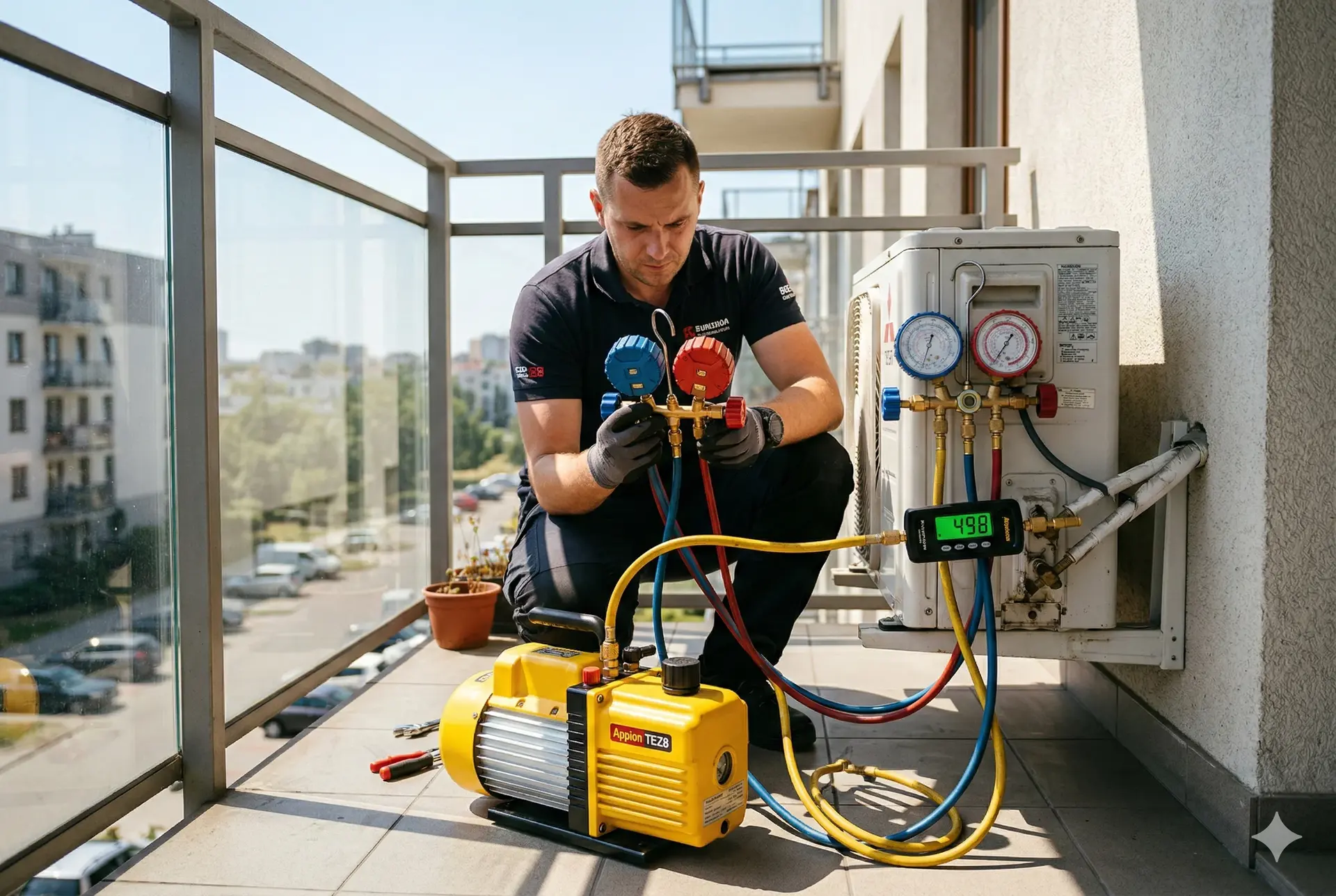
Proper evacuation requires a two-stage vacuum pump and a precision micron gauge. The standard procedure involves connecting the pump to the service ports of the outdoor unit and reducing the pressure in the system to below 500 microns (0.5 Torr). After reaching this level, the valve is closed and the gauge is monitored for at least 15 minutes — this is the so-called standing vacuum test.
The standing vacuum test is the critical moment of the entire process. If the pressure in the system rises after the valve is closed, it indicates one of two situations: a leak in the system or residual moisture evaporating. A leak requires locating and fixing the source before continuing. Residual moisture requires repeating the evacuation cycle — sometimes several times.
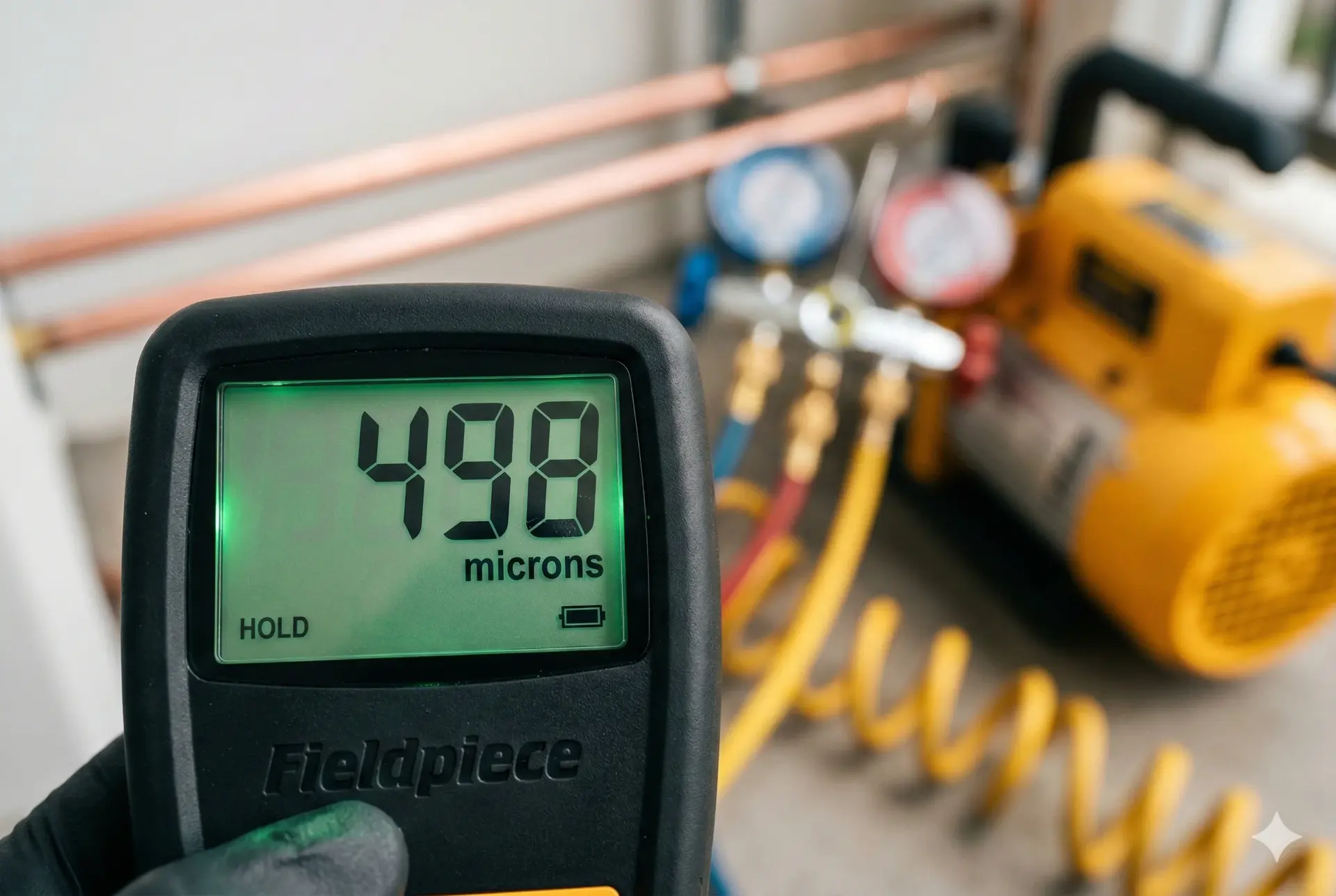
The 500-micron standard is not arbitrary — it corresponds to a water boiling point below zero degrees Celsius under reduced pressure. At this pressure, any moisture in the system evaporates and is removed by the vacuum pump. Some manufacturers require even lower values — down to 200-300 microns — which demands longer evacuation times and better equipment.
The most common evacuation mistakes include: too short a pump-down time (less than 30 minutes), not using a micron gauge (relying solely on the manifold gauge), using a single-stage vacuum pump incapable of reaching adequate depth, and skipping the standing vacuum test. Each of these errors can shorten the AC system's lifespan by several years.
At LeoKlima, we treat evacuation as a mandatory and non-negotiable step of every installation. We use professional two-stage vacuum pumps and digital micron gauges. Every installation is documented — the micron gauge reading is photographed and included in the handover report. This guarantees that the installation has been carried out to the highest standards and will perform reliably for years to come.