Ducted vs. wall-mounted AC — which to choose?
Ducted vs wall-mounted: basics and costs
Choosing between ducted and wall-mounted air conditioning rarely comes down to the simple question of which unit cools better. Both solutions can provide comfort in summer, lower the temperature by several degrees even during Warsaw heatwaves of 30–35°C, and run energy efficiently thanks to inverter technology. The difference begins where everyday apartment use comes in: interior aesthetics, acoustics, scope of renovation, installation cost, and the possibility of sensibly routing the whole system. In practice, for an apartment owner in Mokotów, Ursynów, or Żoliborz, the decision looks different than for an investor fitting out an apartment in Wilanów or for a family renovating a unit in a prefabricated block in Bródno. Wall-mounted air conditioning usually wins on simplicity. Installation typically takes 1 day, does not require a full renovation, and the budget can be kept at a reasonable level. That is why in Warsaw apartments of 40–70 m², this is the solution we see most often. Ducted air conditioning, on the other hand, is a more architectural choice than a purely technical one. It gives a very clean visual effect because instead of a unit on the wall, you only see grilles or diffusers indoors. At the same time, it requires space for ducts, a suspended ceiling, and much better planning of the work. It is especially attractive in a developer finish or during a full renovation, when you can plan the duct route, condensate drainage, and service access to the unit from the outset. It is also worth remembering that the differences are not limited to purchase price. There is also acoustic comfort, the way air is distributed, the level of control in individual rooms, and how the system fits the apartment layout. In a unit with an open living zone and bedrooms on the other side of the corridor, ducted air conditioning can create a more cohesive system. In a compact 50 m² apartment, two wall-mounted splits often turn out to be the more rational solution. That is why this decision should be treated as part of the interior and installation design, not merely as buying an appliance in a larger housing.
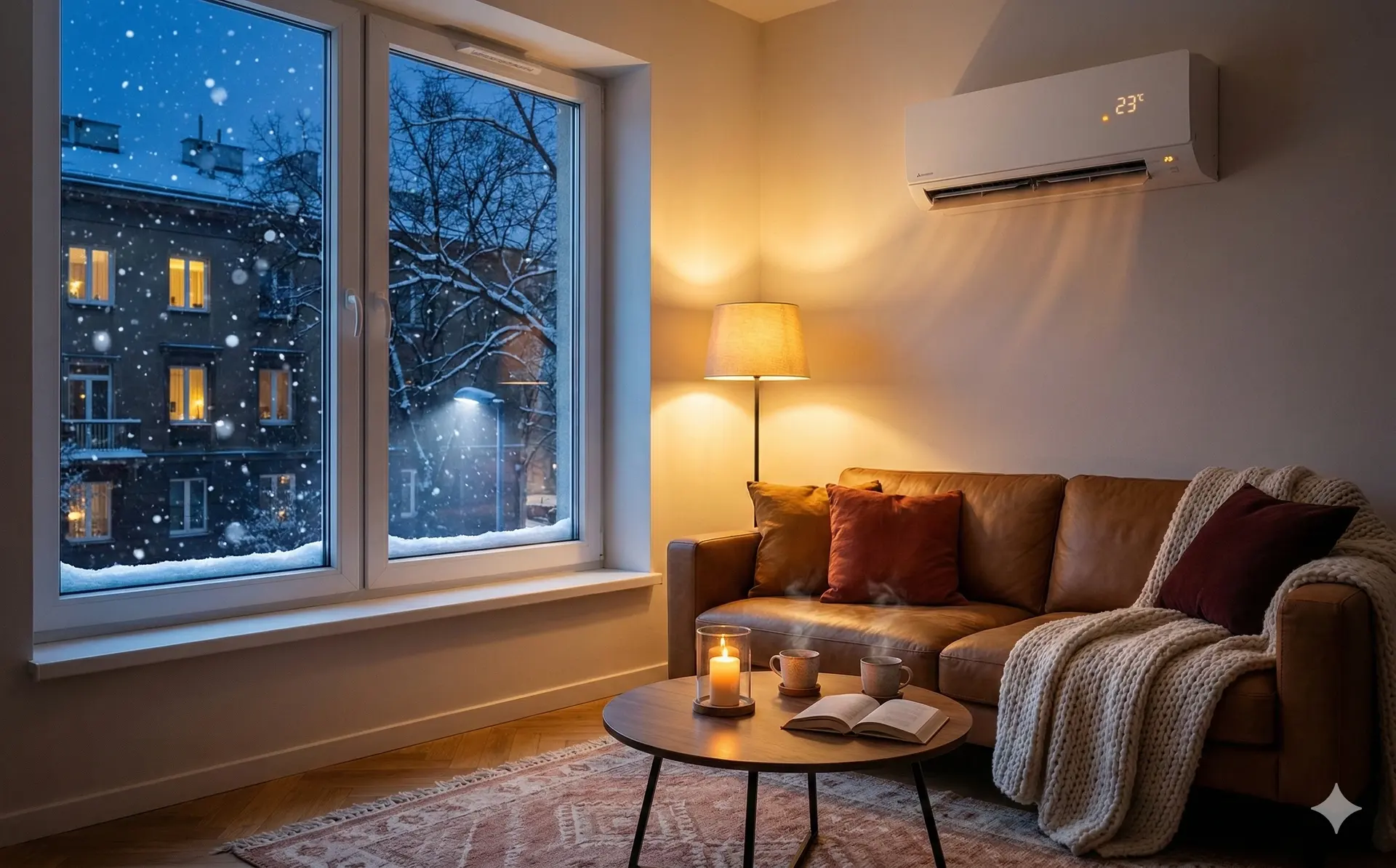
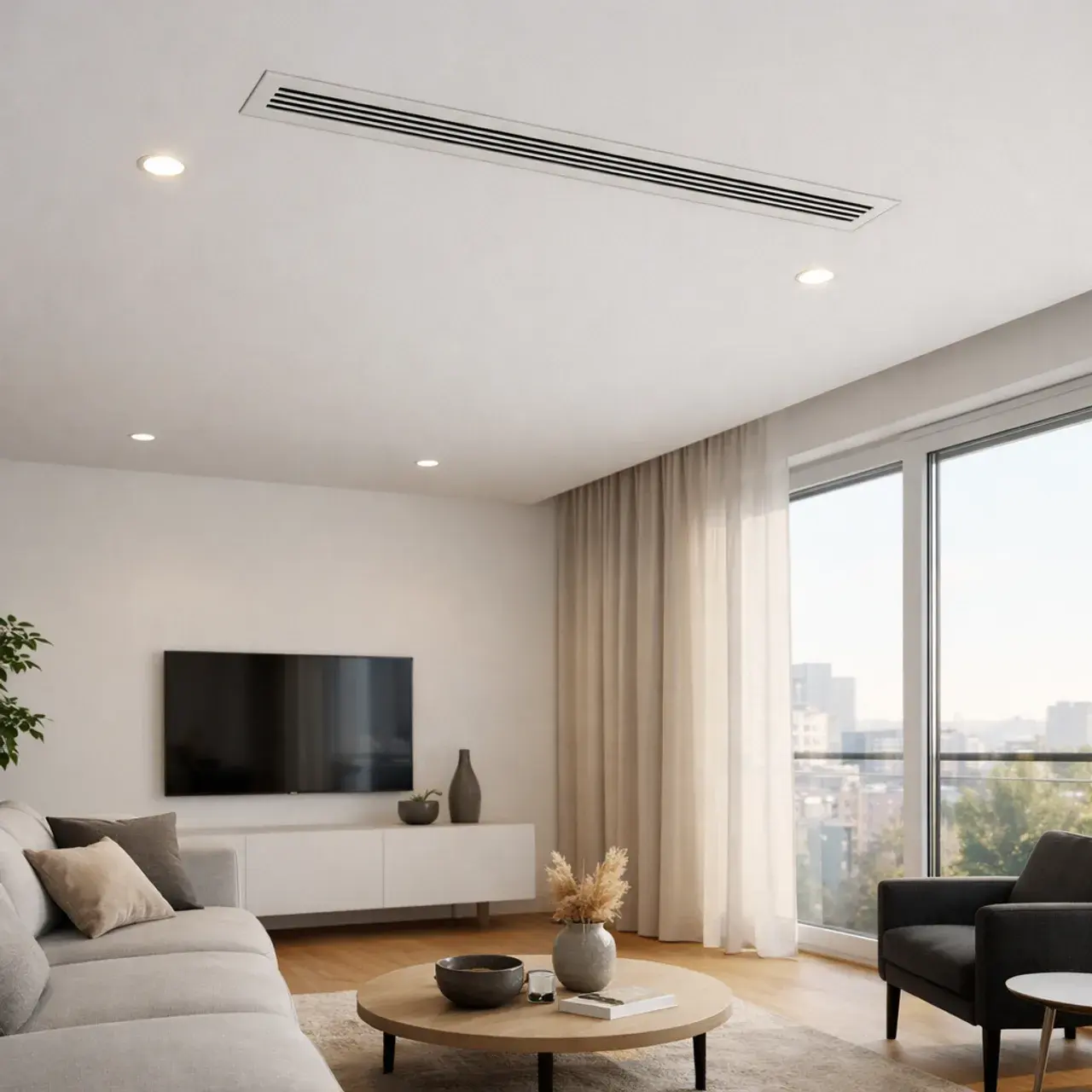
Wall-mounted air conditioning, most often called a wall split, is a system consisting of an outdoor unit and one or more indoor units mounted high on the wall. Inside the indoor unit housing are the key components responsible for removing heat from the room, primarily the evaporator, fan, filters, and automation controlling the airflow. Air from the room is drawn into the unit, cooled on the heat exchanger, and then returned indoors through movable louvers. It is a simple, clear, and well-known solution for users, which is why brands such as Daikin, Mitsubishi Electric, Haier, Samsung, LG, Toshiba, and Rotenso offer a very wide selection of models, from entry-level to premium. Ducted air conditioning works according to the same cooling physics, but distributes air differently. The indoor unit itself is hidden in a suspended ceiling, GK enclosure, or technical space, for example above a bathroom, walk-in closet, or corridor. The cooled air then travels through ducts, most often SPIRO-type or flexible flex ducts, to supply grilles or diffusers in individual rooms. Return air comes back through a separate duct or via a transfer grille, depending on the design. What both systems have in common is the outdoor condenser, the refrigerant circuit, the inverter compressor, and the temperature-control automation. Both wall-mounted and ducted systems can cool, dehumidify, and filter air, and in many models also heat during shoulder seasons. The differences start at the level of how the system interacts with the interior. A wall split is a visible device that independently serves a specific room. A ducted system is more integrated into the apartment architecture and distributes air to several zones from one point. In practice, that means a different philosophy of use. With a wall-mounted unit, the source of airflow is visible, the device is heard directly from the room, and it is controlled locally. With a ducted system, you get a more “invisible” air-conditioning setup, but at the cost of greater complexity in design, installation, and later service.
Cost is for most investors the first moment when dreams meet technical reality. In Warsaw, for an apartment of about 60 m² with two or three rooms requiring cooling, wall-mounted air conditioning is usually clearly cheaper than ducted. The simplest, but often very sensible, option is two separate 2.5 kW wall splits, for example for the living room and bedroom. In 2025 and 2026, the real cost of such a set with installation is usually 9–12 thousand PLN, depending on the brand, installation length, and finishing level. At the lower end are basic Haier, Rotenso, or LG models, while Samsung and Toshiba sit higher, and Mitsubishi Electric and Daikin even higher. If the building facade or the housing community limits the number of outdoor units, or if we simply want one condenser on the balcony, an alternative is a 2x multi-split. Such a system with two indoor units usually costs 11–16 thousand PLN installed, and with higher-grade equipment or more difficult routing, the cost may approach 17 thousand PLN. Ducted air conditioning for the same apartment usually starts from a completely different level. A ducted unit with a capacity of around 3.5–5 kW, suitable for serving the living area and one or two bedrooms, together with ducts, insulation, plenum boxes, diffusers, controls, condensate drainage, and labor, typically costs 18–30 thousand PLN. If you also need to build a suspended ceiling, service hatches, acoustic insulation, and more advanced automation, the budget rises further. That is exactly where the answer lies as to why ducted systems are more expensive. You are paying not only for the unit itself, but for the entire air-distribution infrastructure and for integrating the system with the apartment. In the estimate, a large share comes from installation materials, route design time, precise installation, and coordination with the GK enclosure team. In other words: with wall-mounted units, you buy equipment and standard installation; with ducted systems, you are financing a small HVAC installation that is meant to work quietly, evenly, and remain almost invisible for years.
| Criterion | Wall-mounted (split) | Ducted |
|---|---|---|
| 60 m² cost (2 zones) | 9–16k PLN | 18–30k PLN |
| Visibility in room | Unit 80–100 cm | Grilles only 10–20 cm |
| Min. ceiling height | Irrelevant | ≥ 270 cm |
| Typical SEER | 6.5–9.0 | 5.8–7.5 |
| Per-room zoning | Standard (every unit) | With VAV (+2–5k PLN) |
| HEPA filtration | Difficult | Easy integration |
| Retrofit without renovation | Yes | Nearly impossible |
| Annual service cost | 300–500 PLN | 400–700 PLN |
Aesthetics, acoustics and zoning
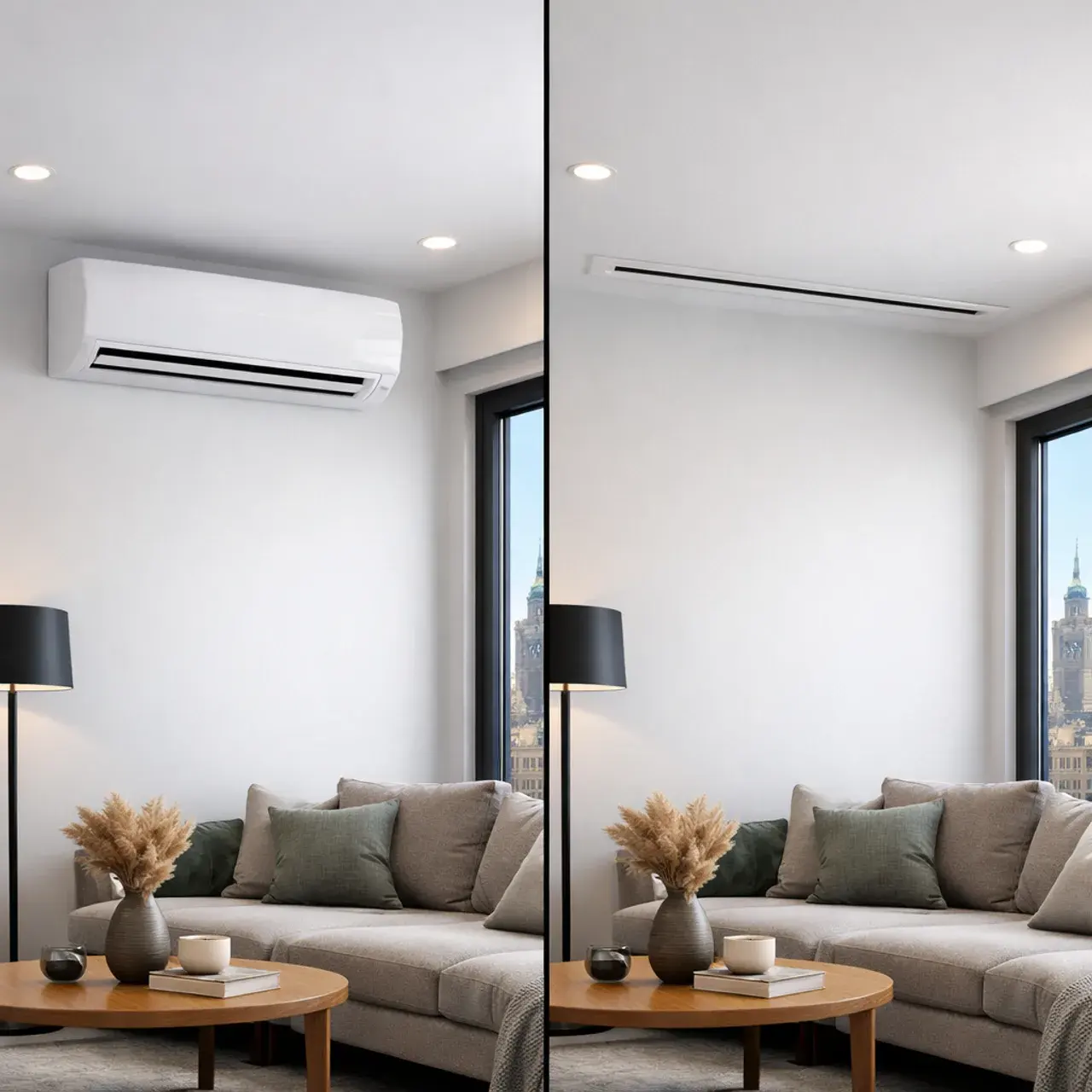
Aesthetics is the area where the difference between ducted and wall-mounted air conditioning is most obvious at first glance. A wall-mounted unit, even if modern, slim, and better designed than older models, always remains a visible element of the furnishing. It usually has a width of around 77 to 99 cm, a height of 25–32 cm, and protrudes from the wall by a dozen or more than 20 cm. In a minimally furnished living room, with refined carpentry built-ins, mouldings, or architectural concrete, such a form is acceptable for some investors, but for others it is simply a foreign object hanging high on the wall. Even designer series such as some LG ARTCOOL, Samsung WindFree Elite, or Daikin Emura models do not disappear from view. They simply look better than classic white housings. Ducted air conditioning solves this problem differently. In everyday use, we see only grilles or diffusers, usually around 125–160 mm in diameter or elongated slots and grilles about 10–20 cm wide, which can be integrated into the ceiling layout. This keeps the interior cohesive and prevents the air conditioning from visually competing with lighting, curtains, furniture built-ins, or artwork. That is a huge advantage in premium apartments, architect-designed flats, and spaces where the owner truly counts every detail. At the same time, wall-mounted units should not be demonized, because in a huge number of Warsaw apartments they are perfectly sufficient. In a standard 50–70 m² unit, especially where the priority is functionality and cost control, a modern split mounted above the balcony door or on a short wall simply stops being a problem after a few days of use. Aesthetics therefore has a very individual threshold of sensitivity. For some, every visible technical element disturbs the perception of the space, and then ducted air conditioning is the natural choice. For others, more important are simple service, lower cost, and no need to interfere with the ceiling, and then wall-mounted air conditioning offers a sufficiently good compromise between appearance and practicality.
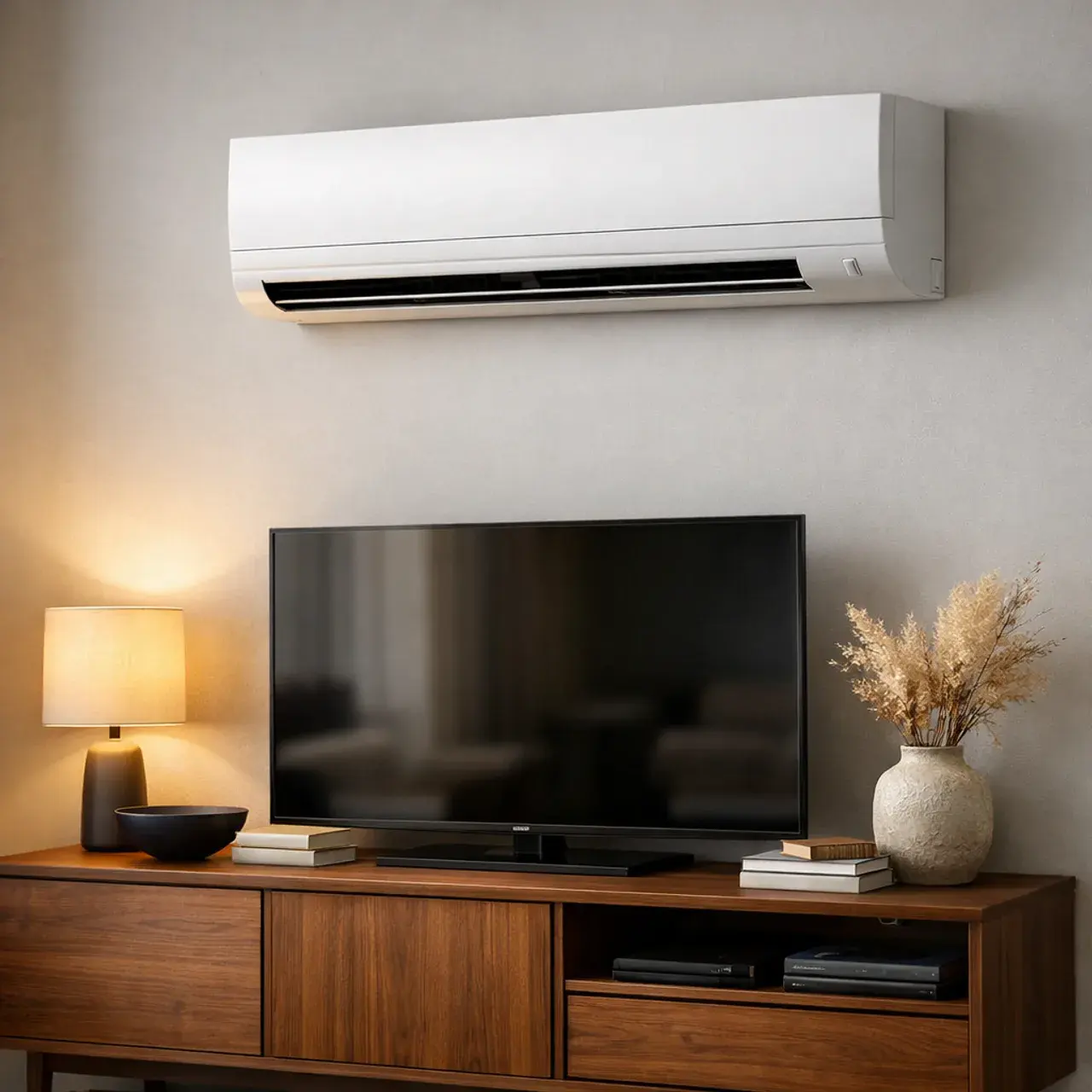
Noise is a parameter that at the purchasing stage is often reduced to one number from a catalogue, whereas in practice it depends on a much larger number of factors. Wall-mounted air conditioners from reputable brands can run very quietly. In night mode or on the lowest fan setting, good models reach about 19–25 dB(A), which is an acceptable level in a bedroom for most users. The problem appears when a room heats up quickly, has large south-facing glazing, or the user sets a high airflow intensity. Then the wall-mounted fan speeds up and the unit becomes clearly audible because it is located directly in the room, often 2–3 meters from the bed or sofa. Ducted air conditioning in the supply room usually reaches around 22–28 dB(A), but the acoustic perception is often better than the number alone would suggest. Why? Because the source of the mechanical noise, namely the fan unit, is hidden above the ceiling, usually above a corridor, bathroom, or walk-in closet. In addition, part of the noise is dampened by the ducts, insulation, and greater distance from the user. As a result, in the living room or bedroom, you hear more of the air flowing through the diffuser than the unit itself. A well-designed ducted system therefore provides a very pleasant, soft acoustic background. However, it must be said honestly that this effect does not happen on its own. If the ducts are poorly selected, the airflow speed too high, the plenum boxes too small, or the diffusers improperly set, humming, whistling, or an irritating rush of air appears. This is a common problem in badly calculated installations where someone tried to save on diameters and sound insulation. In Warsaw apartments, a typical and sensible location for the ducted unit is the space above the bathroom or corridor, because there it is easier to hide the enclosure and still retain service access. From the user’s perspective, the acoustics of ducted air conditioning can be very comfortable, but only if the design takes into account not only cooling capacity but also the operating culture of the whole installation. Wall-mounted systems are simpler and more predictable, while ducted systems have greater quietness potential but require better workmanship.
The topic of filtration and air quality is often omitted in simple comparisons, and yet this is exactly where ducted air conditioning can show a functional advantage over a typical wall unit. In a standard wall split, you usually get basic mesh filters for catching dust and larger impurities, sometimes additional antibacterial cartridges, ionization, a silver-ion filter, plasma, or solutions described in marketing terms as air purification. In practice, this is useful, but the filtration scale remains limited by the unit size, airflow resistance, and the small surface of the filter itself. Ducted systems offer more possibilities because they operate at a higher air volume and have more room for the filtration section. This makes it easier to integrate higher-grade filters, such as F7, and in selected configurations also additional highly accurate filtration modules, even to a standard close to HEPA, if the design provides the appropriate pressure and installation space. This is important for allergy sufferers, families with small children, pet owners, and people living near busy Warsaw streets, where suspended particles, dust, and exhaust fumes are a real problem. Another advantage appears where the apartment has central mechanical ventilation with heat recovery. In premium units and new developments in Wilanów, Służewiec, or Wola, recuperation is increasingly common, and then ducted air conditioning can be coordinated with it much more sensibly. It is not that one device replaces the other, because recuperation is responsible for air exchange, while air conditioning is responsible for cooling and thermal treatment. The point is installation coherence, a similar logic for running ducts, and easier integration of both systems into the ceiling. In an apartment with already planned mechanical ventilation, ducted air conditioning often becomes a natural complement to the whole setup. Wall-mounted units can still work very effectively and will be sufficient for most users, but if the priority is advanced filtration and a high level of HVAC system integration, ducted systems win not only on appearance but also on technical potential. There is only one condition: the design must take into account real airflow resistance, access for filter replacement, and regular service, because the best filtration on paper will not work without proper operation.
Zoning is an aspect that strongly affects everyday comfort, especially in apartments where household members have different temperature preferences. With wall-mounted air conditioning, the principle is simple: each indoor unit serves its own zone and has its own temperature sensor, remote control or controller, and independent ability to switch on, switch off, and set the desired temperature. If we want 23°C in the living room and 25°C or no cooling at all in the bedroom, two separate splits can achieve that without complications. That is why in 60–80 m² apartments, a layout of two or three wall units, whether in single-split or multi-split form, is so practical. Three independent wall units are simply three independent microclimates, although you need to remember the limitations resulting from the condenser capacity in a multi-split system and the fact that control is local rather than central, as in more advanced systems. In ducted systems, the basic layout works differently. One unit serves several rooms, so without additional elements all these zones receive roughly the same operating mode and a similar airflow. That is enough in apartments where we mostly cool the whole night or day zone as one space, but it becomes less convenient when each room is meant to work according to its own rules. The solution is zoning dampers, often referred to as VAV or zoning systems. They allow airflow to individual rooms to be regulated based on signals from room thermostats. In practice, this gives much greater control, but increases the installation cost by an additional roughly 2–5 thousand PLN, and sometimes more with more advanced automation. You also need to calculate the minimum airflow well so the unit operates stably after some zones are closed. At that point, it is no longer a simple “switch it on and it works” arrangement, but a full system with automation. So the answer to the zoning question is this: if independence of each room and simplicity of control are the priorities, wall-mounted units have the natural advantage. If, however, you care about aesthetics, the central character of the installation, and you are willing to pay extra for automation, ducted air conditioning can also provide room-by-room comfort, but it requires a more thoughtful design and a larger budget.
Technical requirements and service
The biggest barrier to ducted air conditioning is not always the price, but the apartment architecture. For such an installation to make sense, you need technical space for the unit, supply and return ducts, insulation, condensate drainage, and service access. In practice, this usually means having to build a suspended ceiling or use an existing enclosure. A safe minimum is usually assumed to be around 25–30 cm of technical space, although the exact value depends on the unit model, duct diameters, and the method of distributing the installation. This is a number worth immediately comparing with the apartment height. In new Warsaw developments, the standard is around 270 cm of net height before finishing, sometimes more in apartments. In such a layout, ducted air conditioning is entirely feasible, especially if the ceiling drop is limited to the corridor, bathroom, or part of the living area. After finishing, you can still keep about 240–250 cm in the main rooms, which is comfortable and visually well received. The situation is completely different in older blocks, especially prefabricated ones, where height may be close to 250 cm. When you subtract 25–30 cm for the installation from such a ceiling, you get dangerously close to the 220–225 cm range, and in an apartment that quickly feels oppressive. Even if it is technically possible to do it, the user experience may be poor. That is why in lower-ceiling units it is often better to choose wall-mounted splits rather than forcing a ducted system into place. The stage of the investment is equally important. In a finished apartment, retrofitting ducted air conditioning is in practice nearly impossible without a full renovation. You have to dismantle ceilings, coordinate electrical work, lighting, built-ins, and often rebuild part of the interior. For this reason, ducted systems work best at the developer-finishing stage or during a full apartment modernization. Wall-mounted air conditioning is much more flexible in this respect. It can be added to a finished unit with relatively little interference. Therefore, when assessing cost-effectiveness, you should look not only at the equipment itself, but also at whether the apartment actually provides the architectural conditions for a sensible ducted implementation without compromises worse than the aesthetic gain itself.
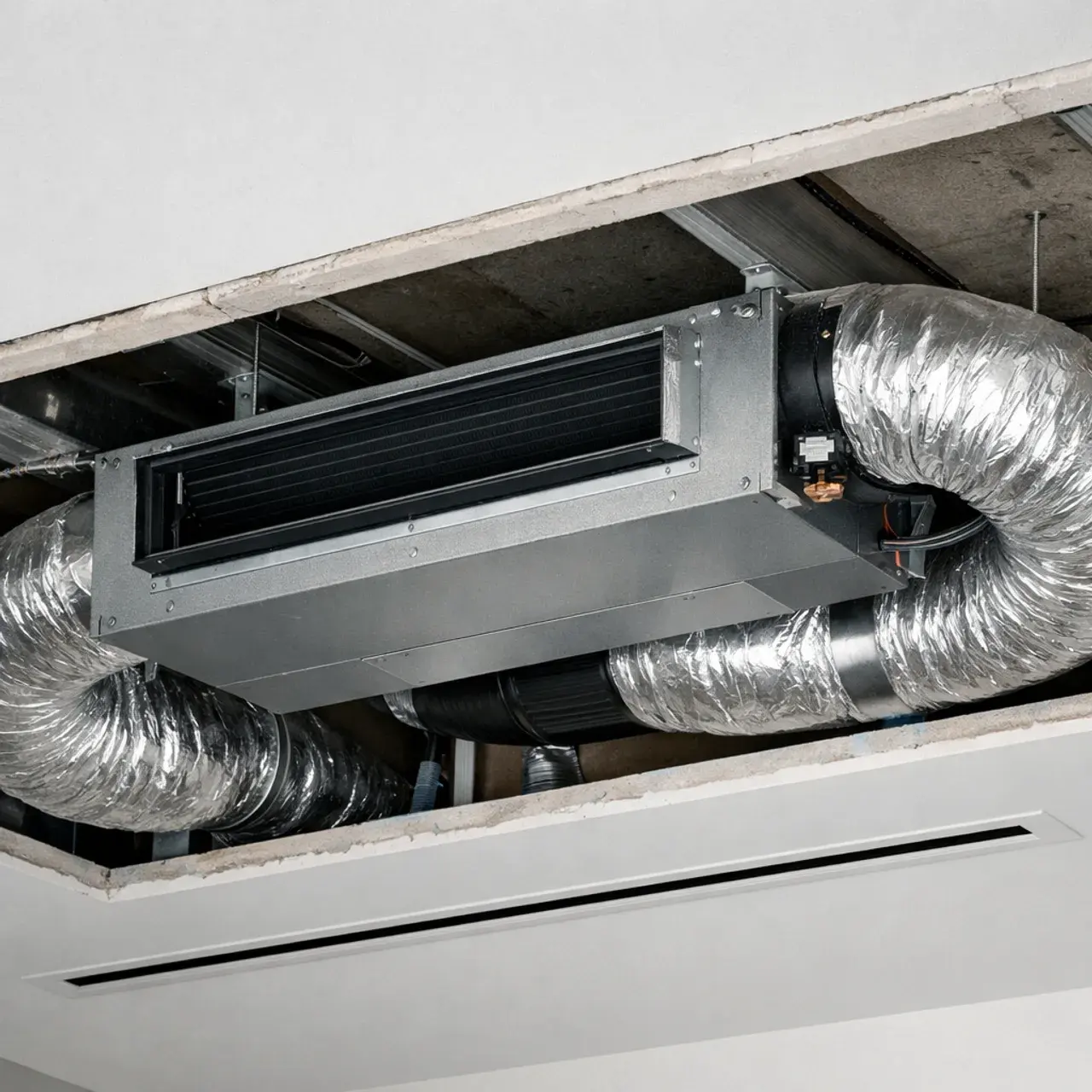
If we compare ducted and wall-mounted air conditioning solely in terms of power consumption, then we have to say it plainly: a well-designed ducted system is not a power-hungry device, but statistically it is often less efficient than good wall-mounted units. This is not due to a single flaw of the unit itself, but to the whole system architecture. In practice, ducted units usually achieve a SEER of around 5.8–7.5, while solid wall-mounted air conditioners from reputable manufacturers such as Daikin, Mitsubishi Electric, LG, Samsung, Toshiba, or Haier typically fall in the 6.5–9.0 range. On paper, the difference looks moderate, but in summer the real electricity consumption can be about 10–20% higher in a ducted system. For a 70–90 m² apartment in Warsaw, intensively cooled from June to August, that may mean a difference of roughly 120–300 PLN per season, depending on the tariff, number of operating hours, and set temperature. The reason is simple: in a ducted system, air must overcome resistance in ducts, plenums, diffusers, and filters, and the distribution system itself also generates heat losses. If the ducts are long, poorly insulated, or run through a warm technical space under the roof, part of the cooling simply disappears along the way. In a wall-mounted split, the air is cooled directly in the room, so the path from the heat exchanger to the user is short and the losses are minimal. However, an important caveat must be added: a poorly chosen wall-mounted system can also operate inefficiently if it is oversized, installed in the wrong place, or forced to cool several rooms through open doors. That is why the energy label alone is not enough. At LeoKlima, we look not only at the unit class, but at the whole system: route length, air distribution method, insulation, number of zones, and the actual habits of the household. Only then can we honestly calculate whether the difference in bills will be symbolic or noticeable after every hot month.
Service is a topic that is very often overlooked at the purchase stage and then comes back at the first inspection or breakdown. And this is precisely where the difference between ducted and wall-mounted air conditioning becomes practical, not catalog-based. In a wall-mounted unit, access to the filters, condensate tray, or housing is simple: the technician stands on a ladder, opens the front panel, and gets to work right away. In a ducted system, access is through a service hatch, i.e. a specially designed inspection panel in the suspended ceiling or enclosure. That hatch must be sufficiently large, removable, and located exactly where access is actually needed to the unit, condensate trap, condensate pump, or connections. If the investor or contractor makes it “permanent,” patches it over, or creates an opening that is too small, a routine inspection can turn into a micro-renovation. The service interval for both systems is similar, and for apartments in Warsaw we recommend at least one inspection per year, preferably before the season. What does differ is the cost. Ducted system service is usually 20–30% more expensive than wall split service, because it takes more time: access to the unit, removal of enclosure elements, more thorough cleaning, and checking the air distribution. In addition, every 2–3 years it is worth planning duct cleaning, especially if there are pets, lots of textiles, or the system also operates in heating and ventilation mode for most of the year. This is not an operation required every season, but from the point of view of hygiene and performance it makes sense. In practice, a standard wall unit inspection in 2025 usually costs about 250–400 PLN per device in Warsaw, while a ducted system costs about 350–550 PLN, and more for more complex systems. At LeoKlima, we always remind clients that the service hatch is not an architectural detail, but an operational element. Well planned, it is almost invisible on a daily basis, but without it even the best Daikin, Mitsubishi, or Rotenso installation becomes troublesome and more expensive to maintain than it should be.
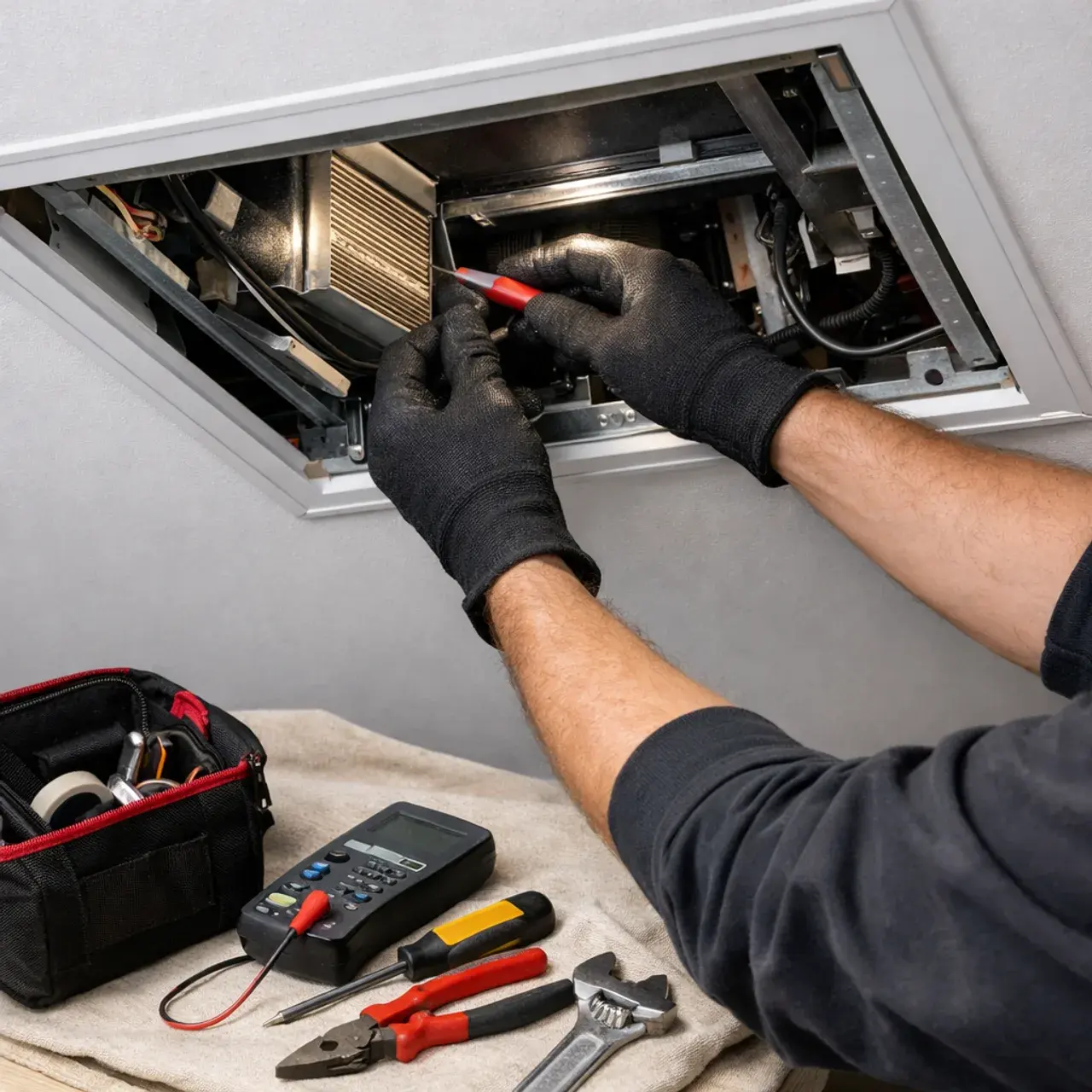
Most problems with ducted air conditioning do not stem from the unit itself, but from design and execution errors that initially seem like minor details. The first classic mistake is too little space under the ceiling. The investor wants to “hide everything,” but leaves too little room for the unit, insulated ducts, distribution boxes, condensate drainage, and a proper service hatch. The result is a cramped system, inconvenient servicing, and a higher enclosure than originally planned. The second common problem is incorrectly selected duct diameters. If the duct is too small, air flows faster, noise increases, efficiency drops, and whistling appears at the diffusers. In practice, the user then feels that the system “blows, but doesn’t cool as it should.” The third mistake is the lack of a service hatch or a hatch that becomes inaccessible after furniture or lighting has been installed. Such savings can backfire at the first cleaning of the condensate tray or replacement of the pump. The fourth problem is uninsulated or poorly insulated ducts running through an unheated space, such as a technical attic. Then condensation, dampness, and even ceiling stains appear. The fifth mistake concerns supply or return air: a diffuser that is too small, the wrong mounting location, or the lack of a sufficiently large transfer grille between zones disrupts circulation. The sixth, very underestimated issue is the lack of acoustic dampers between the unit and the ducts. The unit itself may be quiet, but without vibration and airflow noise damping, sound spreads through the rooms more than the investor expected. In Warsaw, we see this particularly often in apartments finished in a hurry by teams that do “everything,” with experience in gypsum board but not in HVAC. That is why at LeoKlima, before installing ducted systems, we check not only the unit capacity, but also the cross-sections, route lengths, supply locations, service access, and insulation. A properly executed installation is almost invisible and quiet. A poorly executed one becomes a source of noise, energy loss, and costly corrections that are much more difficult after the interior is finished than at the design stage.
- No service hatch above the unit — first maintenance means breaking the ceiling.
- Undersized SPIRO duct diameters — airborne noise plus 15–25% capacity loss.
- Uninsulated ducts in unconditioned space — condensation and ceiling stains.
- Wrong supply diffuser — whistling or insufficient airflow into the room.
- No acoustic silencers between unit and ducts — low-frequency rumble in the bedroom.
- Unit placed above bedroom instead of bathroom/corridor — needless noise.
- No per-room airflow plan — one zone runs cold, another runs warm.
When to choose what
There are projects where ducted air conditioning has a clear advantage, and that is not due to fashion, but to the logic of the whole interior layout. The first typical scenario is a new apartment in developer condition, bought with a view to a turnkey renovation. At this stage it is easy to plan the suspended ceiling, hatches, duct route, and unit location before furniture, lighting, and finished built-ins appear. The second case is a large premium apartment, where uniform aesthetics, the absence of visible wall units, and subtle airflow distributed through diffusers matter. The third scenario is a loft or attic with an irregular room layout, sloping ceilings, and zones that are difficult to cover with a single wall unit. A properly calculated ducted system allows air to be distributed more evenly there, although it requires a very careful design. The fourth situation is a tenement building after a major renovation, especially in Warsaw locations such as Śródmieście, Mokotów, or Stara Ochota, where the investor wants to preserve the elegant character of the interior and reduce the number of visible devices. The fifth case is a single-family house with central ventilation, where technical solutions are easier to integrate and adequate installation space can be provided. On the other hand, wall-mounted air conditioning remains the best choice in many apartments. If the unit is up to 50 m², we want quick installation without a full renovation, the budget is limited, or the owner simply does not want to complicate future service, a wall split or multi-split wins functionally. For example, in a 42 m² apartment in Wola, one good 3.5 kW wall unit from Haier, LG, or Rotenso can cost about 4.5–7 thousand PLN installed and solve the comfort problem practically immediately. Ducted systems in such a unit would usually be overkill. At LeoKlima, we most often recommend ducted systems where the investor is planning the interior comprehensively and is ready to pay more for aesthetics and integration. When the priority is reasonable cost, fast implementation, and ease of use, wall-mounted air conditioning remains the more rational solution.
| Scenario | Recommendation | Indicative budget |
|---|---|---|
| 45 m² flat, no renovation | Wall-mounted (1–2 splits) | 6–11k PLN |
| 60 m² flat, full renovation | Ducted or hybrid | 18–35k PLN |
| 90 m² premium apartment with mezzanine | Ducted with VAV | 30–55k PLN |
| Tenement in heritage-protection zone | Wall-mounted hidden in joinery | 12–25k PLN |
| 140 m² single-family house | Central ducted system | 35–70k PLN |
| Prefab flat, ceiling h. 250 cm | Wall-mounted or multi-split | 10–22k PLN |
In practice, very often the best solution is neither a pure ducted system nor a full wall-mounted system, but a hybrid layout. This is a variant that works especially well in Warsaw apartments of around 65–90 m², where the living room with kitchen forms one representative open zone, and the bedrooms have completely different temperature needs. In such a layout, ducted air conditioning in the day area provides high aesthetics, even air distribution, and no visible unit above the sofa or table. At the same time, classic wall-mounted splits are installed in the bedrooms, where they are cheap, easy to service, and allow independent night-time temperature control. This matters because one person sleeps comfortably at 22°C, while another prefers 19–20°C, and that is exactly where the flexibility of wall units has an advantage over one shared ducted system. In addition, there is no need to run an extensive network of ducts throughout the entire apartment, which limits the scope of ceiling enclosures and the risk of acoustic issues. For a 75 m² apartment in Warsaw, the cost of a sensibly designed hybrid system today is usually around 25–35 thousand PLN, depending on the brand, number of rooms, complexity of the work, and finishing standard. A budget version based on Haier, Rotenso, or selected LG models may be closer to the lower end, while a configuration with Mitsubishi Electric, Daikin, or Toshiba with better automation and quieter units will be closer to the upper end. Such a layout is especially popular in premium apartments in Mokotów, Wilanów, or Żoliborz, where the owner wants a clean line in the living room but does not want to pay for full ducted air conditioning in every room. Importantly, a hybrid solution also gives greater resilience to future changes in use. If a child’s room becomes a study and the study becomes a guest bedroom, it is easier to adjust the operation of independent wall units than to rebuild the whole airflow logic. At LeoKlima, we often recommend this solution to clients looking for a sensible compromise between aesthetics, investment cost, service simplicity, and real everyday comfort.
If you do not know which system to choose, the simplest approach is to go through five concrete decision questions. Step one: do you have sufficient ceiling height or technical space? If yes, and you can easily lower the ceiling by a dozen to several dozen centimeters where the ducts need to run, we move on. If not, wall-mounted air conditioning or a multi-split is usually the safer choice. Step two: what stage is the investment at? If it is a flat under renovation, developer condition, or a house under construction, ducted systems make sense because the installation can be well hidden and coordinated with electrical work, enclosures, and lighting. If the unit is already finished and occupied, the answer is usually: choose wall-mounted, because you avoid major ceiling interference and renovation logistics. Step three: can the budget accept a cost higher by around 50% or more compared with a wall system? If yes, ducted can be considered without risking the investment being later “cut back” on insulation, dampers, and hatches. If not, it is better to buy a very good wall-mounted system than an average ducted one designed on a shoestring budget. Step four: how many independent zones do you really need? If one larger day zone or two logical work areas are enough, ducted can work very well. If each room needs separate control, different operating hours, and different temperatures, wall splits or multi-split win on simplicity and precision. Step five: what is the priority — aesthetics or simplicity? If a clean interior look, no visible units, and a more integrated installation are the top priorities, ducted systems are the natural candidate. If easier service, lower entry cost, and maximum flexibility for the future matter more, a wall system will be more sensible. At LeoKlima, we use exactly this approach during consultations. As a result, the client does not get a “it depends” answer, but a specific recommendation based on the apartment’s parameters, the stage of the project, and expectations. This framework reduces the risk of choosing based only on aesthetics or manufacturer marketing and helps make a decision that will be good not only today, but also five or ten years down the line.
- Does ceiling height allow a suspended ceiling ≥ 25 cm? No → wall-mounted.
- Are you in a full renovation or post-handover? No → wall-mounted (ducted retrofit is 2–3× more expensive).
- Can the budget accommodate +50–80% vs wall-mounted? No → wall-mounted.
- How many independent zones do you need? 1–2: ducted without VAV is enough. 3+: ducted with VAV or multi-split.
- Prioritize aesthetics or service simplicity? Aesthetics: ducted. Service & price: wall-mounted.
When it comes to ducted air conditioning, the purchase procedure should not start with choosing the brand of the unit, but with an on-site assessment and determining whether such a system makes technical sense at all. This is a huge difference compared with a simple wall split, where the scope of work can often be estimated quite quickly from photos and a short conversation. With ducted systems, photos very rarely show everything that really decides the success of the investment. That is why at LeoKlima we place particular emphasis on an on-site meeting before the unit is purchased. During the site visit, we first check the ceiling height and the real availability of technical space. We are interested not only in how many centimeters can be lowered “by eye,” but how much space is needed after taking into account the ceiling structure, duct insulation, lighting, curtain rods, built-in wardrobes, and the routes of other installations. The second point is the duct route: we analyze where they can run, how to limit the number of bends, where to sensibly place supply and return points so as not to create dead zones or drafts. The third area is the location of the outdoor condenser. In multifamily buildings in Warsaw, you need to take into account the balcony, loggia, facade, roof, or designated technical area, as well as noise level and refrigerant line length. The fourth element is condensate drainage, often underestimated but critical for trouble-free operation. The fifth issue is approvals from the building administration or housing community. In many developments in Ursynów, Wola, or Białołęka, there are specific guidelines regarding condenser location, facade aesthetics, condensate drainage, and installation working hours. Without this, it is easy to run into formal conflict after the unit has already been purchased. Only after collecting this data do we select the capacity, system type, and brand, whether Daikin, Mitsubishi, Samsung, Toshiba, LG, or Haier. This process takes a little more time than a quick quote by phone, but it significantly reduces the risk of mistakes, extra charges, and disappointment. In the case of ducted systems, design before purchase is not a luxury, but the standard that simply protects the investor’s budget and final result.
Summary
In the end, it is worth gathering the key conclusions into one simple synthesis. Ducted air conditioning wins where aesthetics, interior cohesion, discreet air distribution, and the ability to better integrate with the overall apartment or house design matter. It gives a very elegant result, can work well with larger living zones, and in a properly planned interior is a premium-class solution not only in name but also in everyday user experience. At the same time, it requires much better preparation: space under the ceiling, a refined route design, service hatches, proper duct insulation, and a larger investment budget. Wall-mounted air conditioning, on the other hand, wins on flexibility, ease of installation, lower cost, and simpler service. It works very well in already finished apartments, in smaller units, in investment properties, and wherever the most important things are a quick result, reasonable price, and the ability to independently control individual rooms. If someone is looking for an intermediate solution, it is worth remembering the multi-split as a “third way” or a hybrid layout, where ducted air conditioning serves the day zone and wall-mounted units serve the bedrooms. This is often the most rational compromise between appearance, cost, and comfort. The most important thing, however, is that you cannot honestly choose between ducted and wall-mounted air conditioning without seeing the specific property. What works great in a 100 m² apartment in Wilanów may not make sense in a 48 m² flat in Bemowo. So instead of guessing based on photos from the internet, it is better to base the decision on real technical conditions and the way the apartment is used. If you want to check which solution will be best in your case, contact LeoKlima and arrange a free on-site visit. We will check the ceiling height, installation routing options, the outdoor unit location, the scope of work, and the profitability of the whole investment. That way, you will get a concrete recommendation, not general theory. Call us at 502 010 010 and let’s talk about air conditioning tailored to your apartment or house in Warsaw.