 LeoKlima

Toshiba
SEIYA 2 (R32)
- 3.3 kW
- Wi-Fi
- White
from 6,547 zł · incl. installation
View details →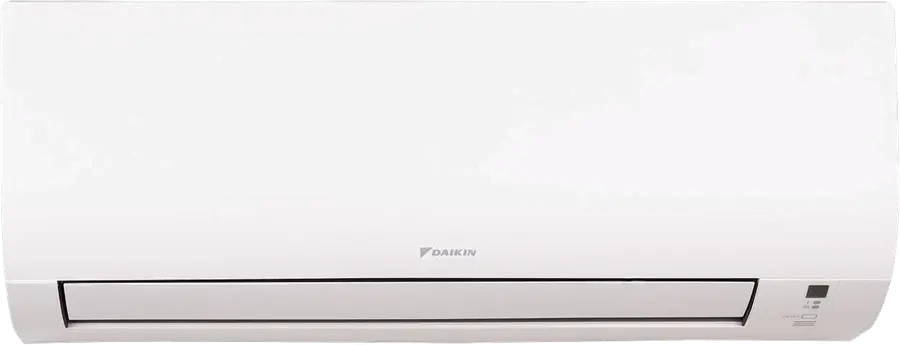
Daikin
The Daikin Comfora 3.5 kW (FTXP35N / RXP35N) is a compact, quiet A++ wall-mounted air conditioner that the manufacturer also designs for fitting above a door.
Price incl. installation
Price on request
The Daikin Comfora 3.5 kW, meaning the FTXP35N indoor unit paired with the RXP35N outdoor unit, is a single-room air conditioner that the manufacturer describes as discreet. The indoor unit is 770 mm wide, 286 mm high and 225 mm deep, weighs 9 kg and, according to Daikin, is suitable for hanging above a door. In a flat in an apartment block, where the space above the door frame is sometimes the only free piece of wall, that is a very practical trait, because you do not have to give up cooling just because there is no free surface. This is a piece of equipment you choose with a clear head rather than on impulse.
The technical data form a coherent picture. Rated cooling capacity is 3.5 kW (range 1.3 to 4.0 kW) and rated heating capacity is 4.0 kW (1.3 to 4.8 kW). Seasonal efficiency is SEER 7.2 for cooling and SCOP 4.64 for heating, both in class A++. The indoor unit runs between 20 and 43 dB, the outdoor unit is rated at 48 dB, and the circuit uses R32 refrigerant. These are not record-breaking figures, but they are honest ones and fit the needs of a typical room well.
On top of that come allergen-capturing technology, three-dimensional airflow and a simple remote control. The manufacturer also mentions the Onecta app, but it does not say outright whether the module needed to use it is included in the set, so we clarify that with you when we prepare the quote. We quote the installed price after a free assessment, once we have seen the place for both units and discussed the pipe route. Before we order anything, we check the wall dimensions, access to the outdoor spot and whether the installation fits the planned route.
Comfora is the Daikin series meant for everyday work in a single room. The manufacturer sums it up in a few phrases: a contemporary, minimalist look, operation so quiet that it is easy to forget about, and air cleaned of allergens. There is no ambition here to be a wall decoration. The unit is supposed to stay out of sight and quietly do its job, day after day, without drawing the household's attention. That is how we see the role of this model in the LeoKlima catalogue.
The 3.5 kW version suits a typical living room with a kitchenette or a larger bedroom. Daikin also shows this series in multi-room layouts, with several indoor units on one outdoor unit, but this page describes an ordinary one-to-one set: FTXP35N inside and RXP35N outside. Such a layout is the simplest to install and the easiest to service later, because each room has its own unit. For us that is an important argument, since flats in Warsaw often have little space and call for particular care when choosing equipment.
The casing of the indoor unit is shared by classes 20 to 35, so the 3.5 kW model is no bigger than the smallest in the family. That is convenient for planning an interior, because we know the 770 × 286 × 225 mm dimensions in advance and can match them to a specific wall before the installers ever visit. The conversation about where to hang the unit then rests on numbers instead of guesswork about whether it will fit above a wardrobe or a door. This approach saves time for everyone involved.
The unit modulates its output and adapts to what the room needs. In cooling the range is 1.3 to 4.0 kW at a rated 3.5 kW. In heating it delivers 4.0 kW rated and 4.8 kW at peak; at low demand it drops to 1.3 kW. A low minimum output means longer, calmer running instead of frequent switching on and off, which favours a stable room temperature and smaller swings in sound level.
Seasonal efficiency is SEER 7.2 for cooling and SCOP 4.64 for heating. Both values fall into class A++. In practice this means moderate electricity use in summer and in the shoulder months, when the air conditioner tops up the heat in the flat before the central heating starts or after it has been switched off. Actual bills depend on insulation, sun exposure and habits, so we do not promise sums; we only point out where the good efficiency comes from. That tells you that you are buying a predictable unit whose abilities can be described with a few concrete numbers and compared with the needs of your own room. A well-matched capacity runs more economically than a unit that is constantly pushed to the maximum.
The operating range of the outdoor unit in cooling is from -10°C to 48°C, and in heating from -15°C to 18°C. This means the Comfora is well suited to topping up heat in spring and autumn, but it is not designed as the main source of heat in the hardest frosts. The circuit uses R32 refrigerant, and the maximum installation length between the units is 20 m, which leaves plenty of freedom when choosing the spot for the outdoor unit. The manufacturer does not describe this model as recommended for the hardest frosts, so we stick to these numbers.
For a bedroom, noise is what matters most. The sound pressure level of the indoor unit lies between 20 and 43 dB, and the lower value corresponds to the quietest speed. At that level the fan noise is close to a whisper, although the real impression depends on the mounting place, on how solid the wall is, and on the time of day when we notice the unit most, which is at night. It is worth aiming the airflow so that it does not blow directly onto the bed.
The outdoor unit is rated at 48 dB. It is good to know this before choosing the spot: a balcony or a facade right under a neighbour's window is a worse idea than a wall facing the courtyard. We give location advice during the free assessment, because the same model can sound quite different depending on how sound reflects off walls and how it is fixed to its brackets. For completeness, these values apply to the 3.5 kW variant and should not be carried over uncritically to other capacities in the same series.
Comfort is also supported by three-dimensional airflow, which according to the manufacturer spreads the stream throughout the room, and by allergen-capturing technology. The manufacturer states that thanks to it the air in the room is cleaner. We do not treat this as a replacement for an air purifier, but as a sensible addition to regularly cleaned filters. It is the cleanliness of the filters, not the name of the technology, that decides how fresh the air is in everyday use. Filters are worth cleaning regularly, following the instructions in the manual.
In the set the manufacturer lists an intuitive remote control that is meant to give full control of the unit. For everyday use that is enough: temperature, operating mode, airflow and timers are at hand without having to install anything on your phone. For many people that is an advantage, because the remote works right after installation and does not require an account or setting up the home network.
Daikin's description also refers to the Onecta app, in which the air conditioner is meant to stay under control from anywhere. We must add, however, that in the materials for this model we did not find information on whether the connectivity module comes with the set or is bought separately. That is why we do not promise Wi-Fi up front and do not assume that it works straight out of the box. In daily use it is enough to set the temperature and leave the rest to the automation, and any extra functions we go through during commissioning.
If remote control matters to you, tell us when we prepare the quote. We will check which configuration is available for the FTXP35N and RXP35N set and agree the installation scope together with any additional module before we order anything. That way you know in advance exactly what you are getting, and we configure the controls in one visit, without extra trips. If in doubt, it is better to ask earlier than to order add-ons after the fact. The remote is also the simplest choice for older family members who do not use apps.
The look of the indoor unit is calm: a rectangular white body with no ornaments. The depth of 225 mm means the unit does not protrude far from the wall, and the height of 286 mm lets you hang it even under a fairly low ceiling. The weight of 9 kg is small, so the wall bracket does not need reinforcing beyond the standard, and hanging the unit does not call for complicated equipment. The white casing goes well with light walls.
The manufacturer stresses installation above a door, and the dimensions really are chosen for it. Before we plan such a spot, however, we check whether there is enough clearance above the frame for free air intake and whether the airflow will blow straight at people passing through the doorway. Sometimes the neighbouring wall turns out to be the better choice, and sometimes that very strip above the door is the only sensible solution. It works especially well in flats where cables or pipes often run above the door, which is why we inspect the wall before hanging the unit.
According to the manufacturer, the outdoor unit suits a roof, a wall or a garden. The choice is therefore wider than with models that have large outdoor blocks, although we verify every location on site for service access, condensate drainage and the rules that apply in the housing community. A well-chosen spot makes later inspections easier and lowers the risk of neighbours' complaints. A calm shape does not draw the eye and does not spoil the look of the living room.
A standard LeoKlima installation covers hanging the indoor unit and placing the outdoor unit, running up to several metres of refrigerant, electrical and condensate lines, passing through the wall and neatly concealing the installation. We then pull a vacuum and check the system for leaks, charge it with refrigerant and start the unit. We carry out each of these steps on site, so that when the crew leaves the air conditioner is working.
At the end we check the operating parameters, configure the controls, show you how to use the unit and hand over the warranty documents. For this model the maximum installation length is 20 m, which is enough with room to spare for most flats. If the route is longer, we say so straight away, so that the scope of work does not surprise you on installation day. When the work is done we leave the place tidy, and you receive clear information on how to look after the unit in the following seasons. A shorter route usually means less work during installation.
We discuss possible surcharges before the work begins. They concern a longer route, drilling through concrete or reinforced concrete, wall chasing, a condensate pump and work from a lift platform. We set the scope during a free assessment, and we quote the installed price after a free assessment. In use, remember to clean the filters regularly and to have periodic inspections, because they have the biggest effect on the durability and stable running of the unit. Discussing surcharges before the work means you know what to expect.
The Comfora 3.5 kW is for someone who wants a plain, quiet and small air conditioner in a flat, and who cares more about dimensions and the manners of the unit than about a long list of extras. It works especially well where the only free place is above a door, and where the look should stay in the background, without a showy casing or coloured finishes.
The strengths are concrete numbers: class A++ in both modes, SEER 7.2, SCOP 4.64, from 20 dB indoors and a weight of 9 kg. The limitation is the heating range down to -15°C wet bulb; if the air conditioner is to be the main source of heat, it is worth considering a model designed specifically for low temperatures. For topping up heat in spring and autumn and for summer cooling of a single room, however, this range is fully sufficient. It is also worth comparing your own needs with the data: a room where several people are constantly present or a lot of equipment stands may need a more powerful unit.
If that sounds like your case, write or call. We will come, look at the wall and the place for the outdoor unit, and then prepare an installation quote with any surcharges itemised. We quote the installed price after a free assessment, so nothing obliges you at the stage of the first conversation. If you are not sure that 3.5 kW is enough, the quote starts with questions about floor area, windows and the number of people in the room.
Technical data
| Model (indoor / outdoor unit) | FTXP35N / RXP35N |
|---|---|
| Cooling capacity (nom.) | 3.5 kW (range 1.3–4.0 kW) |
| Heating capacity (nom.) | 4.0 kW (range 1.3–4.8 kW) |
| SEER (cooling) | 7.2 — class A++ |
| SCOP (heating) | 4.6 — class A++ |
| Refrigerant | R32 |
| Noise level (indoor, min.–max.) | 20–43 dB(A) |
| Noise level (outdoor) | 48 dB(A) |
| Indoor unit dimensions (W/D/H) | 770/225/286 mm |
| Indoor unit weight | 9.0 kg |
| Operating range (cooling, outdoor) | -10°C to +48°C |
| Operating range (heating, outdoor) | -15°C to +18°C |
| Max. pipe length | 20 m |
Questions
The heating operating range of the outdoor unit is from -15°C to 18°C. It works well for topping up heat in spring and autumn. It is not recommended as the only source of heat in the hardest frosts, so in such a scenario we will help you choose another model.
The indoor unit runs between 20 and 43 dB, with the lowest value applying to the quietest speed. The outdoor unit is rated at 48 dB, which is why we choose its location away from bedroom windows.
The manufacturer mentions the Onecta app, but does not say whether the connectivity module is included in the set. We will check this for your configuration during the free assessment and we do not promise Wi-Fi without confirmation.
It is 770 mm wide, 286 mm high and 225 mm deep, and weighs 9 kg. The manufacturer presents it as well suited to fitting above a door. Before you decide, we measure the clearance above the frame and check the airflow direction.

