 LeoKlima

Toshiba
SEIYA 2 (R32)
- 3.3 kW
- Wi-Fi
- White
from 6,547 zł · incl. installation
View details →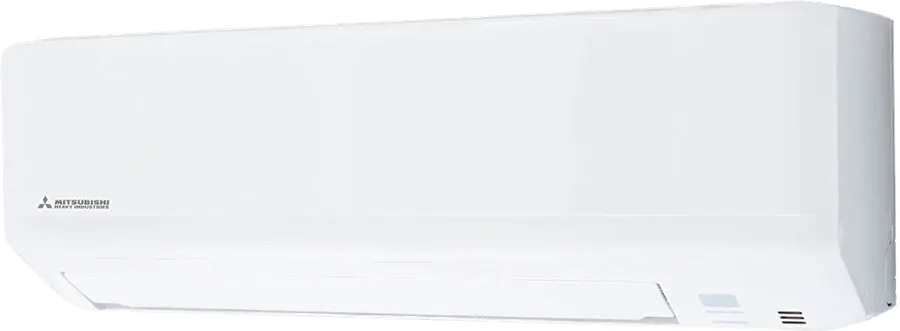
Mitsubishi Heavy Industries
The Mitsubishi Heavy Industries Standard 3.2 kW is a light, compact wall-mounted air conditioner for a small bedroom or home office, run from a wireless remote.
Price incl. installation
Price on request
Does a spare bedroom or a home office really need a large, feature-packed air conditioner? The manufacturer answers that question with the Mitsubishi Heavy Industries Standard series (SRK-ZSP-W1): a compact design intended for small rooms. The SRK35ZSP-W1 indoor unit, paired with the SRC35ZSP-W1 outdoor unit, has a nominal capacity of 3.2 kW in cooling and 3.6 kW in heating. Note that this is Mitsubishi Heavy Industries, a separate Japanese brand, and not Mitsubishi Electric. For a Warsaw flat or townhouse where you are fitting out a single room, it is often a more sensible starting point than a unit with a large reserve of power and features you will pay for and never use.
The appeal is simplicity. The indoor unit weighs 7 kg and is 783 mm wide but only 210 mm deep, and the outdoor unit is, according to the manufacturer, compact and light, which gives you more freedom in choosing where it goes. Everything is run from a wireless remote, with no app and no add-on modules. Those proportions make life easier on a balcony, a facade or a partition wall, where every kilogram and every centimetre counts.
To be fair, there are things this model does with less than pricier designs. The manufacturer's description says nothing about Wi-Fi, the filter is not replaceable, and in heating the unit reaches class A+ rather than A++. The maximum installation length is 15 m. Below we look at who these trade-offs suit and who should look elsewhere. We quote the installed price after a free assessment.
The best place to start is the question most of our Warsaw customers ask: will this be enough for one room? The Standard SRK35ZSP-W1 is the entry-level model in the Mitsubishi Heavy Industries range, and the manufacturer describes it as a solution for small rooms such as a spare bedroom or a home office. It does not try to compete on features with the top models. Its job is to cool and heat one room efficiently, without a surplus of electronics that nobody ends up using. That approach makes sense, because many rooms in flats are small, single-purpose spaces where elaborate operating modes go untouched.
Nominal capacity is 3.2 kW in cooling and 3.6 kW in heating. The unit does not run flat out at that level, though, because its output is adjustable: in cooling it can drop to 0.9 kW and rise to 3.7 kW, and in heating it ranges between 0.9 kW and 4.6 kW. In a small room this matters, since once the set temperature is reached the compressor does not have to keep switching off and on; it simply slows to a low output.
It is also worth knowing that the 35 in the model code is only a size class, not the exact output. The real nominal capacity is 3.2 kW, and that is how we describe it in our listing, so there is no confusion when you compare it with other models carrying similar numbers. If your room is very large or has big south-facing windows, we will choose the capacity during the free assessment instead of guessing from the name. That saves time on both sides and lowers the risk of a unit that is too weak or needlessly large.
The second question is whether such a simple model can cope in winter. The refrigerant is R32 with a low GWP, which the manufacturer pairs with high efficiency. Seasonal efficiency in cooling is SEER 7.3, which earns class A++. In heating the SCOP is 4.5 and the class is A+. The difference is real but small: for a room used mainly in the evening and at night it is a nuance in how you rate the unit, not a different category of appliance. A SEER of 7.3 is respectable for a basic model, because it shows that simplicity here does not mean wasting energy.
The outdoor unit operates from -15 °C to 46 °C in cooling and from -15 °C to 24 °C in heating, measured as outdoor temperature. For Warsaw that covers a typical winter and a hot summer, but keep one thing in mind: this is an air conditioner, not a heat pump meant to heat a whole house. As supplementary heating for a bedroom or office in autumn and spring it does the job well, whereas in hard frost we would not treat it as the only source of warmth.
Power draw rises and falls with the load, so in a small room the unit will spend most of its time in the lower part of its range. On a chilly morning in the office it also matters that the room warms up gradually rather than in jumps, thanks to output control between 0.9 kW and 4.6 kW in heating. The manufacturer also lists the outdoor unit at 47 dB, which is worth discussing with neighbours before we pick the spot on a facade or balcony.
The third question is noise: can you sleep next to it? The indoor unit has three fan speeds, and the quietest drops to 22 dB(A). With the windows closed, that is a level that is hard to tell apart from silence in the room at night. The highest speed reaches 44 dB(A) and is meant for cooling the room quickly when you get home from work, not for running all night. Three steps is fewer than on dearer designs, but in a small bedroom it is usually all you need.
On air quality, the manufacturer describes a self-cleaning feature that is meant to help keep the room air clean. We rely on the manufacturer's description here and add no promises of our own. At the same time, the documentation shows the filter is not replaceable, so the basics remain what they are for any air conditioner: regular cleaning of the indoor unit and a yearly service visit. Do not think of it as a filter you swap every season, just as a part that has to be kept clean.
In a home office you will appreciate a steady temperature without sharp swings, which comes from the modulated compressor. In a bedroom the point is to avoid a dry, strong stream of air on the bed, so during installation we pay attention to airflow direction and the distance of the unit from the headboard. A detail like that affects comfort more than an extra mode on the remote. In an office it also helps to aim the airflow so it does not blow straight onto your keyboard and hands, the most common reason for cold fingers when cooling.
Is the lack of Wi-Fi a problem? The manufacturer's description of this model mentions neither a Wi-Fi module nor an app, so we do not promise remote control from a phone. The unit is operated solely with a wireless remote. If you want to switch the air conditioner on while you are driving home, or you need weekly schedules in an app, this model will not provide that, and it is fairer to choose another one from our range.
For many people this is actually an advantage. The remote works straight after installation, needs no account, no pairing with the home network and no updates, and for older members of the household it is often simply easier. In a guest room or a spare bedroom used now and then, the unit is usually switched on by hand anyway, so remote access would rarely be useful. No app also means fewer things that can break or stop working after you change the router or the phone.
During commissioning we configure the controls and show you how to set the temperature, fan speed and airflow direction. It is worth choosing the setting you will actually use every day right away, so you are not hunting for it in the dark at two in the morning. Many people set one temperature once and only change it with the seasons, and in that scenario a simple remote is entirely enough, with no app menus to learn. If a need for remote control ever appears, it is better to pick a model that has it in the manufacturer's description from the start.
What does an air conditioner like this look like on the wall of a small room? The indoor unit is white, with a plain body and no ornament. It is 783 mm wide, 267 mm high and 210 mm deep, so it does not dominate the room and fits above a door, over a desk or in a narrow spot between a wardrobe and a window. White suits the typical walls in Warsaw flats and does not draw the eye. The regular, simple shape also makes everyday cleaning easier, because there are no recesses or decorative panels where dust collects.
The weight of 7 kg has a practical side. A lighter unit puts less load on the bracket and the wall, is easier to lift into place during installation and carries less risk on lightweight partition walls. The outdoor unit is, as the manufacturer puts it, compact and light, which gives more flexibility in choosing a location: on a balcony, on a bracket against a facade, or on the ground next to the house.
The Standard has nothing that spoils the looks, but it also lacks the showy finishes known from designer models. If the interior is your top priority and you want a device that becomes a feature of the wall in itself, you should look at other offers. If, on the other hand, the unit simply has to work well and stay out of sight, this white, compact casing is a sensible choice. When planning, remember to leave room for servicing: we keep a gap from the ceiling and side wall so the cover can be removed and the inside cleaned without a struggle.
Installation covers the indoor and outdoor units, up to a few metres of refrigerant, electrical and condensate run, the wall passage and a tidy routing of the lines. We then evacuate the system and check it for leaks, charge it with refrigerant and start the unit. Finally we check the operating parameters, configure the controls, show you how to use it and hand over the warranty documents.
Here is a limitation of this model. The maximum installation length is 15 m. For a single room with the outdoor unit just behind the wall that makes no difference, but if the run is to be long, it has to be worked out before you order. A longer run may carry a surcharge, as may drilling through concrete or reinforced concrete, chasing channels into the wall, a condensate pump or work from a lift platform. We discuss everything before the work begins. In a block of flats we also check the housing association's rules on facades, a topic best settled before installation.
We set the scope during a free audit, so there are no surprises at the end. We quote the installed price after a free assessment. In later use, regular cleaning of the indoor unit and a yearly service visit are enough, and because the filter is not replaceable it is the cleaning that deserves attention, especially in a home with pets or when you open windows in the pollen season. After installation we remain available if anything needs fine adjustment.
Back to the questions from the start: will it be enough for a spare bedroom, a home office or a small guest room? Yes, if you expect quiet, unfussy operation, do not need phone control and have the outdoor unit at a modest distance from the indoor one. The quietest speed of 22 dB(A), the light 7 kg indoor unit and the heating range down to -15 °C are concrete arguments that come from the specification, not from advertising.
Will it be enough for a large living room or a whole flat? Probably not. For a bigger volume it is better to choose a more powerful model or a multi-split system, and we will help you pick the capacity at the audit. It is also sensible to count how many rooms you want to cool, because one unit always serves one room. If an app, clearly more advanced modes and class A++ in heating matter to you, look elsewhere in the range, because this model has class A+ in heating.
In short, the Standard SRK35ZSP-W1 is an honest, simple Mitsubishi Heavy Industries air conditioner for one small room. Its strengths are low weight, compact build, flexible installation and a quiet lowest speed; its limits are no Wi-Fi, a filter that cannot be replaced and a shorter maximum installation. Want to check whether it suits your room? Book a free audit, and we will give the installed price afterwards. Call or write to us and we will arrange a convenient time in Warsaw.
Technical data
| Model (indoor / outdoor unit) | SRK35ZSP-W1 / SRC35ZSP-W1 |
|---|---|
| Cooling capacity (nom.) | 3.2 kW (range 0.9–3.7 kW) |
| Heating capacity (nom.) | 3.6 kW (range 0.9–4.6 kW) |
| SEER (cooling) | 7.3 — class A++ |
| SCOP (heating) | 4.5 — class A+ |
| Refrigerant | R32 |
| Noise level (indoor, min.–max.) | 22–44 dB(A) |
| Noise level (outdoor) | 47 dB(A) |
| Indoor unit dimensions (W/D/H) | 783/210/267 mm |
| Indoor unit weight | 7.0 kg |
| Operating range (cooling, outdoor) | -15°C to +46°C |
| Operating range (heating, outdoor) | -15°C to +24°C |
| Max. pipe length | 15 m |
Questions
The manufacturer's description mentions neither Wi-Fi nor an app, so we do not advertise it. The unit is run from a wireless remote. If you need remote control from a phone, choose another model from our range.
The indoor unit has three fan speeds, and the quietest is 22 dB(A). The highest speed is 44 dB(A) and the outdoor unit is rated at 47 dB. For night-time use in a bedroom, the lowest speed is the one to use.
Yes, the unit heats at outdoor temperatures down to -15 °C, has a nominal heating capacity of 3.6 kW and class A+ (SCOP 4.5). It is good supplementary heating for a small room, not a replacement for the main heating of a house.
The maximum installation length is 15 m. The indoor unit weighs 7 kg and measures 783 x 267 x 210 mm. We discuss a longer run before installation. We quote the installed price after a free assessment.

