LeoKlima
Haier
Revive Plus
- 3.5 kW
- Wi-Fi
- White
from 4,353 zł · incl. installation
View details →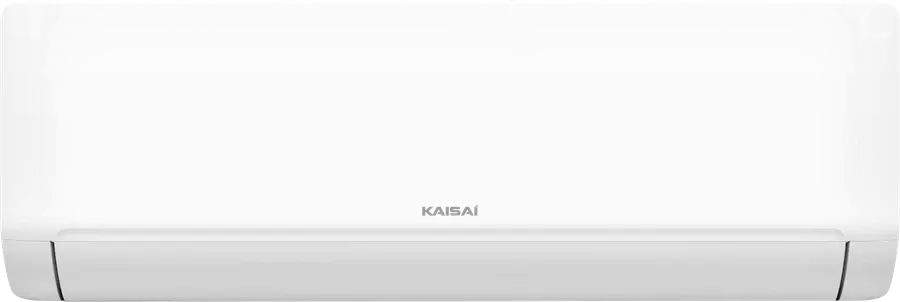
Kaisai
The Kaisai Evo 3.4 kW is a straightforward wall-mounted inverter with built-in Wi-Fi, a silver ion filter and heating that works down to -20°C outside.
Price incl. installation
Price on request
The Kaisai Evo is a wall-mounted inverter air conditioner with a nominal output of 3.4 kW, both for cooling and for heating. The units carry the codes KEV-12TLHI (indoor) and KEV-12TLHO (outdoor). In the LeoKlima catalogue it sits on the sensible, uncomplicated side: no elaborate array of sensors, but all the things a flat owner actually uses every day, namely Wi-Fi, a timer, a night mode and an air filter. For a first-time buyer in Warsaw it is often the first air conditioner in the home, so predictability matters: known figures, a simple remote and no surprises at start-up. Every number on this page comes from the manufacturer's data for the KEV-12TLHI.
The strongest argument for this model is its winter operating range. The manufacturer gives heating at outdoor temperatures from -20°C up to 30°C, and cooling from -15°C to 53°C. The compressor modulates its output between 1.0 kW and 3.8 kW, so on mild days it does not run flat out. Seasonal efficiency is SEER 6.1 for cooling (class A++) and SCOP 4 for heating (class A+). Those are honest, solid figures for a unit that does not aim for the top shelf.
From a resident's point of view the noise level matters too: the indoor unit runs between 22 dB and 42 dB, and the outdoor unit emits 54 dB. Add the R32 refrigerant circuit and a light 7.3 kg indoor unit that is 778 mm wide. It suits a bedroom, a living room or a small office that has to rely on one unit in both summer and winter. We quote the installed price after a free assessment.
The manufacturer describes the Evo series as a combination of stylish design and modern technology, but in practice it is best read through its numbers. The model has 3.4 kW of nominal cooling capacity and exactly the same in heating. That is a typical size for a living room in a new block or a large bedroom. The version covered here is the KEV-12TLHI and KEV-12TLHO set; the same series also has smaller and larger variants rated at 2.6, 5.1 and 7.0 kW, but this page concerns the middle size only. It means you do not get four separate colours or a wide range of add-ons; you get a proven, uniform design that is easy to describe and easy to service over many seasons.
In our range we keep the Evo as a proposal for people who want a good inverter with Wi-Fi but do not want to pay for extra sensors and advanced automation. Class A++ for cooling and A+ for heating is not a market record, yet it is entirely adequate for sensible everyday use. When planning your bills, remember that SEER 6.1 is an annual average, and real consumption depends on the insulation of the room, how much sun it gets and how often you change the set temperature.
It also helps to know how to choose the capacity. A 3.4 kW unit makes sense for rooms where cooling will not be running at the limit of its ability. If the room has large south-facing windows or is open to the kitchen, it is better to talk it through during the free assessment before choosing a size. During the visit we also check where to route the condensate so it does not drip onto a neighbour's facade, and where the outdoor unit fits without blocking access to a window.
The heart of the Evo is DC Inverter technology with an efficient direct-current motor. Instead of switching on and off, the compressor changes its speed smoothly, and cooling capacity lies between 1.0 kW and 3.8 kW. For the user this means fewer temperature swings in the room and lower electricity use when demand for cold or warmth is small. The wide modulation range has another advantage: the unit starts from zero less often, so it puts less strain on the flat's electrical installation. Power draw depends on the current load and is not a fixed value. The manufacturer also mentions a new heat exchanger design but gives no details, so we will not guess at them.
The winter range is the most interesting feature. Heating is declared at an outdoor temperature down to -20°C, and the upper limit of heating mode is 30°C. Two solutions complete the picture: gold-coated exchanger fins and a drip tray heater, which the manufacturer describes as supporting reliability and durability in harsher conditions. Heating capacity lies between 1.0 kW and 3.8 kW, with a nominal value of 3.4 kW. In practice this is enough to top up the heat in the shoulder months and to run through winter, as long as the building is well insulated. Remember, however, that at very low outdoor temperatures heating output drops, and the air conditioner acts as economical supplementary heating, not as the only heat source in an uninsulated building.
In summer the unit will operate up to 53°C outside. The model runs on R32 refrigerant, which the manufacturer presents as more efficient and less burdensome for the environment. The maximum installation length between the units is 25 m, and the height difference can reach 10 m, which leaves a generous margin even in blocks where the outdoor unit hangs on a facade or balcony. The route between the units can be hidden in trunking or a wall chase if the wall allows it.
Acoustically the Evo has a wide span: from 22 dB in the quietest mode to 42 dB at the highest airflow. At the bottom of the scale that is a level suitable for the night; at the top it helps to cool a room quickly after you return from work. The outdoor unit is rated at 54 dB, so when planning the installation spot take care over the windows of neighbours and your own bedroom. Fan speed can be adjusted from the remote, and the available modes are Auto, Cooling, Heating and Ventilation. Airflow can be set to several steps, which is useful when someone in the room dislikes a direct draught. It is worth aiming the stream along the ceiling or away from the bed.
Several elements described by the manufacturer support air quality. There is a silver ion filter, air ionisation, sterilisation at 56°C and an evaporator that the manufacturer calls self-cleaning. ECO mode reduces energy use. Two functions with English names, Fireplace and Breeze away, are not described in more detail by the manufacturer; their exact behaviour is best checked on the remote during handover, together with the operating briefing. The heating mode and the separate ventilation mode make the unit useful outside heatwaves as well, although that is not its main job.
It pays to be level-headed about health promises, though. No air conditioner replaces airing a room or clean filters. Ionisation or a silver filter is an extra, not a reason to give up regular cleaning. The filter mesh should be rinsed every few weeks during the season, and the inside of the unit should go in for a service check once a year.
The manufacturer states plainly that the unit has an integrated Wi-Fi module that lets you control the air conditioner from an app even when you are not at home. That is convenient if you want to switch cooling on an hour before coming back from work, or check that you have not left the unit running. The module is not an add-on to be bought separately, as with some other models, and we configure the network connection during commissioning. We set up the app together with you, so you know at once how to create a schedule and how to check the unit's status from your phone.
An ordinary remote is useful every day as well. It lets you choose the operating mode, adjust the fan and set a timer that switches the unit on and off. The timer is especially handy in a bedroom: the room can be cooled before sleep, and during the night the unit can be left in quiet mode or programmed to switch off. Remote control makes sense in winter too: you can warm a room before you get home instead of leaving the unit on standby all day.
In the materials we have the manufacturer does not name the app or mention voice control, so we do not promise such features. If a particular voice assistant matters to you, ask us before buying; we will check with the distributor and say plainly what is available.
The indoor unit is white and takes the form of a flat rectangle measuring 778 × 272 × 192 mm (width, height, depth). It weighs 7.3 kg, so it needs no special wall reinforcement and can be hung on ordinary plasterboard construction or masonry. It is not a unit meant to decorate a living room; it is a clean, small body that does not draw attention and sits comfortably next to furniture. The smooth, light finish is easy to wipe with a damp cloth, and the flat shape leaves little room for dust.
The manufacturer draws attention to the golden exchanger fins and the drip tray heater. The first are meant to improve durability in a harsh environment, the second to protect against condensate freezing when the outdoor temperature falls. We do not call this self-cleaning: it is a coating and a heating element, not a cleaning function. According to the manufacturer, it is the evaporator separately that is self-cleaning, and that is how the description reads. Users wash the filters themselves, and leave the inside of the unit to a service visit.
The outdoor unit goes on a facade or balcony. When choosing the place we take into account service access, the direction of the air discharge and the 54 dB noise level. The bracket for the outdoor unit is selected only after we have looked at the wall or balcony. Think about this before purchase, because in some housing communities a facade installation needs the manager's consent.
Installation by LeoKlima covers hanging the indoor unit and placing the outdoor one, and running up to several metres of refrigerant, electrical and condensate lines. We make the wall penetration and route the lines so that they look tidy. Next we pull a vacuum, check the tightness of the system, charge the refrigerant and start the unit. All the steps are done in one visit, and after the job we leave the workplace tidy.
Finally we check the operating parameters, configure the controls, including the Wi-Fi connection, and show you how to use the unit. You also receive the warranty documents. The maximum installation length for this model is 25 m, so in a typical flat we usually fit with room to spare.
Some work may involve a surcharge that we discuss before starting: a longer route, drilling through concrete or reinforced concrete, wall chasing, a condensate pump or work from a lift platform. We settle the scope at the free assessment. Before the summer season it is worth booking a short check: washing the filters, inspecting the condensate drain and confirming that the unit starts without errors.
The Kaisai Evo 3.4 kW is a good choice for someone who wants an all-year air conditioner without complicated functions but with Wi-Fi as standard. It fits particularly well in flats where the unit will also top up the heating in the shoulder season and on cool days, because the manufacturer declares heating operation down to -20°C. A medium-sized room, a bedroom or a living room with one external wall are the typical uses. In a bedroom 3.4 kW leaves a margin, and in a medium living room it lets the unit reach the set temperature quickly.
It fits less well if you expect the highest energy class, a very quiet outdoor unit or presence sensors. SEER 6.1 and SCOP 4 are good but not record values, and 54 dB outside calls for a careful choice of installation spot. If running economy matters more, compare this model with more expensive series during the free quote.
Contact LeoKlima and we will come to look at the installation site, measure the route and match the size to the room. A conversation like this before purchase saves time, because it quickly shows whether the Evo suits the flat or another model would be better. We quote the installed price after a free assessment.
Technical data
| Model (indoor / outdoor unit) | KEV-12TLHI / KEV-12TLHO |
|---|---|
| Cooling capacity (nom.) | 3.4 kW (range 1.0–3.8 kW) |
| Heating capacity (nom.) | 3.4 kW (range 1.0–3.8 kW) |
| SEER (cooling) | 6.1 — class A++ |
| SCOP (heating) | 4.0 — class A+ |
| Refrigerant | R32 |
| Noise level (indoor, min.–max.) | 22–42 dB(A) |
| Noise level (outdoor) | 54 dB(A) |
| Indoor unit dimensions (W/D/H) | 778/192/272 mm |
| Indoor unit weight | 7.3 kg |
| Operating range (cooling, outdoor) | -15°C to +53°C |
| Operating range (heating, outdoor) | -20°C to +30°C |
| Max. pipe length | 25 m |
Questions
The manufacturer declares heating operation at outdoor temperatures from -20°C up to 30°C. Gold-coated exchanger fins and a drip tray heater are meant to add reliability in harsher conditions. Nominal heating capacity is 3.4 kW, with modulation from 1.0 to 3.8 kW.
The indoor unit works between 22 dB and 42 dB depending on fan speed. The outdoor unit is rated at 54 dB, so during installation we pay attention to the windows of neighbours and bedrooms.
Yes. According to the manufacturer the model has an integrated Wi-Fi module and can be controlled from an app, including from outside the home. We set up the network connection when commissioning the unit.
The indoor unit is 778 mm wide, 272 mm high and 192 mm deep, and weighs 7.3 kg. The maximum installation length is 25 m. We settle the scope of work and any surcharges at the free assessment.