LeoKlima
Haier
Revive Plus
- 3.5 kW
- Wi-Fi
- White
from 4,353 zł · incl. installation
View details →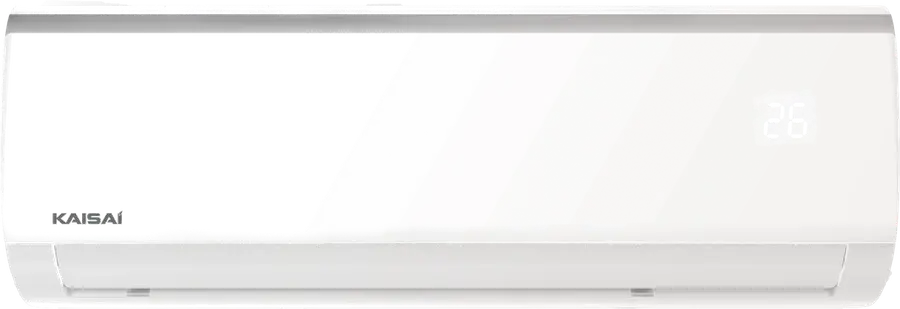
Kaisai
The Kaisai Fly 3.5 kW (KWX-12KRHI / KWX-12KRHO) is a white wall-mounted air conditioner with two-stage air filtration, standard Wi-Fi and heating rated down to -25 °C.
Price incl. installation
Price on request
The Kaisai Fly in its 3.5 kW version is a set made of the indoor unit KWX-12KRHI and the outdoor unit KWX-12KRHO. The manufacturer presents it as a new version of the series in which proper air filtration has been added to cooling and heating. For a customer in Warsaw who is looking for a unit for an apartment and does not want to overpay for a long list of extras, it is an interesting proposition: it carries an A++ rating for cooling and A+ for heating, runs on R32 refrigerant and uses a DC inverter compressor. This description relies only on the manufacturer's own leaflet, so we quote the numbers as published and leave out anything the manufacturer does not state.
What sets it apart most is the pair of filters. The Cold Catalyst filter is meant to remove chemical compounds such as carbon monoxide, hydrogen sulfide, ammonia, benzene and formaldehyde, while the Bio HEPA filter traps, according to the manufacturer, 99% of particles of 0.3 μm and up to 95% of particles between 0.1 and 0.3 μm. This is worth considering where the windows face a busy street or where someone in the household is sensitive to dust and pollen. Wi-Fi is part of the standard equipment, so there is no module to buy separately.
The figures you will care about day to day: cooling capacity of 3.5 kW (from 1.1 to 3.9 kW), heating capacity of 3.8 kW (from 1.1 to 4.2 kW), SEER 6.5 and SCOP 4.1. The indoor unit runs at between 21.5 and 39.5 dB and the outdoor unit at 55 dB. The operating range is from -15 to 50 °C in cooling and from -25 to 30 °C in heating, which means that during a Polish winter the unit can supplement your heating in shoulder seasons and on cooler days.
The Fly series covers wall-mounted Kaisai air conditioners, and the 3.5 kW variant discussed here corresponds to the KWX-12KRHI / KWX-12KRHO column of the manufacturer's leaflet. We point out the KRHI letters because that code describes the new version of the series with extra functions and the filtration system. When we take an order we always check the full set code, so that the parameters we give you match the unit that ends up on your wall.
In our catalogue the Fly plays the role of a sensible but not stripped-down model. It has no elaborate presence sensors and no excess of modes, but it does have a concrete package: A++ in cooling, A+ in heating, a DC inverter, standard Wi-Fi and two filters. For many flats in apartment blocks and old townhouses that is a sufficient list, because most people use only a few functions: cooling in summer, heating at the start and end of the season, and a quiet night mode. Talking about the offer using the same numbers you will find in the unit's documentation also prevents any gap between what you read and what you receive.
A capacity of 3.5 kW is typical for a single living room or for a bedroom combined with a relaxation corner. The final choice for a particular room depends on sun exposure, ceiling height, the number of windows and the appliances that give off heat, which is why we look at the flat during a free assessment before preparing an offer. If a room is large or has big south-facing windows, we would rather suggest a stronger set than raise expectations of a single unit.
The system is built around a DC inverter compressor and R32 refrigerant. Nominal cooling capacity is 3.5 kW, and the unit can modulate it within a range of 1.1 to 3.9 kW. In heating, the nominal 3.8 kW varies from 1.1 to 4.2 kW. The lower limit matters, because in a small room an air conditioner rarely has to run at full speed, and instead of constantly switching on and off it holds the temperature at low power. In practice, during the day, when only gentle upkeep is needed, the compressor runs calmly and brings in full power only when a heated room is being cooled quickly.
The seasonal indicators are SEER 6.5 for cooling and SCOP 4.1 for heating, which gives classes A++ and A+. The manufacturer also lists an innovative heat exchanger design and an energy-saving DC fan motor. Within the LeoKlima range it is worth remembering that models with a higher SEER cost more, and the difference in your electricity bill depends on how many hours a year the unit runs. Someone who switches the air conditioner on mainly for a few weeks in summer will feel the bill less than a person working from home through the whole season.
The outdoor unit works in cooling from -15 to 50 °C and in heating from -25 to 30 °C. The manufacturer stresses that the unit provides heating when the outside temperature falls to -25 °C. In practice heating output drops at very low temperatures, and an air conditioner does not replace a full heating system but complements it. The figure of -25 °C describes the lower limit of operation, not comfortable output, so when we plan winter heating we talk honestly about expectations. In addition, the remote controller can switch on continuous heating at 8 °C, which keeps an empty room from cooling below that value.
Filtration is the main argument for this model. The first stage is the Cold Catalyst filter, which, according to the manufacturer, removes carbon monoxide, hydrogen sulfide, ammonia, benzene and formaldehyde from the air. The second is the Bio HEPA filter, which retains 99% of dust, particles and bacteria of 0.3 μm and up to 95% of particles between 0.1 and 0.3 μm, including fungal cells and some viruses. These are the manufacturer's claims and not our measurements, but the direction of the solution is clear: the air conditioner is meant not only to change the temperature but also to clean the air circulating in the room.
Filters, however, need looking after. A dirty filter reduces airflow and weakens the result, so at every service visit we check their condition and explain which parts you can clean yourself and which need replacing. If you have pets that shed hair, or someone smoked in the room, filters clog faster and servicing is worth planning more often than the minimum recommendation suggests. Regular visits are also a good moment to inspect the heat exchanger and the condensate drain.
The 3D airflow function is responsible for the temperature distribution; it is meant to ensure optimal circulation and an even spread of warmth or coolness through the room. When you set the louvres, it helps to direct the stream above the place where you sit or sleep while still letting air reach the opposite wall, and the 3D function is meant to ease exactly that balance. The indoor unit's noise level lies between 21.5 and 39.5 dB, so on the lowest speed it is a good candidate for a bedroom. The outdoor unit runs at 55 dB, which has to be taken into account when choosing a spot on the balcony or facade.
According to the manufacturer, Wi-Fi is standard on this model, so controlling it from a phone does not require buying an adapter. That lets you switch on the air conditioner on your way home, change the temperature, or check whether the unit was turned on by mistake. We set up the details of the app and the connection to your home network together with you at commissioning. The app does not replace the remote controller but complements it; both ways of control work in parallel.
The wireless remote controller has three extra functions that the manufacturer highlights. The first is self-cleaning of the exchanger, a cycle intended to limit moisture and deposits on the indoor unit's exchanger after shutdown. The second is the continuous heating at 8 °C mentioned earlier. The third is Follow Me, the use of a temperature sensor in the remote: the unit judges conditions where the remote lies, not only next to the unit, which can be useful when the air conditioner hangs high and you sit at a desk at the other end of the room. The exchanger self-cleaning cycle, as the manufacturer calls it, does not remove the need for service, but it helps keep the exchanger in better shape between visits.
The basic abilities include Auto, cooling, heating and ventilation modes, fan adjustment from the remote and an on/off timer. There is therefore no need to dig into complicated menus, and daily operation comes down to setting a temperature and a mode. People who prefer the remote to an app can skip Wi-Fi altogether.
The indoor unit is white, with what the manufacturer calls an elegant panel meant to suit any interior. Its dimensions are 805 mm wide, 285 mm high and 194 mm deep, and it weighs 7.3 kg. The fairly low casing and small depth mean that the unit does not dominate the room, even if it hangs at eye level, for instance above a sofa or a chest of drawers. In a bright interior the white casing blends into the wall, and in a darker room it works as a subdued accent that does not draw attention.
The manufacturer also describes the innovative heat exchanger design and the highly rated SEER and SCOP values, which is usually the result of a larger heat transfer surface. The light weight of the indoor unit makes installation on plasterboard walls easier, but we always decide on the fixing method after looking at the wall. At handover we check together with the customer that the unit is level and the pipes run neatly, because a smooth front hides no flaws.
The installation data worth knowing when planning: the maximum length of the run between the units is 25 m, and the working refrigerant is R32. If a house or flat has an unusual layout and the outdoor unit has to sit far from the indoor one, we check that we stay within this limit before we present a quotation.
We precede the installation quote with a free assessment, where we agree the position of the units, the route of the installation and any difficulties. We quote the installed price after a free assessment. The standard scope covers mounting the indoor and outdoor units, running up to several metres of refrigerant, electrical and condensate lines, and making the wall penetration with a tidy arrangement of the cables. We record the agreed points so that everyone shares the same assumptions on installation day and nobody learns of extra costs halfway through the job.
After mounting we pull a vacuum and check the tightness of the system, then charge it with refrigerant and start the unit. We check operating parameters and configure the controls, including the Wi-Fi connection, and finally show you how to use the remote and the functions described above, and hand over the warranty documents. We also leave you hints about cleaning the filters and the date of the first service.
Some items may raise the cost, and we discuss them before the work begins. They include a longer run, drilling through concrete or reinforced concrete, wall chasing, a condensate pump and work from a lift platform. After installation the air conditioner needs regular servicing and filter cleaning; with a model that has two purifying filters this matters especially, because their effect depends on cleanliness. For safety, cleaning of filters is done with the unit switched off, and any work on the installation itself is left to a service technician.
We recommend the Kaisai Fly 3.5 kW to people who want to combine cooling, heating and air filtration in one unit but are not looking for the highest energy class. The A++ and A+ ratings and the SEER 6.5 and SCOP 4.1 figures are a good starting point for a flat where the air conditioner works seasonally. Standard Wi-Fi and a remote with the Follow Me function are enough for comfortable daily use. It is a sensible choice for someone who first checks the list of functions actually needed and only then compares brand and price.
If you have allergies, live by a busy street, or care that the air blown into the room is pre-cleaned, the Cold Catalyst and Bio HEPA arrangement gives a clear advantage over simpler models. Just remember that the claims about filter effectiveness come from the manufacturer, and that their performance depends on cleanliness and timely servicing.
If, on the other hand, the priority is the lowest possible electricity bill or the quietest outdoor unit, compare this model with more expensive series that have a higher SEER. Every set in our catalogue is described with the same parameters, so they are easy to set side by side. We quote the installed price after a free assessment, and if you ask about room size, window type or whether the unit should also work in winter, we will match the capacity to real conditions during the visit.
Technical data
| Model (indoor / outdoor unit) | KWX-12KRHI / KWX-12KRHO |
|---|---|
| Cooling capacity (nom.) | 3.5 kW (range 1.1–3.9 kW) |
| Heating capacity (nom.) | 3.8 kW (range 1.1–4.2 kW) |
| SEER (cooling) | 6.5 — class A++ |
| SCOP (heating) | 4.1 — class A+ |
| Refrigerant | R32 |
| Noise level (indoor, min.–max.) | 21.5–39.5 dB(A) |
| Noise level (outdoor) | 55 dB(A) |
| Indoor unit dimensions (W/D/H) | 805/194/285 mm |
| Indoor unit weight | 7.3 kg |
| Operating range (cooling, outdoor) | -15°C to +50°C |
| Operating range (heating, outdoor) | -25°C to +30°C |
| Max. pipe length | 25 m |
Questions
Yes. The manufacturer gives a heating operating range of -25 to 30 °C, and the heating capacity is 3.8 kW. Output drops at very low temperatures, so we treat the air conditioner as a supplement to your heating, especially in shoulder seasons.
The indoor unit runs at between 21.5 and 39.5 dB depending on fan speed. The outdoor unit is rated at 55 dB, so it is worth choosing its position carefully, particularly close to neighbours' windows.
According to the manufacturer, Wi-Fi is a standard feature of this model, so no extra module is needed. We configure the connection to your home network at commissioning.
The indoor unit is 805 mm wide, 285 mm high and 194 mm deep, and weighs 7.3 kg. The maximum installation length is 25 m, and we agree the scope of work and any extra charges during a free assessment.