LeoKlima
Haier
Revive Plus
- 3.5 kW
- Wi-Fi
- White
from 4,353 zł · incl. installation
View details →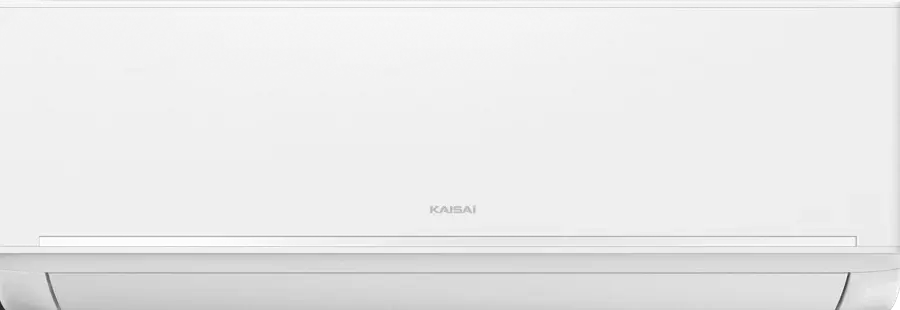
Kaisai
The Kaisai Ice is a 3.5 kW wall-mounted inverter with ionisation, a Bio-HEPA filter and a Wi-Fi module as standard, heating down to -25 °C outdoors.
Price incl. installation
Price on request
The Kaisai Ice, made up of the KLW-12HRHI indoor unit and the KLWB-12HRHO outdoor unit, is a wall-mounted inverter air conditioner with 3.5 kW of cooling and 3.8 kW of heating capacity. It runs on R32 refrigerant. The manufacturer gives it class A+++ for cooling and A++ for heating, with a SEER of 8.5 and a SCOP of 4.6. Next to many units of the same size that is a top-shelf efficiency result, reached without piling on expensive electronics: you get a sensible set of air-quality features and a Wi-Fi module in the box, and anything beyond that can be added as an option.
In a flat, what matters most is how the unit behaves when nobody is watching it. The indoor unit runs between 21 and 39 dB(A), so on its lower fan speeds it is little more than background hum. Output modulates from 1.4 to 4.3 kW in cooling and from 1.1 to 4.4 kW in heating, which means the compressor does not have to run flat out when the load is light. 3D air supply spreads the airflow around the room, while ionisation and the Bio-HEPA filter look after what that air contains.
Ice comes in two colours, white and black; this page covers the white version. The indoor unit is 835 mm wide, 295 mm high and weighs 8.7 kg, so it fits above a door or window in a typical bedroom or living room. We quote the installed price after a free assessment. During the visit we check where both units will go, how the pipework will run, and whether 3.5 kW really suits the floor area and sun exposure of the room.
The Kaisai Ice is for people who want good energy efficiency without paying extra for everything that can be squeezed into an air conditioner. The manufacturer describes it as a wall unit with a modern, stylish front, available in white and black, with the highest energy class and a wide range of control options. In the LeoKlima catalogue we treat it as a sensible mid-market choice: plenty of efficiency, a full set of air-quality features and a straightforward, easy-to-read specification.
The rated figures for the 3.5 kW variant are as follows: cooling 3.5 kW (from 1.4 to 4.3 kW), heating 3.8 kW (from 1.1 to 4.4 kW), class A+++ for cooling and A++ for heating. The set consists of the KLW-12HRHI indoor unit and the KLWB-12HRHO outdoor unit. The manufacturer also publishes data for 2.6, 5.3 and 7.0 kW, but we describe only the 3.5 kW variant, which usually covers one room of average size.
If you are looking for a unit for a bedroom or living room and you care about a low bill over the season, Ice is a natural candidate to compare against more expensive ranges. We will explain the difference in equipment during the free assessment, without pushing extras that would do nothing for you. Ice does not try to be everything to everyone: the manufacturer does not mention a presence sensor or elaborate automation. What it does include is what you use every day, namely good efficiency, air filtration and remote control. That makes it easy to judge whether it covers your needs, and to avoid paying for functions you would never use.
The heart of the system is DC Inverter technology with a high-efficiency direct-current motor. Instead of switching on and off, the compressor changes speed smoothly, and the changes in output stay within the ranges quoted above. The manufacturer lists the operating modes as automatic, cooling, heating and ventilation. On top of those there are two saving modes, ECO and GEAR, which limit energy use when you do not need full power.
The seasonal figures show that the unit is economical in both directions: SEER 8.5 for cooling and SCOP 4.6 for heating. In practice that means the air conditioner can act as supplementary heating in the shoulder seasons. The outdoor unit operates from -15 to 50 °C in cooling and from -25 to 30 °C in heating, so it keeps working even in a hard frost. We do not, however, treat it as the only source of heat in winter: at very low temperatures output drops, as with any air-to-air heat pump.
For winter the manufacturer fitted a compressor heater and a condensate tray heater. They stop condensate from freezing and help the unit start on frosty days. The R32 refrigerant has a lower climate impact than older refrigerants, and the system is designed for an installation length of up to 25 m. In a flat that means the outdoor unit can sit on a balcony, a facade or another chosen spot, even when it is not directly behind the wall of the room. We make such decisions together with you during the assessment, because the position of the outdoor unit affects both the look of the facade and the length of the run, and the run affects the final installation cost.
The health side of Ice rests on two elements. The first is air ionisation, which the manufacturer describes as a way of reducing dust mites, mould, bacteria and viruses, as well as humidifying the air and giving a feeling of freshness in the room. The second is the Bio-HEPA filter, which traps dirt particles and microorganisms. We do not promise that the unit replaces an air purifier, but as a complement to the everyday work of an air conditioner this set makes sense, especially in a flat on a busy street.
Temperature is kept even by 3D air supply, which directs the airflow so that it does not concentrate in one spot. The indoor unit runs between 21 and 39 dB(A), from a quiet whisper to clearly audible airflow at the highest speed. The outdoor unit reaches 54.5 dB(A), which is worth weighing against your neighbours' windows when it is mounted on a facade; we discuss this at the assessment stage.
Filters should be cleaned regularly, following the manufacturer's instructions, because they decide whether the benefits of ionisation and Bio-HEPA still count after a few months of use. A clean filter also means less load on the fan and a lower electricity bill. It is worth remembering a simple rule: an air conditioner does not exchange the air in a room, it only circulates it, so in a bedroom it helps to air the space briefly from time to time. Ionisation and filtration then work on fresh air rather than stale air, and support sleep comfort noticeably better.
Unlike many units where the app requires buying an adapter, the Kaisai Ice has a Wi-Fi module as standard. The manufacturer says it lets you control the operating parameters around the clock from anywhere. In practice you can switch on cooling on the way home from work, or check whether you turned the unit off when you left in the morning. We set up the network connection during commissioning, so it is not left for later.
For those who prefer something traditional there is a standard remote. The manufacturer also provides options for more demanding installations: a wired remote control and a central controller with a BMS gateway, connected through the MFB expansion board. That sets Ice apart from simple basic models: the unit can be tied into a larger system in an office, a surgery or a flat with building automation. The wired remote and the central controller are optional extras and are not part of the basic set.
The ECO and GEAR modes are set from the remote or the app. Both serve to save energy, and the manufacturer lists them as part of the equipment alongside automatic, cooling, heating and ventilation modes. At handover we show you how to use them and which settings work best in a typical Warsaw flat. It is also worth setting your favourite temperatures straight away, so that daily use comes down to a single button. If you plan to connect the unit to building automation, tell us before the quote, because that requires choosing the right additional equipment.
The front of Ice is flat and calm, with no decorative elements, so in the white version it blends well into the wall. The manufacturer calls it modern and stylish, and alongside the white version it offers a black one with the same parameters. That is a real advantage if matching the interior matters to you, but this page describes the white version, so ask us about the availability of the black one before you decide. A white unit suits places with light walls where the air conditioner should remain a discreet part of the room rather than an accent.
The indoor unit measures 835 mm wide, 295 mm high and 208 mm deep, and weighs 8.7 kg. It is a fairly light unit that does not call for a reinforced wall, although we assess the fixing on site in any case. The slim depth lets you mount it above furniture without the impression of a heavy block hanging on the wall.
For the record: coatings and materials are not the same as functions; the manufacturer's description makes no claim about self-cleaning of the unit, so filters have to be kept clean as with any other air conditioner. Outside stands an outdoor unit of standard construction with a condensate tray heater, whose job is to protect against freezing. With R32 refrigerant and an indoor unit of 8.7 kg, this is a set of moderate size that is easy to fit in a typical flat. A well-done installation is as important here as the equipment itself, so we pay attention to how neatly the pipes and cables are routed.
Installing the Kaisai Ice covers mounting the indoor unit and positioning the outdoor unit, running up to a few metres of refrigerant, electrical and condensate lines, and passing through the wall with a tidy routing of the installation. We then pull a vacuum and check the system for leaks, charge it with refrigerant and start the unit. Finally we check the operating parameters, configure the controls (the Wi-Fi module included), explain how to use the unit, and hand over the warranty documents.
The manufacturer allows an installation length of up to 25 m, which leaves plenty of freedom, but we always agree the scope of work at a free assessment. Possible surcharges are discussed before work starts: a longer run, drilling through concrete or reinforced concrete, chasing channels into walls, a condensate pump or work from a lift platform. This way the installed price we quote after the assessment does not change during the job.
After installation the air conditioner needs simple, regular care: cleaning the filters and a periodic service that includes checking that the condensate drains freely. With Ice it is especially worth looking after the Bio-HEPA filter and the heat exchanger, because the effectiveness of ionisation and filtration depends on them. We suggest a service once a year, ideally before the cooling season, when the unit starts working hardest. It covers the condition of the heat exchanger, the condensate and the connections, plus a check that the controls and Wi-Fi work as they did after installation. If something needs repair, we tell you before starting, with no surprises on the bill.
Choose the Kaisai Ice if you want an air conditioner with high seasonal efficiency (A+++ in cooling, SEER 8.5, SCOP 4.6), with ionisation and a Bio-HEPA filter, and a Wi-Fi module without buying an adapter. It is a good candidate for a bedroom or living room in a block of flats, where quiet (from 21 dB(A)) and low running costs matter. It also suits people who want to extend the controls later, since the manufacturer offers an optional wired remote and a central controller with a BMS gateway. A further plus is the choice of a white or black casing with the same parameters, which makes it easier to match the interior without giving up performance.
Consider another model if you want elaborate presence sensors, an especially striking design, or you expect the air conditioner to replace heating in the hardest frosts. Ice heats down to -25 °C, but like any air-to-air heat pump it loses part of its output there. If your flat is large, has several zones or heats up strongly on the south side, it is worth talking about higher output or a second unit. We prefer to suggest that at the quote stage rather than explain shortcomings after installation.
The best next step is a free assessment. We will measure the room, judge the installation route and tell you plainly whether 3.5 kW is the right output. We quote the installed price after a free assessment, and the decision is yours. In a typical bedroom or living room of average size, 3.5 kW usually suffices with room to spare, and the low noise level means the unit will not disturb work or rest.
Technical data
| Model (indoor / outdoor unit) | KLW-12HRHI / KLWB-12HRHO |
|---|---|
| Cooling capacity (nom.) | 3.5 kW (range 1.4–4.3 kW) |
| Heating capacity (nom.) | 3.8 kW (range 1.1–4.4 kW) |
| SEER (cooling) | 8.5 — class A+++ |
| SCOP (heating) | 4.6 — class A++ |
| Refrigerant | R32 |
| Noise level (indoor, min.–max.) | 21–39 dB(A) |
| Noise level (outdoor) | 54.5 dB(A) |
| Indoor unit dimensions (W/D/H) | 835/208/295 mm |
| Indoor unit weight | 8.7 kg |
| Operating range (cooling, outdoor) | -15°C to +50°C |
| Operating range (heating, outdoor) | -25°C to +30°C |
| Max. pipe length | 25 m |
Questions
The manufacturer gives a heating operating range of -25 to 30 °C, with 3.8 kW of heating capacity and a SCOP of 4.6. The unit therefore keeps working in hard frost, but like any air-to-air heat pump it loses some output there, so we treat it as supplementary heating.
The indoor unit runs between 21 and 39 dB(A) and the outdoor unit reaches 54.5 dB(A). On low speeds in a bedroom the unit is quiet, while at the highest speed the airflow is clearly audible.
No. The manufacturer lists the Wi-Fi module as a standard element, so control from a phone is possible without an extra adapter. The wired remote control and the central controller with a BMS gateway are the optional extras.
The indoor unit is 835 mm wide, 295 mm high, 208 mm deep and weighs 8.7 kg. The maximum installation length according to the manufacturer is 25 m, and we agree the actual scope of work at a free assessment.