 LeoKlima
Toshiba
HAORI
- 3.5 kW
- Wi-Fi
- Heating function
from 9,321 zł · incl. installation
View details →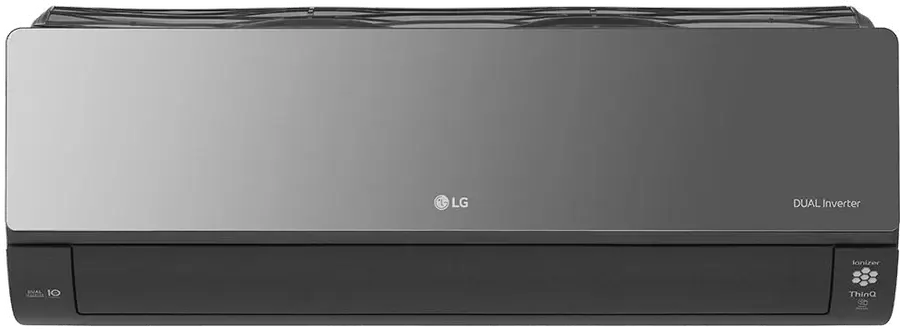
LG Electronics
LG ARTCOOL Mirror is a black, wall-mounted 3.5 kW inverter air conditioner with an ionizer, UVnano and built-in Wi-Fi with ThinQ, suited to Warsaw apartments.
Price incl. installation
Price on request
The LG ARTCOOL Mirror in its 3.5 kW version is a wall-mounted air conditioner that stands apart at first glance from the white units hanging in most apartments. The manufacturer describes the casing as black, and that is what defines the whole ARTCOOL line. If the unit is meant to be seen in the living room or bedroom rather than hidden behind a wardrobe, this model answers that brief. The unit codes are AC12BK NSJC (indoor) and AC12BK UA3C (outdoor). We stick to what the manufacturer confirms and add no conclusions of our own.
Technically, LG relies on an inverter compressor and a wide operating range. Nominal cooling output is 3.5 kW, but the unit can drop to 0.9 kW and rise to 4.0 kW. For heating, the manufacturer gives a range from 0.9 to 5.1 kW. The data we base this description on contains no nominal heating output, so we do not state one. We do not state SEER or SCOP either, because we do not have them in this data set, and we do not describe an energy class.
In the model's feature list LG names UVnano, an ionizer, an anti-allergy filter and built-in Wi-Fi with the ThinQ app. The indoor unit weighs 9.9 kg and measures 837 × 308 × 192 mm, and according to the manufacturer its sound level lies between 19 and 41 dB. The refrigerant is R32. We take care of choosing the mounting spot, planning the pipe route and commissioning the unit. We quote the installed price after a free assessment, once we have seen the wall and the place for the outdoor unit.
ARTCOOL is the line in LG's range for people who treat an air conditioner as part of the interior. The Mirror model in the 3.5 kW version is one of the smaller units in the series, so it suits a typical living room, a bedroom or a spacious studio. The black casing, indicated both by the manufacturer's description and by the colour entry in our catalogue, is meant to be noticed, not hidden. For a Warsaw client living in a panel block or a new apartment building, the decision is simple: you choose the unit for its looks, and we choose the installation method so that what is visible looks tidy.
We do not present this model as the cheapest way to cool a room. It is an option for a client who picks the look and the brand first and compares numbers afterwards. That is why we say plainly what is missing from the data: there is no nominal heating output, no SEER or SCOP, and no sound level for the outdoor unit. Instead of guessing, we would rather point this out and discuss it before ordering, so nobody buys on assumptions. Such frankness is not a flaw of the model, only information about the state of the data.
In practice we start the conversation by asking where the unit will hang. A dark casing looks different on a light wall than on a graphite one or next to dark cabinetry, so the catalogue photo is only a starting point. During the free assessment we check the wall, the distance from the window, the hanging height and the place for the outdoor unit, and only then confirm that the model really fits the interior.
An inverter compressor does not switch on and off in steps; it changes output smoothly. In this model cooling runs from 0.9 to 4.0 kW around a nominal 3.5 kW, and heating from 0.9 to 5.1 kW. The lower limit is a practical value: on transitional days, when light cooling or a little extra heat is enough, the unit does not have to run at full power, and the room temperature stays more even. The wide range applies to both cooling and heating, so one unit covers minimal-speed operation and a large reserve for very hot days.
The upper heating limit, 5.1 kW, is higher than the nominal cooling output. For the client this means a reserve for cooler days in autumn and spring. We add a caveat, though: without a stated operating temperature range for the outdoor unit, we do not promise a specific heating output in hard frost. In Warsaw we treat the air conditioner as supplementary heating in the shoulder seasons, not as the only heat source in the flat, and we decide on heating only after discussing insulation and the layout.
The refrigerant is R32. According to the manufacturer the outdoor unit measures 717 × 495 × 230 mm, so it is fairly compact, which makes it easier to find a place on a balcony or facade. Details such as bracket load capacity, access for maintenance and condensate drainage are verified during the site visit, because they decide whether the installation is simple or needs extra solutions.
According to the manufacturer the indoor unit runs at a sound level from 19 to 41 dB. The lower value corresponds to quiet operation, the upper to maximum fan speed. At 19 dB the unit is suitable for a bedroom provided the fan is set low at night. At full output you should expect clearly audible noise, as with any air conditioner, so it is better to start cooling a large, heated room earlier, before you lie down in it. If the bed is right under the unit, consider an airflow setting that does not blow directly on the sleeper.
For air quality, LG lists three elements in the feature list: UVnano, an ionizer and an anti-allergy filter. We name them as the manufacturer does, without adding our own promises about effectiveness. If someone in the household has allergies it is worth discussing separately, but no air conditioner replaces ventilation or regular cleaning, and filters do not clean themselves. A short airing of the room after long operation is also good practice, especially in a bedroom.
Whatever the equipment, every filter needs cleaning. With daily use in season we recommend checking it every few weeks and having the whole installation serviced once a year, including the heat exchanger, the condenser and the condensate drain. A neglected filter reduces airflow, raises noise and spoils comfort more than any limitation of the model itself.
LG lists built-in Wi-Fi with the ThinQ app among the model's features. This means the module is part of the unit and not a separate add-on to buy. From a smartphone you can switch the air conditioner on, change the mode or the temperature even when you are away, for example an hour before coming home from work, so that it is already pleasant when you open the door.
In practice Wi-Fi needs a good network signal where the unit is installed. A unit on a hallway wall far from the router can be troublesome, so we take this into account when choosing the spot. During commissioning we configure the controls and show how to pair the unit with the app, so you do not have to do it yourself in the evening after installation. If the network in the flat is weak, a signal booster may be the answer, and we will discuss it on site.
Besides the app, the air conditioner can of course be operated with a standard remote. Any extra control functions that the manufacturer does not describe in the data for this variant we leave out, so as not to promise something that has not been confirmed. If a particular function matters to you, for example a weekly schedule, ask us before ordering and we will check it in the documentation. Anything beyond the manufacturer's data is a question to us, not a promise.
We describe the look of the indoor unit only as the manufacturer and our catalogue do: the casing is black. The name Mirror suggests a mirror-like inspiration, but we do not describe surface details that are absent from the source material. To see how the unit looks, it is best to refer to the product-page photos, and if in doubt we will show them during the site visit. When choosing wall colour and furniture layout, remember that the black body will be a dominant accent.
The indoor unit measures 837 × 308 × 192 mm and weighs 9.9 kg. It is a flat, not very deep body that does not protrude far from the wall. At 837 mm wide it takes up roughly as much space as a small shelf or a picture above a sofa, so it is easy to fit into the layout of a room as long as the wall is not filled with furniture up to the ceiling. The compact size also makes it easier to hang above a door or in a niche, provided the clearance below the ceiling required for free air intake is kept.
What spoils the look of an installation is often not the air conditioner itself but badly routed pipes and cables. That is why LeoKlima runs the installation neatly, with a tidy wall penetration, and where needed we suggest hiding the route in a chase or a cover strip, which we agree before the work. With a black unit a light, visible cable on a dark casing looks particularly careless, so we know the details matter here.
Installation covers mounting the indoor and outdoor units and running up to a few metres of refrigerant, electrical and condensate lines. We make the wall penetration and route the installation neatly. We then evacuate the system, check it for leaks, charge it with refrigerant and start the unit, so that it works as intended from day one. Before drilling, we mark the exact position of the wall opening to avoid conflicts with services in the wall.
After start-up we check the operating parameters and configure the controls, including the connection to the app. At the end we give an operating briefing and hand over the warranty documents, together with recommendations on service intervals. We have no maximum pipe length for this model in the data, so we set the scope at the free assessment instead of stating a number the source does not confirm.
Possible surcharges, discussed before the work, are a longer route, drilling through concrete or reinforced concrete, chasing, a condensate pump and work from a lift platform. We quote the installed price after a free assessment. After the season it is worth planning a service visit, filter cleaning and a check of the condensate drain, which takes little time and prevents problems in summer.
The ARTCOOL Mirror 3.5 kW makes sense for someone who wants a black unit from a well-known brand, with Wi-Fi as standard and a cooling range from 0.9 to 4.0 kW. It suits a room of moderate size where the look of the wall matters and a quiet mode from 19 dB is useful. It will also help to judge whether a 3.5 kW class is right for your room, not only where to put the unit. For an apartment in a block where the air conditioner is meant to be a visible element, it is a sensible proposal.
It is not the choice for someone who compares seasonal efficiency alone, because SEER and SCOP are not given here. In that case we will show other models with a full set of data and compare them fairly, without inflating one at the expense of another. We also do not promise a specific output in frost, because the data gives no operating temperature range.
If you want to check whether this air conditioner fits your flat, book a free assessment. We will look at the wall, the place for the outdoor unit and the pipe route, and then quote the installed price. It usually takes a short visit, and you get a clear answer on what can be done and what it will cost. If it turns out another model suits better, we will say so plainly.
Technical data
| Model (indoor / outdoor unit) | AC12BK NSJC / AC12BK UA3C |
|---|---|
| Cooling capacity (nom.) | 3.5 kW (range 0.9–4.0 kW) |
| Refrigerant | R32 |
| Noise level (indoor, min.–max.) | 19–41 dB(A) |
| Indoor unit dimensions (W/D/H) | 837/192/308 mm |
| Indoor unit weight | 9.9 kg |
Questions
Yes, the manufacturer lists built-in Wi-Fi with the ThinQ app among the model's features. At commissioning we configure the controls and show you how to connect the unit to your smartphone.
The manufacturer gives a sound level from 19 to 41 dB. The lowest value applies to the quietest operation, the highest to maximum fan speed. We do not have an outdoor unit sound level in the data, so we do not state one.
It measures 837 × 308 × 192 mm and weighs 9.9 kg. We set the installation scope and any surcharges at a free assessment, and we quote the installed price after a free assessment.
The manufacturer gives a heating output range from 0.9 to 5.1 kW. The data has no operating temperature range for heating, so in Warsaw we treat it as supplementary heating, not as the only heat source.
Similar models

